
In a London terrace or semi, the party wall is the one you share with next door. When a damp patch appears on it, the problem feels twice as awkward: the cause might be in your house, in your neighbour’s house, on the roof you share, or in the wall itself, and you can’t see half of it. Damp on a party wall is common in Victorian and Edwardian streets, and it’s usually solvable, but the order you do things in matters.
This guide explains the usual causes, how to narrow them down from your side, how to approach your neighbour, and where the Party Wall etc. Act 1996 comes in if repairs or damp-proofing are needed.
What counts as a party wall
The GOV.UK explanatory booklet on the Party Wall etc. Act 1996 describes a party wall as one that stands astride the boundary between two owners, or one owner’s wall that separates both buildings. Only the part that does the separating is “party”. A garden wall built wholly on one owner’s land, or an external wall built up to but not astride the boundary, isn’t a party wall.
That matters because a damp party wall can be affected by what happens on either side, and because work to it may involve your neighbour formally.
The usual causes
1. A leak on your neighbour’s side
Bathrooms, kitchens and heating pipes are often fixed to the party wall. A leaking shower tray, a failed bath seal, a weeping pipe joint or a leaking washing machine next door can soak into the wall and show on your side. Signs: a defined patch, often at a level that matches a room next door, that doesn’t change much with the weather and may get worse at certain times of day.
2. A leak on your side
Don’t assume it’s next door. Your own pipes, radiators, waste pipes and appliances on the party wall should be checked first; it’s quicker and avoids an awkward conversation. Our guide to finding the real source of a recurring leak may help.
3. The roof and the top of the wall
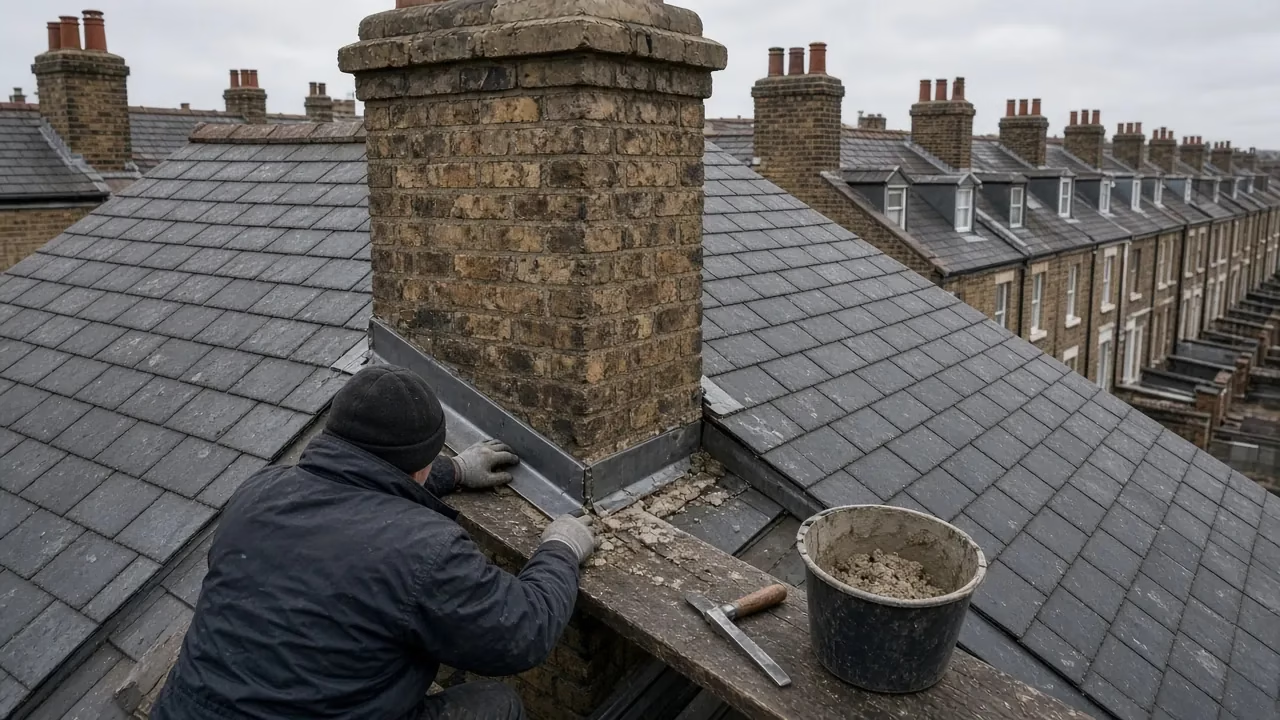
Party walls in terraces often run up through the roof, sometimes as a parapet between the two roof slopes, and some streets have a shared valley gutter or a step where two roofs meet at different heights. Failed flashing, a cracked parapet coping, a blocked valley or slipped slates can let rain into the top of the wall. Damp then shows on the top-floor ceiling corner or high on the party wall, and is worse after rain. A loft conversion next door can also leave new junctions at the party wall that need checking.
4. A chimney breast in the party wall
In many London terraces, chimney breasts sit back to back in the party wall. A capped or uncapped stack, damaged flaunching or salts left in the old flue can cause damp patches on the breast. See our guide to damp on an unused chimney breast.
5. Ground moisture at the base
Low-level damp on a party wall can come from a failed or bridged damp-proof course, a damp floor void, or raised ground or paving outside where the party wall meets the front or back of the house, including on your neighbour’s side. Look at both front gardens and both back gardens if you can. See patio higher than the damp proof course and rising damp vs penetrating damp.
6. Condensation
A party wall between two heated homes is usually warm, so condensation on it is less common than on outside walls. It can still happen in an unheated room, where furniture is pushed tight against the wall, or if the property next door is empty and cold for a long period. Condensation usually shows as mould spots spread across a surface rather than a defined tide mark.
Narrowing it down from your side
- Map the patch. Note its height and position: top-floor corner (roof), chimney breast (flue), mid-wall in line with a bathroom or kitchen next door (plumbing), or a band at the base (ground).
- Record the timing. Take dated photos and note whether it’s worse after rain, worse in cold weather, or unchanged.
- Check your own services on and near the wall.
- Look outside and up. From the street and the garden, check the parapet, flashings, gutters and the ground level at both ends of the party wall. Use binoculars rather than a ladder.
- Look in the loft if you have one, at the party wall and where it meets the roof, after rain.
Moisture meter readings on their own won’t tell you the cause, and a high reading on a wall with old salts doesn’t always mean it’s wet now. The RICS consumer guide to damp and mould recommends a survey compliant with the Joint Position Statement (JPS 2022) from someone without a commercial interest in selling a product, where the cause isn’t clear.
Talking to your neighbour
Most party wall damp is resolved with a friendly conversation. Share your photos and timeline, explain what you’ve already checked on your side, and ask whether they’ve noticed anything: a leak, a recent bathroom fit, work on the roof. Ask if they’d be willing to check the room on the other side of the patch. It often helps to offer to share the cost of an independent inspection.
If the cause turns out to be a leak on their side, it’s usually their responsibility to fix it, and their home insurance may be relevant. If it’s a defect in the shared wall or roof, the cost may be shared. Keep records of what was found and agreed. If the conversation goes nowhere, get independent legal or surveying advice rather than escalating on your own; we’re builders, not lawyers.
Where the Party Wall Act comes in
The Party Wall etc. Act 1996 sets out rights and duties for certain work to a party wall. According to the GOV.UK booklet, the most commonly used rights under section 2 include repairing a party wall and inserting a damp-proof course, as well as underpinning, cutting in for beams and demolishing and rebuilding. If you plan work covered by section 2, you need to inform the adjoining owners before you start.
Two points are especially relevant to damp:
- Injecting or inserting a damp-proof course into a party wall is listed as a section 2 right, so a damp-proofing quote that includes the party wall should take the notice process into account. That’s another reason to be sure ground moisture is really the cause before agreeing to it. See is a chemical DPC really needed?
- Costs can be shared for defects. The booklet explains that where a party wall is repaired because of a defect or want of repair, section 11(4) and (5) provide for the cost to be shared in proportion to the use each owner makes of the wall and each owner’s responsibility for the defect.
The booklet also says some minor work, including removing old plaster and replastering, may be too minor to need a notice, but the key question is whether the work could affect the wall’s structural strength or damage the neighbour’s side. If in doubt, ask a qualified professional. For notices and timelines in general, see our guide to the Party Wall Act for extensions.
If you need to go onto a neighbour’s land to repair your own property and they won’t agree, the Access to Neighbouring Land Act 1992 lets you apply to court for an access order for works reasonably necessary to preserve your property, which can include repair of a building. That’s a last resort, and you’d want legal advice first.
What usually fixes it
- Plumbing leak: repair at source (whichever side), then allow the wall to dry before replastering or redecorating.
- Roof or parapet: repair flashings, coping, pointing or the valley gutter, which often needs both owners’ cooperation and sometimes scaffolding.
- Chimney: cap and ventilate correctly, repair the stack, and deal with salt-contaminated plaster once it’s dry.
- Ground moisture: lower bridging ground or paving, restore under-floor ventilation, and only then consider damp-proof course work, with the party wall process in mind.
- Condensation: improve heating and ventilation in the room and keep furniture slightly off the wall.
Don’t seal the wall with waterproof paint or tanking from one side before the cause is fixed; it can push moisture elsewhere, including into your neighbour’s house.
Frequently asked questions
Who is responsible for damp on a party wall?
It depends on the cause. A leak is usually the responsibility of the owner whose pipe or fitting is leaking. Where the shared wall itself needs repair, the Party Wall etc. Act 1996 provides for costs to be shared in proportion to use and responsibility for the defect.
Can my neighbour’s leak cause damp on my wall?
Yes. Bathrooms and kitchens are often fixed to party walls, and a slow leak can soak through. A patch in line with a wet room next door that doesn’t change with the weather is a common sign.
Do I need a party wall notice for damp proofing?
Inserting a damp-proof course into a party wall is listed as a section 2 right in the GOV.UK booklet, so notice is likely to be needed. Replastering alone may be too minor. Get advice for your specific work.
Is damp on a party wall rising damp?
Not necessarily. Leaks, roof defects, chimneys and condensation are all common causes. Damp from the ground, if present, typically shows as a band at the base of ground-floor walls.
Damp on your party wall?
We trace the cause on your side, outside and at roof level, and give you a clear written explanation you can share with your neighbour, before recommending any work. See our damp survey service and damp proofing in London, request a project review, or call 020 7971 1318.
General information only, not legal advice. Sources checked on 13 November 2026.