
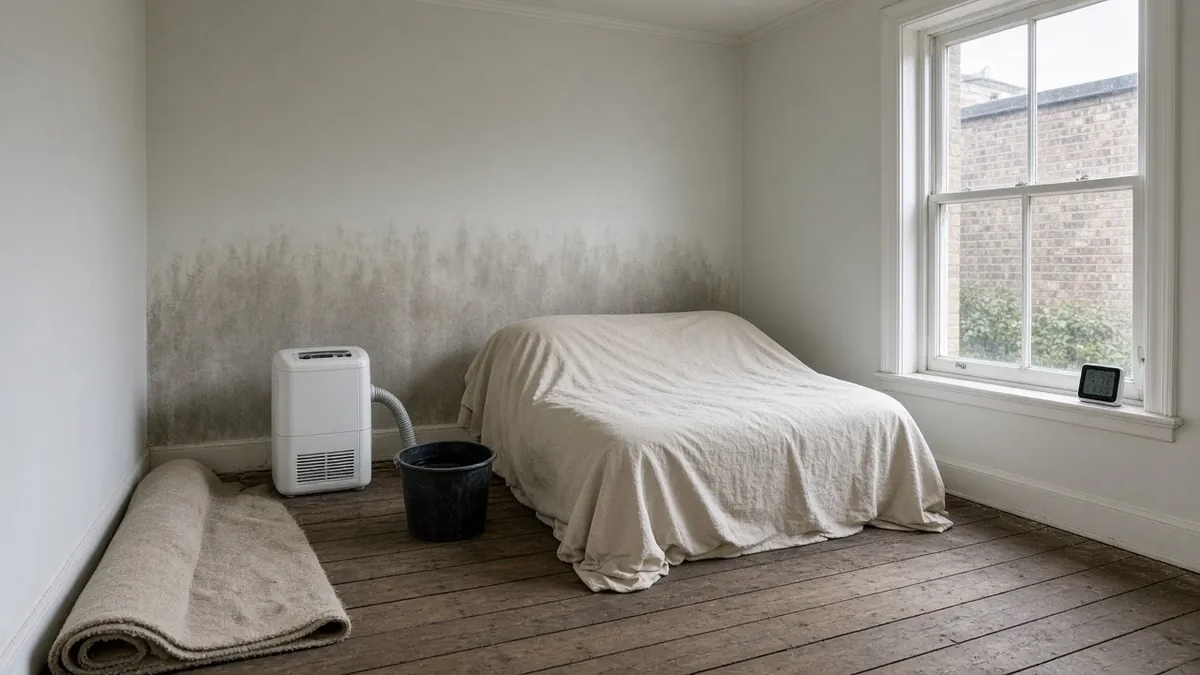
Once a leak has been fixed, the next question is always the same: how long until the wall is dry and the room can be put back together? It’s tempting to replaster or paint as soon as the surface looks dry, but that’s the most common reason a repaired wall seems to “fail” a few weeks later. The surface dries first. The plaster and masonry behind it can stay wet for much longer.
This guide explains what controls drying time, realistic expectations, how to dry a wall safely without causing new damage, how to tell when it’s really dry, and when plaster has to come off rather than be dried.
First, make sure the leak is really fixed
A wall won’t dry if water is still getting in. Before planning any drying, confirm the source has been repaired: the pipe joint, the shower seal, the radiator valve, or the roof or gutter above. If the patch keeps growing or returns after a dry spell, the leak may not be the only cause. Our guide to leaks that come back after repair explains how to trace one properly.
If you live in a flat and the water came from upstairs, take photos and dates now. Our guide to a leak in your flat and who pays explains insurance and responsibilities.
How long do walls take to dry after a leak?
There’s no single answer, because it depends on how wet the wall got, how long it was wet, what it’s made of, and the conditions in the room. LABC’s guidance on drying out buildings gives the traditional rule of thumb for buildings made with traditional materials: allow one month per 25mm of thickness to be dried, in good drying conditions.
That rule is a guide, not a promise, but it shows why drying is slow:
- A short leak that only wetted the plaster surface can dry much faster, because there’s only a thin layer to dry.
- A wall soaked through, such as a solid brick wall in an older London house after a long hidden leak, can take months.
- Cold rooms, closed-up houses and winter all slow drying down. Moving, drier air speeds it up.
Finishes matter too. Vinyl paints, wallpaper and tiles slow the moisture leaving the wall.
How to dry a wall safely
The aim is steady drying, not the fastest possible drying. LABC warns that drying shouldn’t be accelerated too much with heaters or dehumidifiers, because it can cause cracking of screeds and plaster, and splitting and opening of joints in fitted woodwork.
Ventilation
When the air outside is drier than inside, opening windows replaces moist room air with drier air, which then picks up more moisture from the wall. If windows stay closed without a dehumidifier, the moisture has nowhere to go and can condense on cold surfaces, leading to mould.
Gentle heat
LABC explains that heating with the windows open increases both the rate of evaporation and the amount of moisture the air can carry away. Steady background heat works better than blasting a room with heaters.
Dehumidifiers
With a dehumidifier, keep the windows and external doors closed, or it will try to dry the outside air too. Internal doors can be left open so the whole affected area dries together. LABC notes that dehumidifiers remove water more quickly from thin timber than from thick masonry, so watch skirtings, doors and floorboards for distortion.
Things to avoid
- Flueless gas or paraffin heaters. They produce water as they burn, and LABC says they shouldn’t be used as the heat source for drying.
- Painting or papering too soon. A sealed surface traps moisture in the wall. If you have to decorate early, LABC suggests a porous finish such as emulsion, accepting that it may need redoing.
- Pushing furniture back against the wall. Leave space for air to move.
How to tell when the wall is really dry
You can’t tell by looking or touching. LABC says it’s not possible to judge whether a material is dry enough to finish just by looking at it or touching it. The practical approach is to measure and watch the trend:
- Mark a few points on the affected wall, and one on a dry wall in the same room for comparison.
- Take readings at the same points every week or so, and write them down.
- Look for a steady downward trend that levels off, not a single good reading.
- For important decisions, such as before replastering, ask for readings at depth rather than just at the surface.
Treat a cheap moisture meter as a guide to change over time, not an absolute answer. Salts and some finishes can give high readings even on a dry wall.
When the plaster needs to come off
Some plaster won’t recover however long you dry it. Signs it needs replacing:
- It sounds hollow when tapped, or is coming away from the wall.
- It’s soft, crumbling or powdery. Gypsum plaster that has been wet for a long time often loses strength.
- Salts keep appearing as white, fluffy deposits, or patches come back on humid days. See efflorescence on walls.
- Paint keeps bubbling even after the wall seems dry. See paint bubbling on walls.
- Mould has stained deep into the surface.
Removing badly damaged plaster can also speed drying, because it exposes the masonry. When it’s time to replaster, choose a system that suits the wall. On older solid walls, breathable materials are often the better choice. Our guide to plastering after damp repairs explains the options.
Don’t forget the hidden parts
Water travels. After a leak, check under floorboards, inside stud walls, behind kitchen units and under the skirtings near the wet area. Timber that stays wet can start to decay, so damp joists or skirtings should be checked once the area has dried.
Frequently asked questions
Can I replaster as soon as the wall feels dry?
It’s better not to. The surface dries first while the masonry behind can stay wet. Wait until readings show a steady, stable trend.
Will a dehumidifier dry a wall faster?
Yes, in a closed room it helps, but don’t overdo it. Drying too fast can crack plaster and distort timber.
Why is the damp patch still there weeks after the leak was fixed?
It may simply still be drying, especially in winter or in a thick solid wall. If it’s growing or coming back, the leak may not be fully fixed or there may be another cause.
Do I need a damp survey after a leak?
Not always. If the patch isn’t shrinking, keeps returning, or you’re not sure the leak was the only cause, an inspection can confirm what’s happening before you redecorate.
Wall still damp after a leak?
We check whether the source has really stopped, how wet the wall still is, and whether the plaster can be saved, before anything is redecorated. See our damp survey in north London and damp proofing in London, request a project review, call 020 7971 1318 or message us on WhatsApp.