
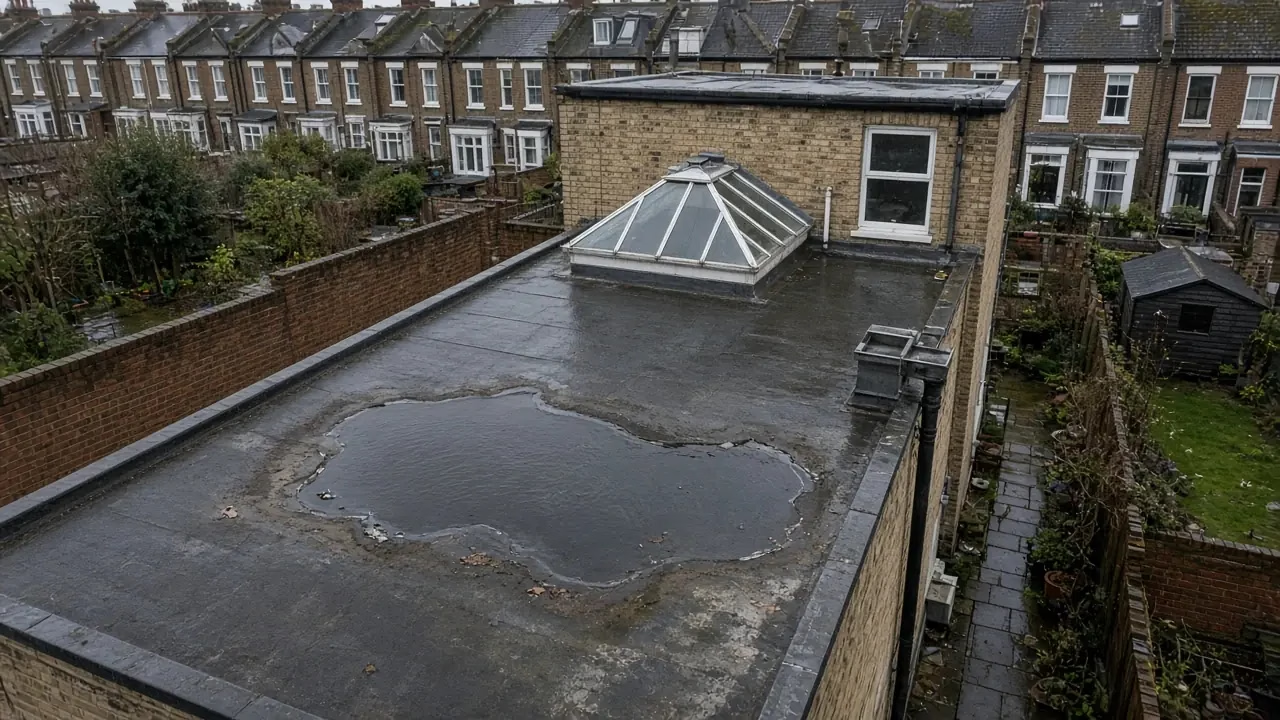
You look out of the bedroom window the day after heavy rain and there’s a puddle sitting in the middle of the extension roof. A day later it’s still there, with a ring of dirt around it. Is that normal, or is the roof failing? Ponding is a common worry for London homeowners with single-storey kitchen and rear extensions. It’s worth taking seriously, but not panicking about.
This guide explains why water ponds on flat roofs, what the standards expect, how to tell whether it’s a problem, and the usual ways to put it right.
What “ponding” actually means
Every flat roof gets wet, and most hold a little water for a short time while it drains. Ponding is water that collects in one area and stays there, because it has nowhere to go. The LABC Warranty technical update on ponding describes how rainwater should flow over a roof as a thin surface film to the outlet, and says that, for warranty purposes, roof areas should be free-draining and ponding water must be avoided.
A “flat” roof isn’t meant to be level. It’s built with a slight slope, called a fall, so water runs to a gutter or outlet.
What fall a flat roof should have
The British Standard for flat roofs is BS 6229. For most flat roofs, it expects a minimum finished fall of 1:80 (a 1cm drop for every 80cm of roof). For years, the usual practice was to design for 1:40 so that the roof still achieved 1:80 once building tolerances and deck movement were taken into account. The LABC Warranty update and the NHBC Standards (Chapter 7.1) both describe that approach, and the NHBC table gives a design fall of 1:40 and a minimum finished fall of 1:80 for membrane roofs. For tapered insulation, the NHBC table gives a design fall of 1:60.
The 2025 revision of BS 6229 moved away from a blanket “design 1:40”. According to Bauder’s summary of the changes, the standard still requires a minimum fall of 1:80 on most roofs, but the design fall is now based on structural analysis or a level survey, with 1:60 often a suitable starting point and 1:40 needed where deflection is greater. The common thread is simple: the finished roof should drain, with no back falls.
Why water ponds on extension roofs
Not enough fall, or the fall runs the wrong way
If the firrings or tapered insulation weren’t set out with enough fall, or the fall was built towards the house instead of the gutter, water will sit. This is the most common cause on older extensions.
The deck has sagged
Joists that are undersized, wet or overloaded can deflect over time, creating a dip in the middle of the roof. Even if the roof had a fall when it was built, a sag can trap water. A dip that’s growing is a structural question, not just a roofing one.
The outlet sits higher than the roof around it
Bauder’s summary notes that outlets should be installed in sumps to prevent them standing proud. An outlet that sits slightly above the membrane leaves a shallow pond around it that never quite drains.
Something interrupts the fall
Rooflights, lanterns, upstands and plant all block the flow of water. Both the LABC Warranty update and the BS 6229 guidance refer to small diverting falls, called crickets, to steer water around them. Without them, water collects on the uphill side of the lantern. If your extension has a lantern, our guide to roof lanterns, skylights and pitched roofs explains the options.
Blocked gutters and outlets
Leaves, moss and debris from nearby trees can block an outlet or gutter, especially in autumn. This is the cheapest cause to fix, so check it first.
Is ponding causing damage?
Standing water isn’t a leak by itself, but it makes problems more likely and harder to spot. Water sitting on a roof keeps the membrane wet, collects dirt and debris, encourages algae and moss, and adds weight. Any small defect under a pond is under constant water rather than the occasional shower. It also takes longer to dry out, so leaks can appear inside days after the rain has stopped.
Look out for:
- a pond that’s still there several days after rain;
- a pond that’s getting bigger or deeper over the seasons;
- cracking, blistering or splitting of the membrane, or open laps;
- stains on the ceiling below, or damp where the extension meets the house;
- a ceiling inside that’s started to dip.
If you’re seeing damp inside the extension, our guide to damp in a new extension covers the other common causes.
Simple checks you can do safely
Don’t walk on the roof unless you’re sure it’s safe to do so. Most of these checks can be done from an upstairs window.
- Take photos of the roof after heavy rain and again each day until it’s dry, so you can see how long the water sits and how far it spreads.
- Check whether the gutter or outlet is clear and water runs freely into the downpipe during rain.
- Look at where the pond sits. In the middle suggests a dip in the deck; around the outlet suggests the outlet is too high; behind a lantern or upstand suggests an interrupted fall.
- Check the ceiling below for stains, cracks or a dip.
- Find any paperwork: drawings, the building control completion certificate, the roofing guarantee and any warranty. These may show the intended fall and who installed the roof.
How ponding is usually fixed
- Clear the drainage: clean the outlet, gutter and downpipe, and fit a leaf guard if trees are nearby.
- Lower or add an outlet: set an outlet in a sump, or add an extra outlet at the low point, where the layout allows.
- Re-form the falls: lay tapered insulation or new firrings over the deck to create proper falls, then re-cover the roof. This is often combined with improving the insulation.
- Add crickets: form small diverting falls behind lanterns and upstands.
- Deal with the structure: if the deck has sagged, find out why. Wet or rotten joists, or joists that are too small for the span, need repairing or strengthening before the roof is re-covered.
Patching the membrane over a pond doesn’t solve anything. If the water still has nowhere to go, it’ll be back after the next storm.
Flat roofs on garage conversions face the same issues; see our guide to garage conversion flat roofs. If you’re planning where the roof water will go on a new extension, see our guide to soakaways for extensions.
Frequently asked questions
Is some standing water on a flat roof normal?
A thin film of water draining away after rain is normal. Water that stays in one area long after the rain has stopped is ponding, and the standards expect roofs to be free-draining.
What’s the minimum fall for a flat roof extension?
BS 6229 expects a minimum finished fall of 1:80 for most flat roofs. The design fall needs to be steeper to allow for deflection and building tolerances; the NHBC Standards give 1:40 for membrane roofs and 1:60 for tapered insulation.
Will ponding make my flat roof leak?
Not on its own, but it keeps the roof wet, collects debris and puts any weak spot under constant water. It’s a warning sign that the roof isn’t draining as designed.
Can ponding be fixed without replacing the whole roof?
Sometimes. A blocked or raised outlet can be fixed locally. If the falls are wrong across the roof, re-forming them usually means overlaying and re-covering the roof.
Water sitting on your extension roof?
We look at the falls, the outlets and the structure underneath before recommending a repair. See our house extension service in London, request a quote and project review, call 020 7971 1318 or message us on WhatsApp.
General information only. Sources checked on 24 November 2026.