
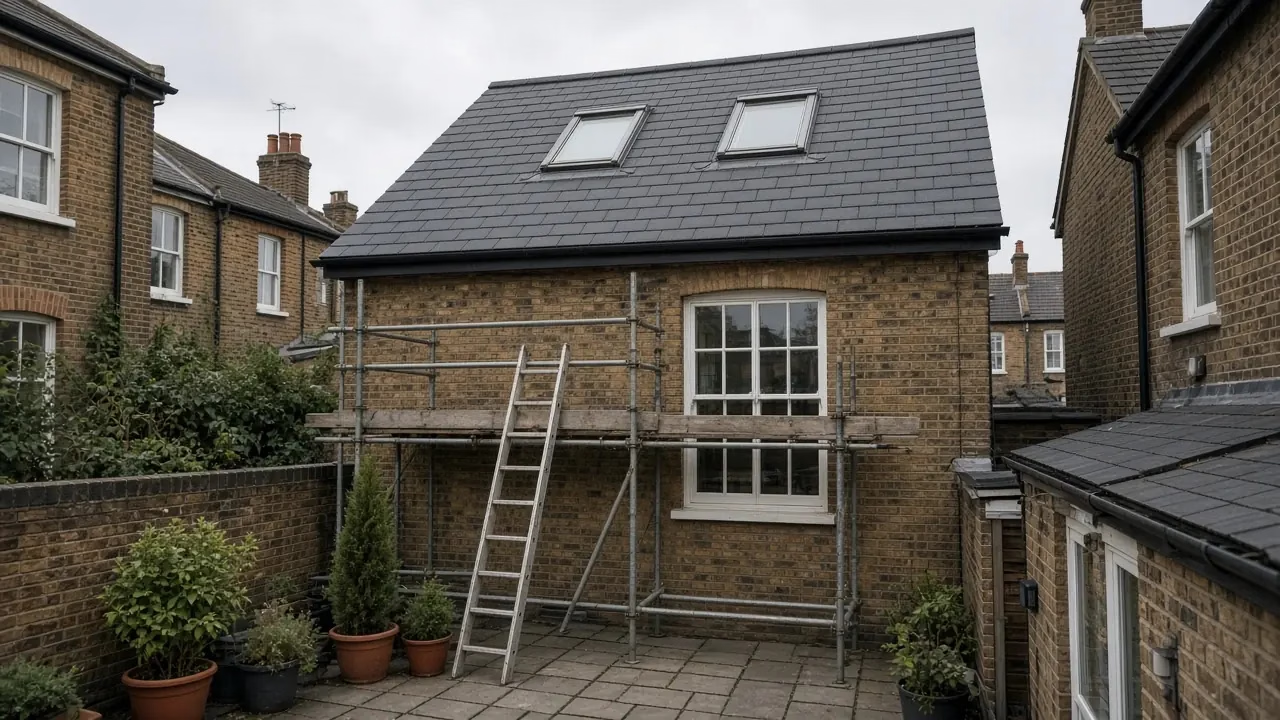
Adding rooflights is often the first step towards using a loft properly, whether it’s a simple room in the roof, a home office or brighter storage. It also raises a common question before any loft project: do rooflights need planning permission? In England the answer is usually no, but only if a short list of limits is met, and a few London-specific situations can change that.
This guide covers the permitted development rules for rooflights, the 150mm projection limit, side-facing roof slopes, conservation areas and flats, and why building regulations still apply even when planning doesn’t.
The short answer
Rooflights on a house are normally covered by permitted development under Class C of Part 1, Schedule 2 of the General Permitted Development Order 2015 (“other alterations to the roof”). The government’s technical guidance on householder permitted development gives the installation of roof lights and windows as an example of what Class C covers. If your rooflight meets all the Class C limits and conditions, and your permitted development rights haven’t been removed, you don’t need to apply for planning permission.
The Class C limits for rooflights
It mustn’t stick out more than 150mm
Class C doesn’t allow an alteration that would protrude more than 0.15 metres beyond the plane of the slope of the original roof, measured perpendicular to the external surface of the roof. In practice that means the whole installed rooflight, not just the glass: the frame, the upstand and the flashing all count. A low-profile or flush rooflight sits comfortably within the limit. A rooflight on a deep kerb, or one raised by a new roof build-up, may not, so check the installed height in the manufacturer’s details against the roof slope before ordering.
It’s measured from the original roof
The Order defines “original” as the building as it existed on 1 July 1948, or as it was built if it was built after that date. If your roof has been altered or re-covered since then, the starting point for the 150mm measurement is still the original roof plane.
It can’t be higher than the highest part of the original roof
The highest part of the alteration can’t be higher than the highest part of the original roof. For an ordinary rooflight set into a slope, this is rarely an issue, but it matters for anything near the ridge.
Side-facing roof slopes: obscure glass and limited opening
This is the condition that catches most people. Any window on a roof slope forming a side elevation of the house must be:
- obscure-glazed, and
- non-opening, unless the parts that open are more than 1.7 metres above the floor of the room it’s installed in.
On many London semis and end-of-terrace houses with hipped roofs, the side slope faces straight at the neighbour. If you want clear glass or a rooflight that opens at a normal height on that slope, you’ll be outside permitted development and will need to apply. Rear and front slopes aren’t subject to this condition.
Other exclusions
Class C doesn’t cover chimneys, flues, soil and vent pipes, or solar panels (solar has its own rules). It also doesn’t apply where the house was created through certain change-of-use permitted development rights, or was built under Part 20 (new dwellinghouses on existing buildings).
Flats and maisonettes
Householder permitted development rights in Part 1 apply to “dwellinghouses”. The Order says that, for these purposes, a dwellinghouse doesn’t include a building containing one or more flats, or a flat within such a building. If you own a top-floor flat and want to add rooflights, you’ll normally need planning permission, as well as consent from the freeholder under the lease. Our guide to loft conversions in leasehold flats explains the lease side.
Conservation areas, Article 4 and listed buildings
Unlike dormers under Class B, Class C has no blanket exclusion for conservation areas. A rooflight in a conservation area can therefore still be permitted development, as long as your council hasn’t removed the right.
That’s the catch in much of London. The technical guidance explains that a council can remove permitted development rights through an Article 4 direction, or may have removed them by a condition on the original or a later planning permission for the house. Where that has happened, you’ll need a planning application. Many London councils have Article 4 directions in some of their conservation areas, and these can cover alterations to roof slopes, particularly those facing the street. Check the council’s conservation area page and the planning history of your property before you order anything. Our guide to Article 4 directions in north London explains how to check.
If the house is listed, a rooflight that affects its character will need listed building consent, regardless of permitted development.
Planning isn’t the same as building regulations
Even when a rooflight doesn’t need planning permission, the work still has to be done safely and to the building regulations. Fitting a new rooflight usually means cutting and trimming rafters, adding insulation and making the opening weathertight. If the rooflight is part of a loft conversion, the whole conversion needs building regulations approval, including the structure, fire safety, insulation and stairs. Our guide to building regulations for loft conversions covers what’s checked.
If you’re also planning a dormer, its volume counts towards the loft limits under Class B. See our guide to loft conversion volume calculation.
A quick checklist before you order rooflights
- Is it a house, not a flat or maisonette?
- Has the council removed permitted development rights with an Article 4 direction or a planning condition?
- Is the house listed?
- Will the installed rooflight, including frame and flashing, project 150mm or less from the original roof slope?
- Is any rooflight on a side-facing slope? If so, is it obscure-glazed and either fixed or opening only above 1.7m from the floor?
- Have you checked the building regulations side with your builder or building control?
If you’re unsure, you can apply to your council for a Lawful Development Certificate, which confirms that the work is lawful without a full planning application. It’s not compulsory, but it’s useful evidence when you come to sell.
Frequently asked questions
Do I need planning permission for a Velux-style rooflight?
Usually not on a house in England, provided it projects no more than 150mm from the original roof slope, isn’t higher than the highest part of the roof, meets the side-slope conditions and your permitted development rights haven’t been removed. The brand doesn’t matter; the installed projection does.
Can I put rooflights on the front of my house?
Class C doesn’t restrict front slopes in itself. In a conservation area with an Article 4 direction covering the front roof slope, you may need permission. Check with your council.
Do rooflights in a conservation area need planning permission?
Not automatically. Class C still applies in conservation areas unless the council has removed it, which many London councils have done for some streets through Article 4 directions.
Can I replace an old rooflight without planning permission?
Replacing like for like within the same limits is normally covered by Class C too. If the new unit sits higher than the old one, or you’re in an area with an Article 4 direction, check first.
Thinking about rooflights or a loft conversion?
We check the planning position, the structure and the building regulations before suggesting a design. See our loft conversion service in London, request a quote and project review, call 020 7971 1318 or message us on WhatsApp.
General information only. Rules described apply in England. Sources checked on 24 November 2026.