
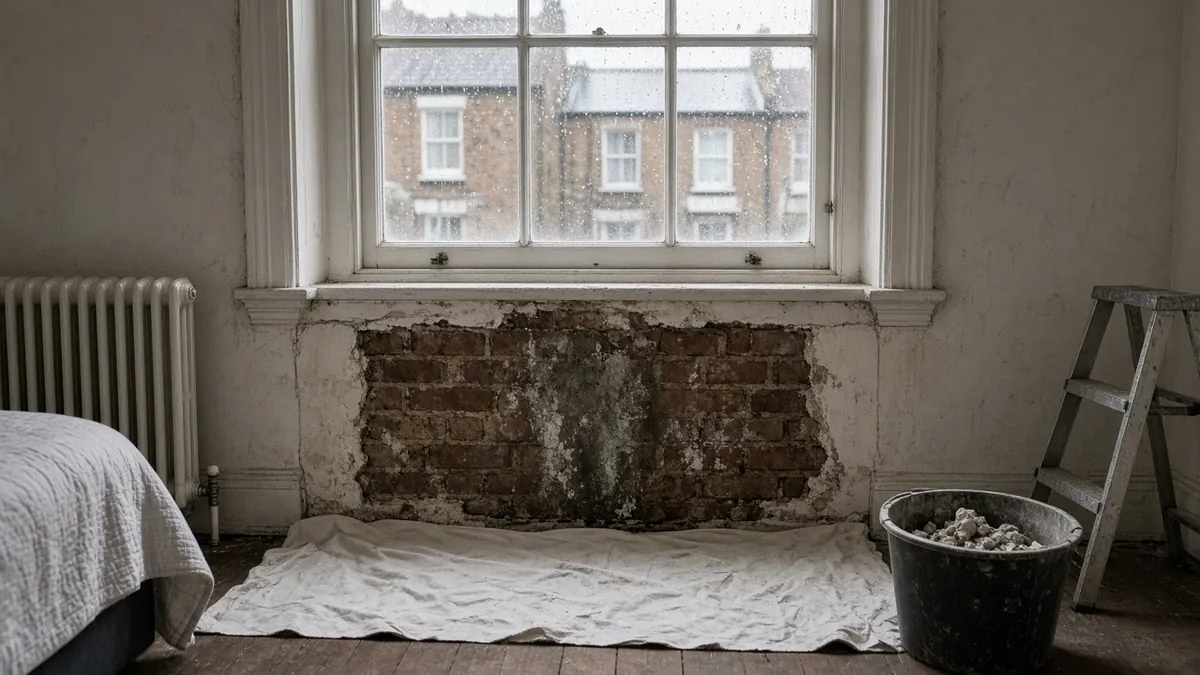
A brown tide line on the plaster below the window, paint flaking under the window board, black spots in the corners or a wet patch that appears after a storm: damp under a window is a common problem in London homes. The good news is that the position narrows the list of causes. The awkward part is that two very different problems, rain getting in and condensation forming inside, can look almost the same.
This guide walks through how to tell them apart, what to check outside and in, and how each cause is normally put right.
Start with when and where it appears
- Worse during or after heavy or wind-driven rain: points to water getting in through the sill, the frame joint or the wall around the opening.
- Worse in cold weather and in the mornings, with water on the glass and mould on the reveals or window board: points to condensation.
- A patch centred under one end of the sill: often a cracked sill, a failed sill joint or water tracking round the end of the sill.
- Damp just above a radiator under the window: check the radiator valves and pipes as well; see our guide to damp behind a radiator.
- Upstairs: it can’t be rising damp. Look at rain penetration and condensation.
The RICS consumer guide on damp and mould gives “broken sealant around a window letting rainwater in” as a typical example of penetrating damp, and notes that condensation is most visible on window glass but forms on other cold surfaces too.
Outside: the sill and the joints around the frame
The sill and its drip
A sill should slope away from the window and throw water clear of the wall. The Property Care Association’s Code of Practice for the control of dampness (2023) says window sills should be checked for drip mouldings, beads or throats, because these features directly below the sill stop excessive water running down the masonry. It lists cracked window sills and defective seals around windows and doors among the typical external causes of rain penetration.
Things to look for:
- a drip groove under the sill that’s been filled with paint, mastic or mortar, or was never there;
- cracks across a stone or concrete sill, or open joints between sill sections;
- a sill that’s flat or tilts back towards the window;
- a replacement window with a short sill, or a plastic sill extension that stops at the brick face instead of projecting past it.
The joint between the frame and the wall
Approved Document C (paragraph 5.29) says the joint between walls and window frames should resist rain getting into the building. Sealant shrinks and comes away with age, often along the bottom edge where it’s hard to see. A failed bead needs raking out and renewing properly, not another bead on top.
The damp-proof course under the sill
Approved Document C (paragraph 5.30) also says damp-proof courses should be provided to direct moisture outwards where sill elements, including joints, don’t form a complete barrier, for example under openings. In cavity walls, cavity closers and sub-sill damp-proof courses can be missing or damaged, particularly where windows have been replaced. These can only be confirmed by opening up, so they’re usually checked after the simpler causes have been ruled out.
Water from higher up
Water that gets in above the window can show up below it. A leaking gutter, a failed cavity tray over the lintel or cracked render can all send water down inside the wall. Our guide to damp above a window covers cavity trays, lintels and weep holes.
Inside: condensation on a cold reveal
The window is usually the coldest part of the wall, and the reveals and the wall just below the window board are often colder still. The PCA Code of Practice lists the surfaces of windows, doors and reveals among the places where condensation typically forms, and notes that condensate on non-absorbent surfaces like glass can run and drip onto materials where it causes damage. Water running off the glass every morning soaks the window board and the plaster below it.
Signs that it’s condensation:
- water on the inside of the glass on cold mornings;
- black spot mould on the reveals, the window board and behind curtains;
- worse in bedrooms and after cooking, showers or drying washing indoors;
- no clear link with rainy weather.
Newer, more airtight windows with closed or missing trickle vents can make this worse; see mould after new windows. In a bay, where several cold surfaces and joints meet, see our guide to damp around a bay window.
Simple checks you can do
- Keep a short diary for two or three weeks: weather, temperature, and when the patch gets darker or the glass runs with water.
- Look under the outside sill for a clear drip groove, and along the sealant at the bottom and sides of the frame.
- Check the gutter and any downpipe above the window during rain.
- Feel the radiator valves and pipes under the window for any weeping.
- Take photos of the patch at the same time each day so you can see whether it changes.
How it’s usually fixed
- Failed sealant: rake out and reseal the frame joint with a suitable flexible sealant.
- Sill problems: re-form or clear the drip, repair or replace a cracked sill, or fit a sill that projects and throws water clear.
- Cavity or sub-sill details: open up locally to repair or fit the missing damp-proof course or closer.
- Condensation: better ventilation (open trickle vents, extract in kitchens and bathrooms), steadier heating, and sometimes insulating a cold reveal.
- Making good: once the cause is fixed and the wall has dried, replace salt-damaged or crumbling plaster and redecorate.
Frequently asked questions
Why is the wall under my window damp only when it rains?
Rain is getting in, usually through a cracked or badly drained sill, a failed seal between the frame and the wall, or a missing damp-proof course under the sill. Water from above the window can also run down inside the wall.
Is damp under a window rising damp?
Very unlikely, especially if it starts at the window and spreads down, or is on an upper floor. Rain penetration and condensation are far more common causes around windows.
Can new windows cause damp under the window?
Yes, in two ways: a poorly detailed sill or frame seal can let rain in, and a more airtight house with closed trickle vents can increase condensation on the reveals.
Will resealing the window fix it?
Only if failed sealant is the cause. If the sill drip, a cracked sill or the damp-proof course under it is the problem, new sealant won’t stop it.
Damp under a window you can’t pin down?
We check the outside, the window details and the room together and tell you what’s causing it before suggesting any work. See our damp survey service and damp proofing guide for London homes, request a quote and project review, call 020 7971 1318 or message us on WhatsApp.
General information only. Sources checked on 23 November 2026.