
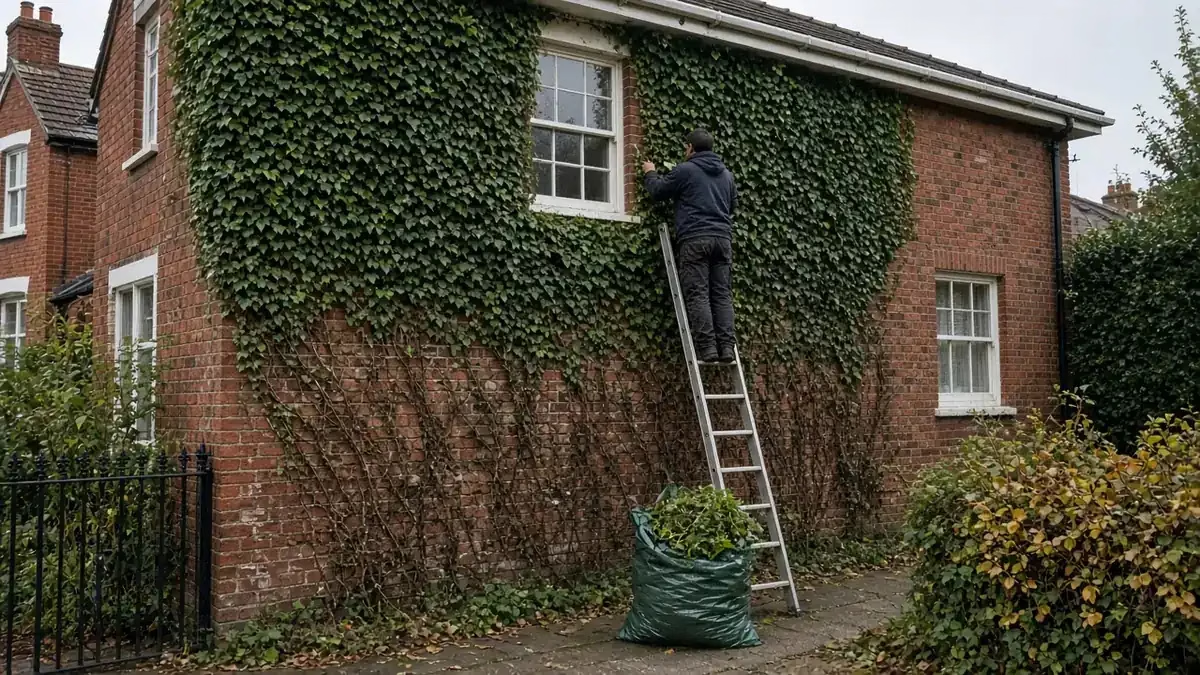
Ivy on a London brick house divides opinion. Some people love the look, while buyers, surveyors and neighbours often see it as a damp problem waiting to happen. If you’ve got damp inside on a wall that’s covered in ivy outside, it’s natural to blame the plant. The research on this is more nuanced than either side tends to admit, and it points to a practical answer: the ivy itself is rarely the cause of damp, but it can hide the problems that are, and it can create some of its own.
Does ivy cause damp? What the research says
Historic England has studied ivy on walls in detail, including long-term monitoring of test walls. Its research concludes that the effect of ivy on the moisture content of walls is complicated, with no simple answer as to whether it increases or decreases damp. In summary:
- a thick covering of ivy shields a wall from rain;
- it may reduce evaporation of moisture near ground level where a wall already has a damp problem;
- monitoring found any influence of ivy on near-surface damp was well within the normal seasonal range;
- there was no evidence that ivy influences deeper-seated moisture in walls.
Historic England also found that ivy reduces temperature extremes and the frequency and severity of frost, which can damage vulnerable bricks and stone, and that its climbing rootlets attach to the surface without penetrating the material or drawing moisture from it.
A separate study by the Royal Horticultural Society and the University of Reading used small model buildings covered with common ivy, Boston ivy and climbing hydrangea. The RHS reports that the plants did not cause humidity issues and that, on warm winter afternoons, relative humidity inside the ivy-covered models was 5.7% lower than inside bare ones. These were scaled-down models, not real houses, so treat the figures as an indication rather than a guarantee for your wall.
So the short answer is: healthy ivy on a sound wall is unlikely to be what’s making your room damp. That’s not the end of the story, though.
Where ivy really does cause problems
Historic England lists the problems ivy can cause on buildings, and several of them lead directly to damp:
- Blocking gutters and downpipes. Overflowing gutters soaking a wall are a common cause of penetrating damp, and ivy growing into them makes blockages more likely.
- Lifting slates, tiles and copings. Once ivy gets under a roof covering or a parapet coping, rain follows.
- Dislodging pointing and masonry. Ivy can’t bore into a sound wall, but stems grow into existing cracks, open joints and holes, and can widen them.
- Growing into windows and roof spaces, including round frames and under eaves.
- Hiding the wall. A thick cover conceals cracks, failed pointing, spalled bricks and damp patches, so problems go unnoticed for years.
- Getting in the way of maintenance, such as repointing, painting and gutter clearing.
Historic England’s research also notes that the greatest damage tends to happen when ivy “roots in” to a wall that’s already deteriorating, where shoots find darkness, moisture and decayed material in cracks and cavities. In other words, ivy exploits defects rather than creating them on a sound wall.
Many London houses have soft lime-mortar brickwork with eroded pointing, which is exactly the kind of wall where stems can work their way in. That’s a reason to keep an eye on ivy, not necessarily to remove it.
Damp inside behind an ivy-covered wall: how to find the real cause
If there’s damp on the inside of a wall that has ivy outside, look for the usual causes before blaming the plant:
- Gutters and downpipes on that wall: are they choked with leaves or ivy, or leaking at the joints?
- The roof edge and parapet: lifted slates, displaced copings, ivy growing under the eaves.
- Ground level and the base of the wall: soil, leaf litter or a flower bed built up against the wall above the damp-proof course, especially where the ivy is rooted. See ground levels against the damp-proof course.
- The brickwork itself: once you can see it, check for open joints, cracks and spalling bricks.
- Condensation: if the damp is black mould on a cold external wall inside, it may have nothing to do with the outside at all.
Our guides to rising damp vs penetrating damp and damp on a gable end wall cover these checks in more detail.
Remove it, cut it back or keep it?
Historic England’s advice is that ivy shouldn’t be removed simply because it’s untidy, and that the options range from complete removal through partial removal and management to leaving it alone. For a house, we’d usually think about it like this:
- Keep it clear of the roof, gutters, downpipes, windows and vents. Trim it back regularly so it never reaches the eaves.
- Remove it where it’s growing into the wall, where the wall needs repair, or where you need to see the brickwork to diagnose damp.
- Don’t rip it off. Historic England notes that pulling stems off forcefully can damage the surface underneath and will leave marks. Cut it into sections and let it die back before removing it carefully.
- Be careful with cutting at the base where ivy is already growing into cracks or cavities. Historic England’s research found this common practice can stimulate rooting-in, and it’s no longer recommended in that situation. Get advice first.
- Check for nesting birds. Under section 1 of the Wildlife and Countryside Act 1981, it’s an offence to intentionally take, damage or destroy the nest of any wild bird while it’s in use or being built. Thick ivy is a favourite nesting spot, so plan major cutting work outside the nesting season or check carefully first.
After the ivy comes off
Expect to find some repairs: old rootlet marks, loose pointing and perhaps damaged bricks. Repoint with a mortar that suits the wall (usually lime for older solid brick walls) rather than hard cement, and fix any gutter or roof defects you uncover. Then let the wall dry before judging whether the inside damp has gone.
Frequently asked questions
Does ivy cause damp in houses?
Research by Historic England found no simple answer: ivy shields walls from rain but may slow evaporation where a wall is already damp, and it found no evidence that ivy affects deeper moisture. Ivy is more likely to cause damp indirectly, by blocking gutters or getting into roofs and damaged pointing.
Can ivy damage brickwork?
On a sound wall the rootlets only attach to the surface. Damage happens where stems grow into existing cracks and open joints, or where ivy roots into a deteriorating wall.
Is it safe to kill ivy by cutting it at the base?
Not always. Where ivy is already growing into cracks or cavities, Historic England’s research found cutting at the base can stimulate rooting-in. Get the wall looked at first.
When should I cut back ivy?
Avoid major cutting when birds are nesting, because intentionally damaging an active nest is an offence. Light trimming to keep ivy away from gutters and the roof can be done when you’ve checked there are no nests.
Damp on a wall covered in ivy?
We’ll find out whether the damp is coming from the gutters, roof, ground levels, brickwork or condensation, and what to do about the ivy. See our damp survey service and damp proofing guide for London homes, request a quote and project review, call 020 7971 1318 or message us on WhatsApp.
General information only. If your house is listed, speak to your council’s conservation officer before major work. Sources checked on 19 November 2026.