
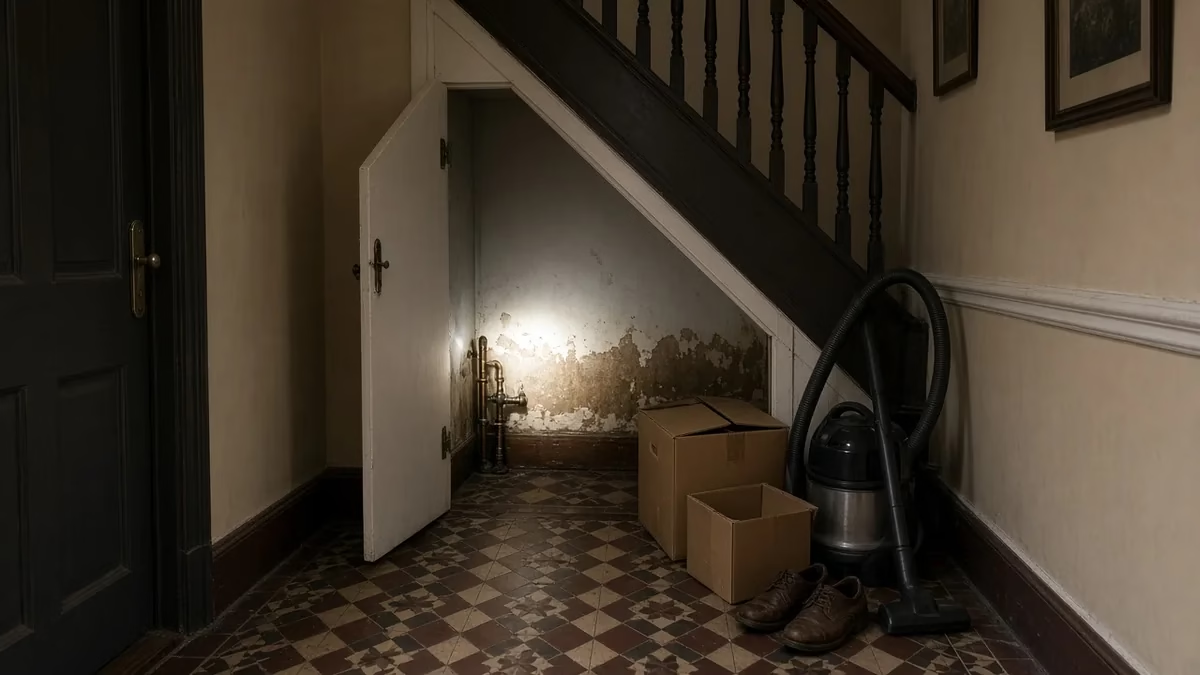
The cupboard under the stairs is where a lot of London homes keep the things nobody looks at every day: the hoover, the coats, the boxes, and often the gas or electricity meter and the stopcock. So damp there tends to be found late. A musty smell when you open the door, mould on a cardboard box, a tide mark at the bottom of the wall or a soft, crumbly skirting board are the usual first signs.
Damp under the stairs has several possible causes, and they need very different fixes. It’s a small, enclosed, unheated space at ground level, sometimes against an outside or party wall, sometimes over a void under the floor, and often with water pipes nearby. This guide explains how to work out which cause you’re dealing with before spending money on treatment.
Why the space under the stairs gets damp
The cupboard combines several things damp likes. It’s at the lowest level of the house, close to the ground. It’s usually closed, with little air movement and no heating. In many Victorian and Edwardian terraces it sits against the party wall or an external wall, and in houses with suspended timber floors it may be above part of the underfloor void. And because services often come into the house here, there may be supply pipes, a stopcock or a meter in the corner.
The RICS consumer guide to damp and mould lists many of the defects that can cause damp, including leaking water supply pipes, failed underground drainage, blocked low-level vents for suspended floors, raised ground levels next to walls and internal plumbing leaks. Several of those can show up first in an under-stairs cupboard.
The four usual causes
1. Condensation in a closed, cold cupboard
A cupboard with the door shut stays colder than the hall. Moist air gets in whenever the door opens, meets a cold wall or floor and condenses. Signs include a general musty smell, mould on stored items such as boxes, bags and shoes as well as on the walls, no clear tide line, and a problem that’s worst in winter. Drying washing in the hall or storing damp coats and wet umbrellas in the cupboard makes it worse.
2. A slow plumbing leak
If the stopcock, a water supply pipe, a heating pipe or a waste pipe from a cloakroom or kitchen runs nearby, a small leak can keep one patch permanently damp. The giveaway is a wet area that stays the same regardless of the weather, and doesn’t dry out when the cupboard is aired. The RICS guide mentions leaking water main supply pipes and internal plumbing leaks among the causes to check. If you suspect a hidden leak, our guide to a water meter spinning with no visible leak shows how to test for one.
3. Ground moisture and a bridged damp-proof course
Damp can come from the ground if a solid floor has no damp-proof membrane, or if the wall’s damp-proof course is bridged, for example by raised paving or soil outside, or by render taken down to ground level. This tends to show as damp at the base of the wall, sometimes with salts. Check what’s on the other side of the wall: a front path, a side passage or a neighbour’s raised patio can all be the cause. See patio higher than the damp proof course.
4. A suspended floor that can’t breathe
Many London period houses have suspended timber ground floors with a ventilated void underneath, kept dry by air bricks in the outside walls. If air bricks are blocked by a later extension, a raised flower bed, paving or a well-meaning homeowner trying to stop draughts, the void can become damp. The RICS guide lists blocked low-level vents for suspended floors as a cause of damp. The under-stairs cupboard often shows it first, as a musty smell or soft boards. Our guide to a musty smell under floorboards covers this in more detail.
Penetrating damp through an external wall, from a leaking gutter, downpipe or defective pointing, can also show up here, especially if the cupboard backs onto a side passage.
Simple checks you can do first
- Empty the cupboard. Take everything out, including from the floor, and look at where the damp and mould actually are: on the contents, on the walls, at floor level or around pipes.
- Look at the pipes. Check the stopcock and any visible joints for drips, green or white deposits, or a wet patch underneath. Dry kitchen paper wrapped around a joint and checked the next day can show a slow weep.
- Air it. Leave the door open for a few days and see whether things improve. If the damp fades, condensation is likely to be a large part of the problem. If one patch stays wet, look for a leak.
- Go outside. Find the wall behind the cupboard and look for raised ground, paving above the damp-proof course, blocked air bricks, a leaking gutter or a broken downpipe.
- Note the timing. Is it worse after rain, worse in cold weather or the same all year? That pattern helps whoever inspects it.
If there’s a gas meter in the cupboard, don’t move or alter it yourself, and keep the area around it clear. Gas work must be done by a Gas Safe registered engineer.
What usually fixes it
- For condensation: improve airflow with a vented door or grilles, keep stored items off the floor and away from the walls, stop drying washing in the hall and don’t store wet coats in a closed cupboard.
- For a leak: repair the pipe or fitting, then let the floor and wall dry out fully before redecorating.
- For bridging or blocked air bricks: lower the ground or paving outside, clear or replace the air bricks, and restore ventilation to the void.
- For a damp solid floor: the right repair depends on how the floor is built, so it should be inspected first.
Avoid sealing the problem in. Painting the cupboard with damp-proof paint, lining it with plastic or injecting a chemical damp-proof course before you know the cause can trap moisture and move the damp somewhere else. Our guide to damp surveys versus damp-proofing quotes explains why diagnosis comes first.
Keep an eye on the stair timbers too. Persistent damp can lead to rot in timber that stays wet; see our guide to wet rot, dry rot and damp.
When to call in a damp inspection
Get professional advice if the damp keeps returning after you’ve aired the cupboard, if there’s a tide line or salts, if skirting boards or floorboards feel soft, if you find fungal growth on timber, or if you can’t find the source. A proper inspection should look at the whole picture, including the outside wall, floor construction and plumbing, not just a meter reading on the wall.
Frequently asked questions
Why does my under-stairs cupboard smell damp?
Usually because it’s closed, cold and poorly ventilated, so condensation forms and mould grows on stored items. A slow plumbing leak, ground moisture or a damp void under a suspended floor can cause the same smell.
Is damp under the stairs rising damp?
Not necessarily. Low-level damp can also come from leaks, bridged damp-proof courses, blocked air bricks or condensation. Find the cause before agreeing to any treatment.
How do I stop condensation under the stairs?
Let air move through the cupboard with a vented door or grilles, keep items off the floor and away from the walls, and avoid storing wet coats or drying washing nearby.
Can damp under the stairs damage the staircase?
Timber that stays damp for long periods can decay, so persistent damp around stair timbers should be investigated and the cause fixed.
Damp under your stairs?
We trace whether it’s condensation, a leak, the ground or the floor void before recommending anything, so you don’t pay for a treatment you don’t need. See our damp survey service and damp proofing in London, request a project review, or call 020 7971 1318.
General information only. Don’t alter gas or electricity meters yourself. Sources checked on 12 November 2026.