
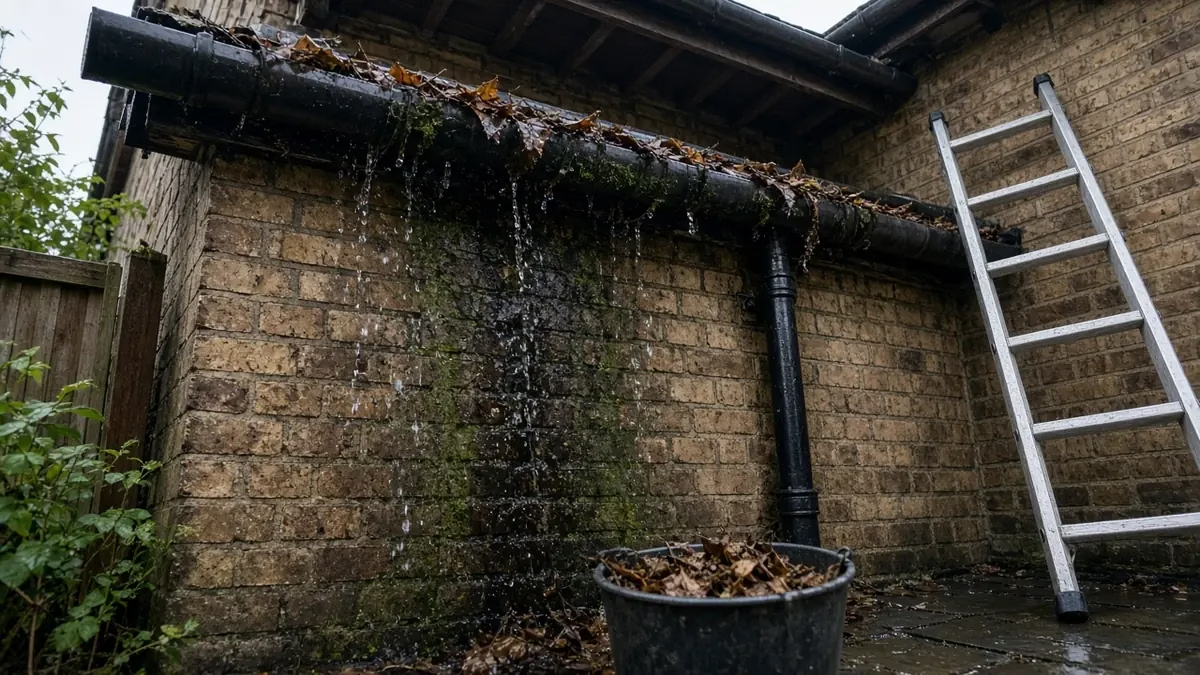
Late autumn is when a lot of damp patches seem to appear out of nowhere. The leaves have come down, the rain has set in, and a gutter that coped all summer is now full of leaves and moss. Water that should run to the downpipe spills over the edge or runs down the back of the gutter onto the wall, and within a few weeks there’s a dark patch inside, often upstairs near the ceiling.
This guide explains how blocked or leaking gutters cause damp inside a house, how to recognise the pattern, the checks you can do safely from the ground, and what to do once the gutter is fixed.
How a blocked gutter makes a wall damp
Gutters and downpipes are meant to collect rain from the roof and take it away to a drain or soakaway. When they’re blocked, broken or badly aligned, water ends up on the wall instead. Manchester City Council’s advice on penetrating dampness lists spilling from a blocked gutter among the typical defects that let water pass from outside into the home, alongside missing tiles, badly fitted windows and missing pointing.
One overflow on one wet day rarely causes a problem. It’s the repeated soaking of the same patch of wall, storm after storm, that stops it drying out. Older solid brick walls, common across London, can hold a lot of water and take a long time to dry, so damp can appear inside some time after the overflow started.
The common faults are:
- leaves, moss and debris blocking the gutter or the outlet into the downpipe;
- a blocked downpipe, often at a bend or at the bottom shoe, so water backs up and overflows at the top;
- failed joints between lengths of gutter, which drip onto the same spot every time it rains;
- sagging or wrongly sloped runs, where water sits in the gutter and spills over;
- water running behind the gutter onto the fascia and the top of the wall, which is easy to miss from the ground;
- a downpipe discharging onto the ground next to the wall, or into a blocked gully, which soaks the base of the wall.
How to recognise gutter damp inside
Manchester City Council describes penetrating damp as something that gets worse after rain and usually appears as a well-defined damp patch that looks and feels damp. Gutter-related damp has a few extra clues:
- It lines up with something outside. The patch sits behind or below a gutter joint, a corner, an outlet or a downpipe.
- It’s high up or on an upper floor. Damp near a bedroom ceiling or at the top of an external wall can’t be rising damp, which comes from the ground.
- It follows the weather. The patch darkens after heavy rain and fades slowly in dry spells.
- The outside wall shows it. Look for dark streaks, green algae or moss on the brickwork below the gutter. Our guide to green algae on walls explains what that staining tells you.
The council also notes that black mould is rarely seen on areas of penetrating damp, because they’re usually too wet and contain salts. If you’re seeing black mould spreading across cold corners and window reveals instead, condensation may be the bigger issue. Our guide to mould on the ceiling helps you tell the difference.
Water doesn’t always show up directly below the leak. It can travel along the wall, down inside a cavity or along timber before it appears, so a patch might be a little way from the fault.
Checks you can do safely from the ground
- Watch the gutters in heavy rain. From a safe spot on the ground, look for water spilling over the front edge, dripping from joints, running behind the gutter or overflowing at the top of a downpipe.
- Look for plants. Grass, moss or small plants growing out of a gutter mean it’s been holding water and debris for a while.
- Check the bottom of each downpipe. Water should go into a gully or drain, not pool against the wall. Lift any leaves off the gully grid.
- Compare inside and outside. Note where the internal patch sits and look at the outside wall directly opposite and above it.
- Take dated photos. Photos of the overflow and the internal patch help a surveyor, and they’re useful if you need to show a landlord, freeholder or insurer when the problem started.
Clearing gutters means working at height. Only use a ladder if you can do it safely, with someone footing it, and never lean out or over-reach. For upper floors, or if you’re not confident, get help from a professional with the right access equipment.
What usually fixes it
- Clearing the gutter and outlets, then flushing the downpipes to make sure water runs freely.
- Resealing or replacing joints that drip.
- Re-fixing brackets so the gutter falls towards the outlet.
- Replacing damaged lengths, especially old cast-iron gutters that have cracked or rusted through.
- Fitting leaf guards where trees overhang, although they still need checking.
- Repairing the wall where years of overflow have eroded the pointing or damaged bricks. See our guides to cement pointing and damp and spalling bricks.
Flat-roof extensions can suffer too, where outlets are blocked and water sits on the roof. Our guide to flat roof extension ponding covers that.
After the gutter is fixed
Manchester City Council notes that once the cause of penetrating damp is fixed, the damp patch should fade and dry out over time. That can take a while in a thick, solid wall. In the meantime:
- keep the room heated and ventilated to help the wall dry;
- don’t rush to replaster or use impermeable paint, which can trap moisture;
- keep an eye on the patch through the next few heavy rain spells to confirm it isn’t getting worse;
- check whether salts are left on the surface once it dries. Our guide to efflorescence on walls explains how to deal with them.
If the patch doesn’t improve after the gutter has been fixed and the wall has had time to dry, there may be another cause. Our guide to why your house smells damp when it rains lists other entry points, and a damp survey can pin it down.
Frequently asked questions
Can a blocked gutter cause damp inside?
Yes. Water overflowing from a blocked gutter repeatedly soaks the wall below, and in time it can pass through to the inside, especially in older solid brick walls.
How do I know if my damp is from the gutter?
Look for a patch that gets worse after rain, sits behind or below a gutter, joint or downpipe, and lines up with staining or algae on the outside wall.
How long does a wall take to dry after a gutter is fixed?
It varies with the wall thickness, how long it was soaked and the weather. A thick solid wall can take a long time, so give it time and watch the patch through a few wet spells before deciding whether further work is needed.
Who is responsible for gutters in a flat?
It depends on your lease. In many leasehold buildings, the freeholder or management company is responsible for the gutters and the external walls. Check your lease and report the problem in writing.
Damp after a wet spell?
We find where the water is getting in, fix the gutter or wall, and advise on drying out and making good. See our damp proofing service in London, request a damp inspection, call 020 7971 1318 or message us on WhatsApp.
General information only. Sources checked on 25 November 2026.