
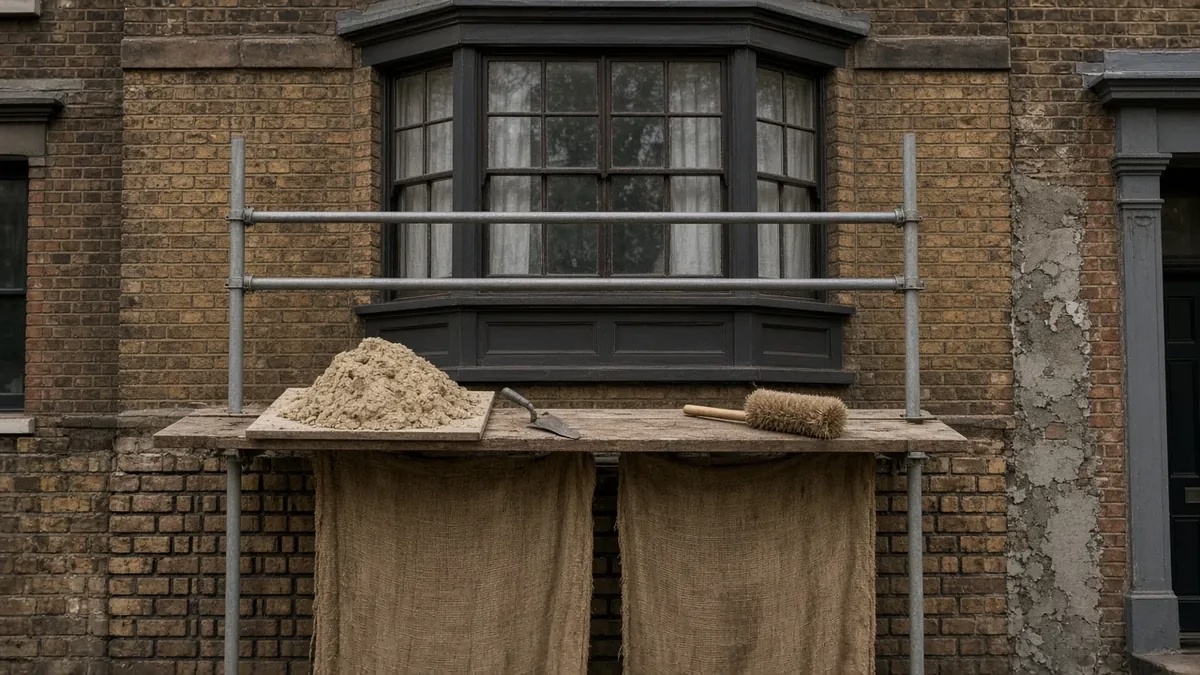
A lot of London’s Victorian and Edwardian houses have been repointed at some point in the last few decades, often with a hard, grey cement mortar. It looks neat and strong, and it’s sold as keeping the weather out. Yet some of those same houses now have damp patches on the inside of solid walls, bricks crumbling on the outside, and white salts appearing on the plaster. The pointing is sometimes part of the reason.
This guide explains how cement pointing can cause or worsen damp in older brick walls, how to tell whether your house has it, and what a sensible repair looks like.
Why the mortar joint matters for damp
Historic England’s guidance on repointing explains that the mortar joint helps keep a building dry in two ways: it stops rain running into the wall through the joints, and it lets moisture already in the wall escape once the weather dries up. Older solid walls rely on that second job. Rain is absorbed into the brick and mortar during wet weather, then evaporates out again.
The problem comes when the joints can’t release moisture. Historic England says that where hard cement mortar has been used, moisture movement becomes concentrated in the bricks, which increases the chance of frost damage and damage from salts crystallising. Its guidance on assessing damp in historic buildings adds that repointing a brick wall with an impermeable mortar reduces the area from which moisture can evaporate freely by almost a fifth.
How cement pointing leads to damp inside
- Shrinkage cracks. Historic England notes that however carefully cement-based materials are applied, there will always be shrinkage cracks, gaps or joints where water can get in.
- Trapped water. Water that gets in through those cracks can’t easily get back out, because many cement mortars lack the pathways that let moisture return to the surface. Over time it builds up.
- Saturation. If the full thickness of a solid wall becomes saturated, Historic England says pathways can develop that carry liquid water from outside to the inside face.
- Ledges. The Society for the Protection of Ancient Buildings (SPAB) points out that joint finishes associated with cement, such as weather-struck or ribbon pointing, can form ledges that trap water.
Inside, this usually shows up as a damp patch on an exposed solid wall that gets worse in wet, windy weather, sometimes with salts, blown plaster or peeling paint. It’s a form of penetrating damp, not rising damp. Our guide to rising damp vs penetrating damp explains the difference.
Signs your house has unsuitable cement pointing
SPAB describes several tell-tale signs:
- a very hard, smooth, dull grey mortar, rather than a lighter, softer, more open-textured lime mortar;
- pointing that has been feathered over the edges of the bricks;
- weather-struck (angled), bucket-handle (concave) or ribbon (protruding) joint finishes;
- mortar that cracks and drops out in short sections, or stands proud of bricks that have worn away around it.
That last sign is the clearest. When the mortar is harder than the brick, the brick becomes the weakest and most permeable part of the wall, and it erodes instead. SPAB calls this a common mistake with old walls. Our guide to spalling bricks covers the brick damage in more detail.
Is cement pointing always a problem?
No. SPAB’s advice is pragmatic: where the cement pointing adheres well and problems such as damp haven’t followed, it’s probably best to leave it to age naturally. Historic England also says sound existing mortar should be left alone, and that repointing is usually only necessary in more exposed areas, low-level areas affected by damp, or where there’s a specific problem such as leaking rainwater goods.
It’s also worth remembering that cement pointing is only one possible cause. Before blaming the mortar, rule out the usual suspects: blocked or leaking gutters, defective sills and copings, a high patio against the wall, or a cement render with the same trapping effect. Historic England says the true cause of decay should be identified, and any defects contributing to it fixed, before repointing.
What a sensible repair looks like
- Diagnose first. Find out where the water is coming from and whether the pointing is really the issue. A damp survey by someone familiar with older buildings is the right starting point.
- Fix the water source. Gutters, downpipes, flashings and sills come before the joints.
- Trial removal. SPAB recommends removing a small area as a trial, because cutting out hard cement can damage the brick edges. If removal is doing more harm than good, a compromise may be better.
- Repoint selectively. Where cement is causing localised damage, rake it out carefully (hand tools are gentler than an angle grinder on soft brick) and repoint with a suitable mortar. Historic England says that for houses built before the early 20th century, this will almost certainly be a lime-based rather than a cement mortar.
- Match the finish. Use a joint profile and colour that suit the original. Lime pointing usually finishes flush or slightly recessed, not proud of the brick.
- Let it dry. Walls take time to dry once the water source is fixed. Don’t seal the inside with impermeable plaster or paint straight away. Our guide to plastering after damp explains why.
Why not just inject a damp-proof course?
Damp caused by water getting through the face of the wall isn’t fixed by a chemical treatment at the base of the wall. If the patch is at mid-height, worse after driving rain, and the outside shows eroded bricks and hard grey joints, the outside of the wall is where the repair belongs.
Frequently asked questions
Can cement pointing cause damp?
In older solid brick walls, it can contribute. Hard cement mortar cracks and lets water in, then makes it harder for the wall to dry out, which can lead to damp on the inside face and decay of the bricks.
How can I tell lime mortar from cement mortar?
Cement mortar is usually hard, smooth and dull grey. Lime mortar is softer, lighter in colour and more open-textured, and it may contain small white lumps of lime or chalk.
Should I remove all the cement pointing on my house?
Not necessarily. Where it’s sound and isn’t causing damage, leaving it may be best. Remove it selectively where it’s causing problems, after a trial area shows it can come out without harming the bricks.
Is lime repointing more expensive?
It can take longer and needs experience, especially if hard cement has to be removed first. The cost depends on access, the extent of the work and the condition of the bricks, so get a quote after a proper inspection.
Damp on an old brick wall?
We start by finding the cause, then repair what’s actually wrong, whether that’s a gutter, the pointing or the bricks themselves. See our damp proofing service in London, request a damp inspection, call 020 7971 1318 or message us on WhatsApp.
General information only. Sources checked on 25 November 2026.