
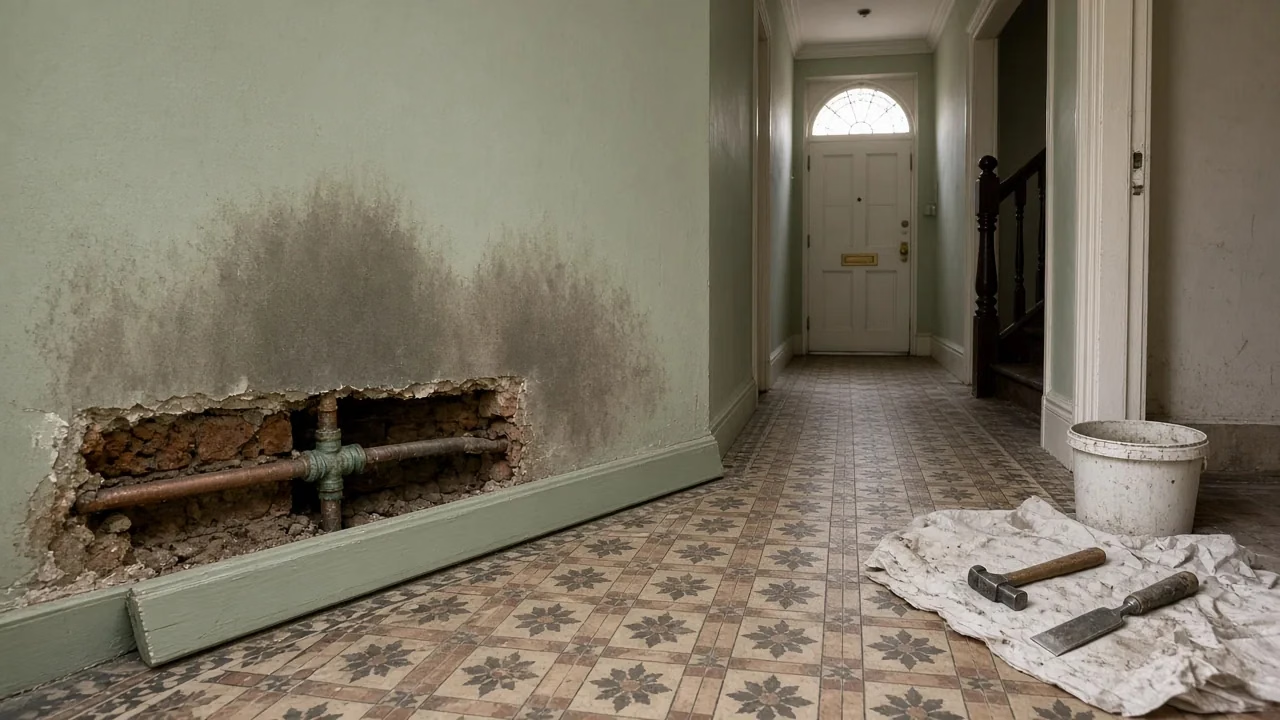
Damp on an outside wall is easy to blame on the weather. Damp on an internal wall is more puzzling. A hallway partition, the wall between the kitchen and the living room, or the wall behind the bathroom basin doesn’t face the rain at all, so where is the water coming from? The answer is usually closer to home than people expect, and it’s rarely a reason to inject a new damp-proof course.
First, a quick definition. Some people say “internal wall” when they mean the inside face of an external wall. This guide focuses on true internal walls (walls with rooms on both sides), but we’ve included a short section on the inside face of outside walls too.
Why the location matters
The RICS consumer guide on damp and mould makes an important point: penetrating damp, rising damp and condensation aren’t causes in themselves, but ways moisture moves through or onto a building. To solve a damp problem, you first need to find where the moisture is coming from. An internal wall rules out some sources straight away, because rain can’t normally reach it directly. That shortens the list.
Cause 1: a plumbing leak
This is the first thing to rule out on any internal wall, especially if the damp appeared suddenly. The Property Care Association’s Code of Practice for the control of dampness says surveyors must always consider whether dampness is caused by a plumbing defect, that even a small leak can cause significant damage, and that the damp may show up some distance from the leak. It also notes that buried pipework in solid floors can leak and cause damp at the junction between the wall and the floor, which is particularly common in 1960s and 1970s buildings where buried copper pipes can corrode in the concrete.
Signs that point to a leak:
- the patch appeared suddenly or is spreading;
- it doesn’t change with the weather;
- it’s near a bathroom, kitchen, radiator, boiler pipework or a pipe run in the wall or floor;
- your water meter moves when all taps and appliances are off, or the heating system keeps losing pressure.
A shower or bath on the other side of the wall is a common source: failed sealant or grout lets water into the wall each time it’s used. See our guides to finding the real source of a recurring leak and water leaking behind bathroom tiles.
Cause 2: salts in a chimney breast
Many London terraces have chimney breasts on internal walls. The PCA Code of Practice explains that combustion gases in chimney flues can deposit sulphates in the masonry, that this is a common source of contamination on chimney breasts at all levels, and that it’s frequently misdiagnosed as penetrating damp. These salts absorb moisture from the air, so the patch can come and go with the humidity in the room. Our guide to damp on an unused chimney breast explains how it’s dealt with.
Cause 3: hygroscopic salts left from an old problem
Even when an original leak or damp problem has been fixed, salts left in the plaster can keep drawing moisture from the air. The PCA Code of Practice describes this as “salt damp”: walls containing hygroscopic salts can be intermittently damp with no liquid water source present, and an electrical moisture meter can suggest salts even when the surface looks dry. It adds that further tests may be needed to tell hygroscopic moisture from free moisture. This is one reason a high meter reading alone shouldn’t decide the treatment. If you see white, fluffy deposits, see our guide to efflorescence on walls.
Cause 4: damp at the base of a ground-floor wall
Damp at the base of a ground-floor internal wall is often blamed on rising damp. Before assuming that, the PCA Code of Practice and the RICS guide both point to more common reasons for damp low down on walls, including:
- leaking pipes in or under a solid floor (see Cause 1);
- blocked air vents and poor ventilation under a suspended timber floor, which the RICS guide lists among the things to check;
- spills, floods or a leaking appliance that soaked into the floor and wall.
The RICS guide notes that “rising damp” is often misdiagnosed and that failure of an original damp-proof course is extremely rare. If someone recommends injecting a damp-proof course into an internal wall, ask what evidence they’ve found that the moisture is rising from the ground, and how they’ve ruled out a leak. Our guide to a musty smell under floorboards covers subfloor ventilation.
Cause 5: a party wall
A wall shared with the house next door is internal to you, but the other side belongs to someone else. A leak, a bathroom or a blocked gutter next door can show up on your side. See our guide to damp on a party wall.
If you mean the inside of an outside wall
If the damp is on the inside face of an external wall, the list widens to include rain penetration and condensation. The RICS guide lists common defects to check outside, such as leaking or blocked gutters and downpipes, poor pointing, cracked render, raised ground levels and roof defects. Condensation usually shows as mould on cold surfaces, around windows and on ceilings near external walls. Our guide to rising damp vs penetrating damp goes through how to tell them apart.
Checks you can do before calling anyone
- Note when it started and whether anything changed: new bathroom, new heating pipes, a flood, a leaking washing machine.
- Do a water meter test: turn off all taps and water-using appliances and watch the meter for movement.
- Check the heating pressure gauge on the boiler over a few days. A steady drop suggests a leak in the heating system.
- Look at what’s on the other side of the wall: shower, bath, sink, radiator, chimney breast or the neighbour’s house.
- Photograph the patch at the same time each day for a couple of weeks to see if it’s growing, shrinking or changing with the weather.
How it’s usually fixed
- Leaks: trace and repair the pipe, seal or fitting, then let the wall dry before replastering.
- Chimney or salt contamination: remove the contaminated plaster and replaster with a suitable specification, and ventilate a disused flue where appropriate.
- Subfloor problems: clear blocked vents and debris to restore airflow under a suspended floor.
- Party wall: work with your neighbour to find and fix the source on their side.
Whatever the cause, fix the source first and let the wall dry out. Replastering or repainting before the source is fixed only hides it for a while.
Frequently asked questions
Can an internal wall get rising damp?
Moisture from the ground can affect a ground-floor internal wall in some houses, but rising damp is often misdiagnosed. Leaks, salts and subfloor problems should be ruled out first.
Why is my internal wall damp when there’s no pipe in it?
Water can travel some distance from a leak, for example along a floor or down from a bathroom above. Salts in a chimney breast or left from an old leak can also make a wall look damp without any pipe nearby.
Is a damp meter reading enough to diagnose damp on an internal wall?
No. The PCA Code of Practice says electrical moisture meters give only qualitative and comparative readings in masonry and can be affected by salts. They’re a guide, not a diagnosis.
Who should I call about a damp internal wall?
If you suspect a leak, a plumber or leak detection specialist first. If the cause isn’t obvious, an independent damp investigation that looks at the whole house before recommending any treatment.
Damp on an internal wall you can’t explain?
We trace the moisture to its source before suggesting any work, and we’ll tell you if it’s a plumbing job rather than a damp-proofing one. See our damp survey service and damp proofing guide for London homes, request a quote and project review, call 020 7971 1318 or message us on WhatsApp.
General information only. Sources checked on 24 November 2026.