
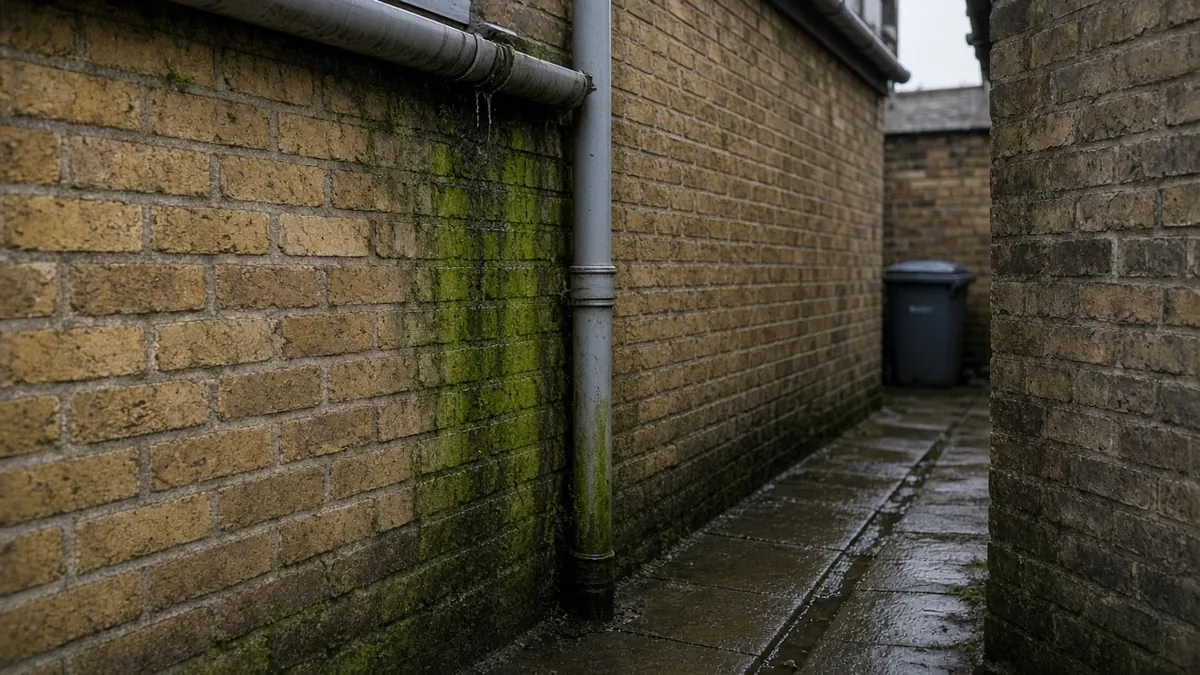
A green film creeping down the brickwork below a gutter, a green band along the bottom of a wall, or a whole side elevation that never quite looks clean: green algae on outside walls is common on London houses, especially on shaded side passages and north-facing walls. It’s easy to treat it as a cleaning job. More often it’s a message that part of the wall is staying wet, and that’s worth reading before you scrub it off.
This guide explains why algae grows on walls, when it points to damp inside, how to clean brickwork without damaging it, and what to fix so it doesn’t come straight back.
Why green algae grows on walls
Algae needs moisture that lasts. Historic Environment Scotland’s Engine Shed brick guidance says algae or green staining is caused by water running down the surface or getting inside brickwork, leading to saturation, that faulty rainwater goods are often the culprit, and that normal exposure to rain alone won’t cause algal growth. The Concrete Society says biological growths only form when masonry or render is wet for significant periods, and are frequently the result of blocked downpipes or leaking gutters.
Shade makes it worse. The Brick Development Association notes that moss and algae don’t survive in direct sunlight or dry conditions, so they tend to be more of a problem in winter and early spring, in colder, shaded areas. That’s why a north-facing wall or a narrow side return between two terraces often shows a light green tint even when nothing is broken.
Is it algae or something else?
On light buff bricks, a green or yellow-green stain can also be vanadium staining, a salt from the brick itself. The BDA points out that vanadium salts are only visible in buff bricks, while algae can grow on any brick type and on the mortar joints. Algae also tends to feel slightly slimy when wet and rubs off on a finger.
What the pattern tells you
- A streak below a gutter joint, hopper or downpipe: a leak or overflow running down the face. This is the most common pattern.
- A band along the bottom of the wall: rain splashing back from hard paving, a blocked gully, or ground and paving built up too high against the wall.
- Patches under window sills or copings: water not being thrown clear because a drip groove is missing, blocked or damaged.
- Around an overflow pipe or air-conditioning outlet: water being discharged onto the wall.
- A faint, even film over a whole shaded elevation: often just aspect and shade, but still worth checking the gutters and pointing.
Does green algae mean damp inside?
Not always, but it’s a strong clue. SPAB’s Fighting Damp advice says patches of algae (green staining) are indicative of rain penetration, and recommends looking for corresponding defects such as leaking gutters, pipes or roof tiles at or near the green staining or damp patches. It also notes that external green staining is symptomatic of rain penetration, not rising damp.
So if you have a damp patch, mould or peeling decoration inside on the same wall, look at the outside first. Solid brick walls, common in Victorian and Edwardian London terraces, are particularly prone to letting persistent wetting through. Our guide to rising damp vs penetrating damp explains why this matters before anyone recommends a damp-proof course, and our article on damp on a gable end wall covers exposed side walls in more detail.
How to clean algae off brickwork safely
Fix the water source first, otherwise the algae grows back. Then:
- Start gently. The Engine Shed guidance says the most suitable and least risky way to remove modest soiling is to wash brickwork down with water and a non-ferrous bristle brush, and to try water first before chemicals.
- Avoid high pressure. The same guidance warns that a high-pressure hose forces water deep into the structure, and that vigorous scrubbing and saturating the lower wall with run-off should be avoided. Old soft bricks and lime mortar are easily damaged.
- Use a biocide if it comes back. The Concrete Society suggests removing thick growth with a stiff brush and brushing a surface biocide well in, preferably in a dry spell so it isn’t washed off before it works. The BDA advises testing any cleaner on an inconspicuous area first and following the manufacturer’s health, safety and environmental instructions.
- Test a small panel first and use an experienced contractor for anything beyond light cleaning, especially on older or decorative brick.
Rendered and painted walls follow the same logic: find why the surface stays wet before cleaning or repainting. Cracked render can hold water behind it; see our guide to cement render and damp.
Fixing the cause so it stays away
- Gutters, hoppers and downpipes: clear them, re-seal leaking joints, fix cracked cast iron sections and make sure downpipes discharge into a working gully.
- Below-ground drainage: Engine Shed lists failed below-ground drainage among the causes of saturated brickwork. A gully that backs up in heavy rain keeps the base of the wall wet.
- Drips and copings: poorly functioning drip details on copings and sills let water run down the face.
- Ground levels and splashback: keep paving below the damp-proof course and allow it to fall away from the wall.
- Pointing: open joints let water in. For old lime-bonded walls, Engine Shed recommends repointing open joints with lime mortar. Our guide to spalling bricks explains what happens when brickwork stays wet through winter.
- Plants: mosses and lichens hold moisture against bricks and mortar, and creepers can cause damage, so cut them back carefully.
Be wary of being sold a clear “waterproof” coating as the first fix. On older solid walls the priority is getting rainwater away from the wall; any coating is a separate decision that needs to suit the wall, not a substitute for repairs.
Frequently asked questions
Is green algae on walls a sign of damp?
It shows the surface stays wet for long periods. Heavy or localised growth usually points to a leaking gutter, downpipe, sill or drain, and SPAB treats green staining as a sign of rain penetration. Check inside the same wall for damp.
Can I pressure wash algae off brick?
It’s best avoided. Heritage guidance warns that high-pressure water forces water deep into brickwork and can damage soft bricks and mortar. Use water, a non-ferrous bristle brush and, if needed, a biocide.
Why does algae only grow on one side of the house?
Usually because that side gets little sun and dries slowly, often a north-facing wall or a shaded side passage. A defect such as a leaking gutter on that side makes it much worse.
Is green algae harmful to brickwork?
The algae itself is mostly a symptom. The damage comes from the water feeding it. Thick moss and lichen can trap moisture and add to frost damage, so fix the source and clean gently.
Green walls and damp inside?
We trace where the water is coming from, outside and in, and only recommend the repairs that deal with it. See our damp survey service and damp proofing guide for London homes, request a quote and project review, call 020 7971 1318 or message us on WhatsApp.
General information only. Sources checked on 23 November 2026.