
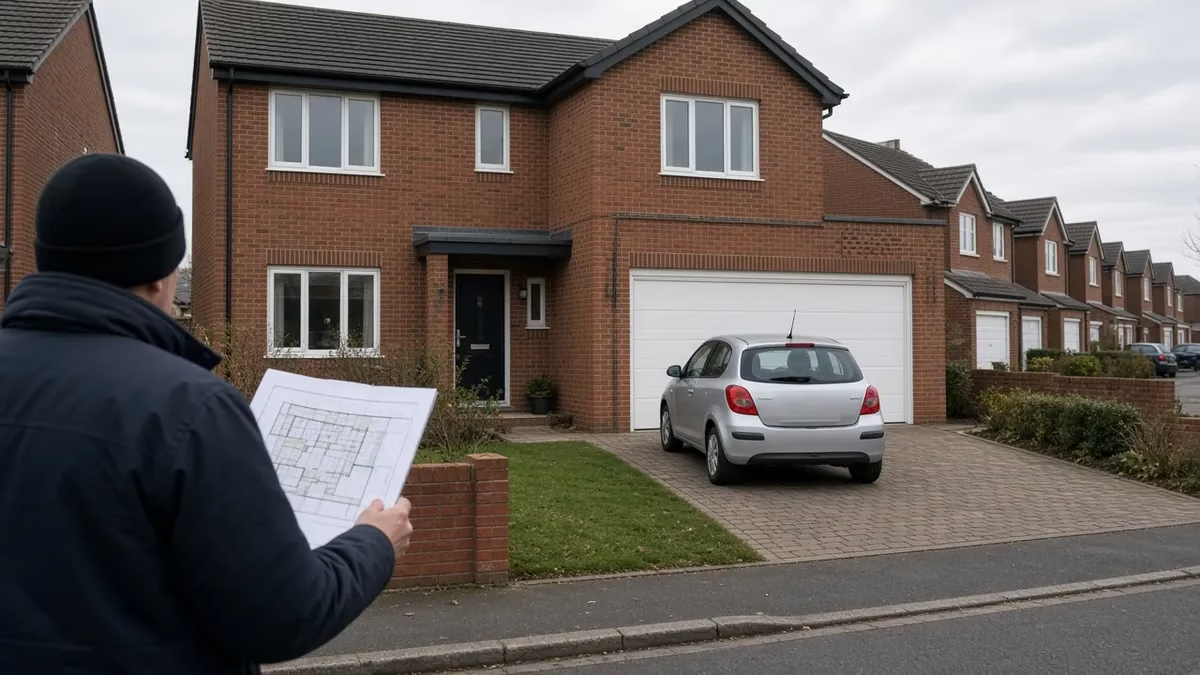
You’ve measured up, found a builder and sketched out the new playroom or office, and then someone on the street mentions that their garage conversion was refused. On many newer London estates, and on some older ones, the original planning permission for the houses includes a planning condition that the garage must be kept for parking. If yours has one, converting the garage isn’t the simple “no planning needed” job most guides describe.
Here’s how to find out whether a condition applies to your garage, what it means in planning law, and the routes you can take if it does.
Why most garage conversions don’t need planning permission, and why some do
The Planning Portal says planning permission is not usually required for a garage conversion, provided the work is internal and doesn’t enlarge the building. That’s because works that affect only the interior of a building, or don’t materially affect its external appearance, are not treated as “development” under section 55 of the Town and Country Planning Act 1990. Replacing the garage door with a wall and window is often treated as a minor alteration that permitted development covers, or that has no material effect on the appearance of the house.
The same Planning Portal page adds an important warning: permitted development rights have sometimes been removed for garage conversions, so you should contact your council before proceeding, “particularly if you live on a new housing development or in a conservation area”. There are two different ways this happens, and it helps to know which one you’re dealing with.
1. A condition that the garage is kept for parking
When a developer gets planning permission for an estate, the council often attaches conditions about parking. A typical condition says that the parking spaces and garages shown on the approved plans must be kept available for parking vehicles and not used for any other purpose. If your garage is one of those spaces, turning it into a room breaches the condition, even if every bit of the work is internal.
Permitted development can’t get you round it. Article 3(4) of the General Permitted Development Order 2015 says nothing in the Order permits development contrary to a condition imposed on a planning permission granted by the council.
2. A condition that removes permitted development rights
Some permissions also include a condition removing specific permitted development rights, for example for extensions or alterations to the houses. That kind of condition doesn’t stop you using the garage as a room on its own, but it can mean the external changes, like replacing the garage door with a window, need a planning application. Government planning practice guidance on conditions says the scope of conditions that restrict permitted development rights needs to be precisely defined, which is why the exact wording matters.
Separately, an Article 4 direction or a conservation area can also limit what you can change on the front of the house without permission. That’s an area-wide restriction rather than a condition on your property’s own permission.
How to check whether your garage has a planning condition
- Search your council’s online planning register for your address. If nothing comes up, search the street name or the estate name: the conditions are usually on the original permission for the whole development, not on your house alone.
- Open the decision notice, not just the application form. Conditions are listed on the decision notice, each with a reason. Look for words like “parking”, “garage”, “retained”, “permanently” and “permitted development”.
- Check the approved plans. A parking condition often refers to “the parking spaces shown on the approved plans”. If your garage is marked as a parking space, the condition is likely to cover it.
- Look for later permissions on your house, such as an extension approval, which may add or vary conditions.
- Check your title deeds separately. Developers sometimes add a restrictive covenant on the garage too. A covenant is a private legal matter, not a planning one: getting planning permission doesn’t release you from it, and you’d need legal advice on it.
If the wording isn’t clear, or you can’t find the decision notice online, ask the council’s planning team for a copy. Don’t rely on the estate agent’s particulars or on a neighbour’s conversion as proof either way: the neighbour may have applied, or may simply not have been noticed.
Your options if there is a parking condition
Apply to vary or remove the condition (section 73)
Section 73 of the Town and Country Planning Act 1990 lets you apply to develop land without complying with a condition attached to an earlier permission. The council considers only the condition, not the whole development again, and can remove it, replace it with a different condition, or refuse. In practice you’d show what parking will remain, for example a driveway that still takes a car, and how the change fits the council’s parking policies.
Some councils will instead ask for a full householder application covering the conversion and any external changes. It’s worth checking your borough’s validation checklist or asking the planning team which route they expect.
Apply for a lawful development certificate if you think the condition doesn’t apply
If you believe the condition doesn’t cover your garage, for example because the garage isn’t one of the spaces named on the approved plans, you can apply for a certificate of lawfulness of proposed development (section 192). It’s a formal decision you can rely on, and useful when you sell. If the council concludes the condition does apply, it will refuse the certificate and you’d need to apply for permission instead.
Keep part of the garage for parking or storage
Occasionally the answer is a smaller conversion. Whether that satisfies a condition depends on its wording and on whether a car can still fit, so it needs checking with the council. Our guide to partial garage conversions covers the building side.
What happens if you convert without dealing with the condition?
Converting in breach of a condition is a planning breach. Under section 187A of the 1990 Act the council can serve a breach of condition notice requiring you to comply, which could mean reinstating the garage. Even if no one complains, the issue often comes up when you sell: buyers’ solicitors look at the planning history, and a missing approval can delay or derail a sale. It’s far simpler to sort it out before the builders start.
Planning is only half of it: building regulations still apply
Whatever the planning position, turning a garage into a habitable room needs building regulations approval: the floor, walls, insulation, ventilation, fire safety and any new window or door are all checked. Our guide to garage conversion building regs explains what’s inspected and when, and garage conversion permitted development covers the usual planning rules where no condition applies.
A few other things are worth checking at the same time:
- Parking on the street. If you’re in a controlled parking zone, losing off-street parking may affect how the council views the application.
- The front elevation. A well-matched brick infill and window is more likely to be acceptable. See filling in a garage door opening.
- Council tax and value. See garage conversions and council tax and how to decide without losing value.
Frequently asked questions
Do I need planning permission to convert my garage in London?
Usually not, if the work is internal and the house still has its permitted development rights. You do need to apply if a planning condition requires the garage to be kept for parking, and you may need to if permitted development rights have been removed or an Article 4 direction applies.
How do I know if my garage has a planning condition?
Look up the original planning permission for your house or estate on the council’s planning register and read the conditions on the decision notice. Look for conditions about parking spaces or garages being “retained”.
Can a planning condition on a garage be removed?
Yes, you can apply under section 73 to remove or vary it. The council decides whether the condition is still needed, usually by looking at how much parking will remain and its local parking policies.
Is a restrictive covenant the same as a planning condition?
No. A planning condition is enforced by the council; a covenant is a private obligation in your title deeds. You may need to deal with both, and planning permission doesn’t override a covenant.
Planning a garage conversion?
We check the planning history and the approved plans for your house at the start, so you know whether a condition applies before you spend money on drawings. See our garage conversion service in London, request a quote and project review, call 020 7971 1318 or message us on WhatsApp.
General information for England only, not legal advice. Planning decisions are made by your local council. Sources checked on 17 November 2026.