
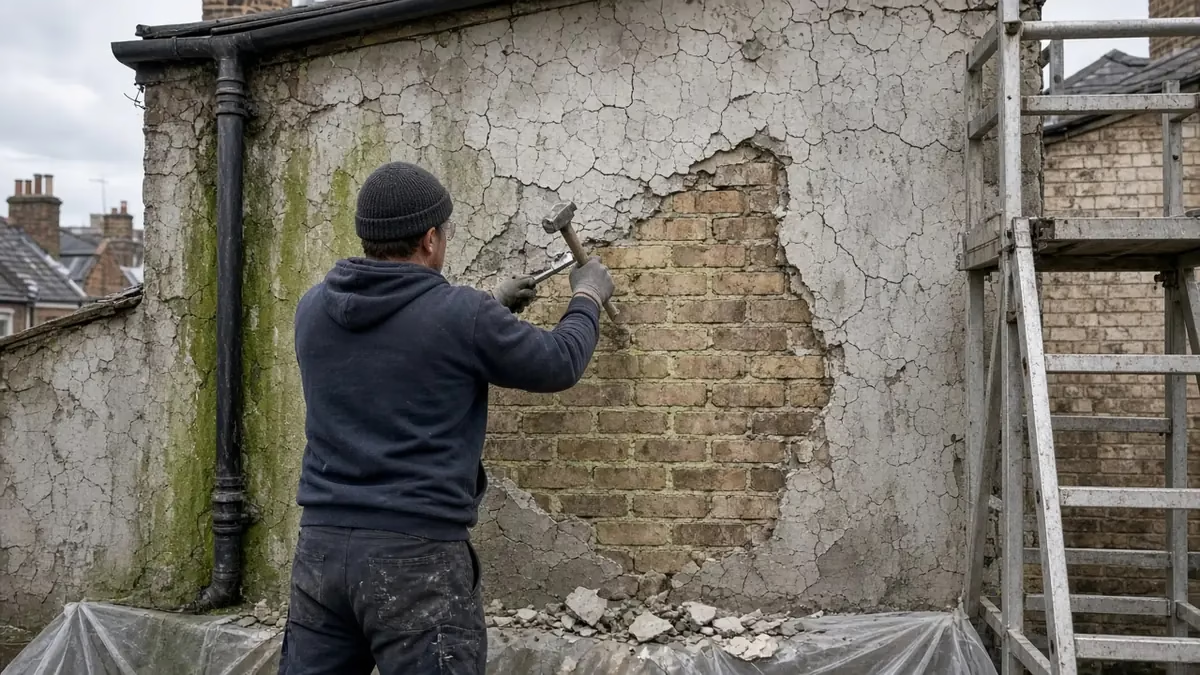
Plenty of London’s Victorian and Edwardian houses have had their brickwork or original stucco covered, patched or replaced with a hard cement render at some point: on a whole elevation, a rear addition, a bay, a garden wall or just a band at the base of the wall. Years later the owners find damp patches inside, blown or cracked render outside, and plaster that won’t stay sound. They’ve often been told the answer is a damp-proof course injection. Quite often the render itself is part of the problem. Here’s why cement render can cause damp in older walls, how to tell if it’s happening in your house, and what to do about it.
How old solid walls handle moisture
Most London houses built before the 1920s or so have solid brick walls, usually without a cavity, built with soft lime mortar. These walls don’t keep water out by being waterproof. They absorb some rain and then let it dry out again from the surfaces, both inside and out. The Society for the Protection of Ancient Buildings (SPAB) describes old buildings as relying on their permeable nature (“breathability”) to let water that the fabric absorbs evaporate back out, while modern buildings depend on an impervious outer layer and cavities.
Why cement render can trap damp
A dense Portland cement render works against that. According to SPAB:
- it restricts evaporation from the outer face of the wall;
- it’s more rigid than the wall, so it develops hairline cracks as the wall moves slightly with temperature and moisture;
- those cracks draw water in, and the water gets trapped behind the render.
SPAB’s technical advice note on control of dampness describes water streaming down cement render, being drawn into fine cracks by capillary action, building up behind the render and eventually finding its way to the inside face. Hard cement pointing and impermeable paints and coatings can have similar effects.
The wall ends up wetter than it would be with no render at all. The moisture has to go somewhere, and often that’s into the plaster and decorations inside, or down to the base of the wall.
Signs your render may be causing damp
- Cracked render, especially fine crazing or cracks that follow the brick courses or run from window corners.
- Hollow-sounding patches when you tap the render, or areas bulging and coming away. SPAB notes that cement renders often fail in patches and detach from the wall.
- Damp inside behind rendered areas, with patches that are worse after wet weather and slow to dry.
- Salts and blown plaster on the inside of the wall.
- A cement plinth or band along the base of the wall outside, with damp at skirting level inside. A render band or plinth taken down to the ground can also bridge the damp-proof course.
- Green staining or algae where water runs down the render.
These signs suggest a problem but don’t prove the render is the only cause. Gutters, downpipes, sills, roofs and ground levels have to be checked too.
Is it lime or cement render?
SPAB notes that cement renders tend to look more uniform, with sharper corners and details, and tend to fail in patches, while lime renders weather back gradually. Signs of cement include a hard, grey, dense material that rings when tapped and a smooth, even finish, often painted with masonry paint. A builder familiar with traditional materials can usually tell by looking at a broken edge. If in doubt, a small sample can be checked.
Fix the water sources first
Before touching the render, deal with whatever is putting extra water onto the wall:
- leaking or blocked gutters, hoppers and downpipes;
- failed window sills and drips;
- defective parapets, copings and flashings;
- ground, paths or paving at or above the damp-proof course; see patio higher than the damp proof course;
- leaking drains or gullies at the base of the wall.
The RICS consumer guide to damp and mould includes cracked render and poor pointing in its list of external checks, alongside gutters, roofs and raised ground levels. Our guide to why a house smells damp when it rains covers common entry points.
Remove, repair or leave the render?
There isn’t a single answer. SPAB’s advice is:
- Removal isn’t always right. Taking cement render off can damage soft brick or stone underneath. A small trial area should be removed first. Where the render is sound and well bonded, leaving it may be best, and a compromise such as removing only a failing base band or hollow patches can work.
- Remove carefully. Levering off large sheets can pull the face off soft bricks. This is a careful hand job.
- Let a saturated wall dry for a while before re-rendering, and make sound any decayed backing.
- Replace with a lime render, generally weaker and more permeable, without added cement, applied by someone familiar with lime.
- Finish with limewash or a breathable paint, not a standard masonry paint, which can trap moisture again.
- Expect salts. A wall that’s been under cement render for years may hold a lot of salt, which a new lime render can draw out. Some re-rendering after a couple of years may be needed in places.
Some houses were never meant to be rendered. Where the brickwork was originally exposed and the render was added later to cover damage, repairing the brickwork and repointing in lime may be an option, subject to planning.
Inside the house
Cement-based plasters and waterproof coatings on the inside face can trap moisture in the same way. If the inside has been re-plastered with a hard sand-and-cement render after a past damp treatment, it may need to come off too. See plastering after damp proofing. Before agreeing to a chemical DPC on a rendered wall, make sure the render and the external defects have been looked at. See is chemical DPC injection worth it? and rising damp vs penetrating damp.
Planning and building regulations
- Building regulations: under Approved Document L (Volume 1, 2021 edition incorporating 2023 amendments, paragraphs 11.2 to 11.4), rendering or re-rendering the outside of a wall counts as renovating a thermal element. If more than 50% of the wall (measured by elevation) is renovated, the whole wall should be improved to a U-value of 0.30 W/m²K where that’s technically, functionally and economically feasible. AD L also says that improvements should be made only where they won’t cause long-term deterioration of traditional, breathable construction such as walls built with lime render or mortar. Speak to building control before a large re-render.
- Planning: changing the external finish of a house can need planning permission, especially in a conservation area, under an Article 4 direction, or for a listed building (which needs listed building consent). Many London streets are in conservation areas, so check with your council before stripping or re-rendering a front elevation.
Frequently asked questions
Can cement render cause damp?
On older solid-walled houses, yes. Cement render restricts evaporation and develops fine cracks that let water in and trap it behind the render, which can lead to damp inside.
Should I remove cement render from my Victorian house?
Not automatically. Try a small trial area first. If the render is failing or causing damp, careful removal and replacement with lime is usually best. Sound, well-bonded render may sometimes be better left.
What should replace cement render on an old house?
Generally a lime render without added cement, finished with limewash or a breathable paint, applied by someone experienced with lime.
Will a damp-proof injection fix damp behind cement render?
Unlikely, if the render and external defects are what’s keeping the wall wet. Diagnose and fix the water sources first.
Damp behind rendered walls?
We check the render, the brickwork, the gutters and the ground levels before recommending anything, so the fix suits how your wall was built. See our damp survey service and damp proofing in London, request a quote and project review, call 020 7971 1318 or message us on WhatsApp.
General information only. For listed buildings or conservation areas, speak to your council’s conservation officer before starting. Sources checked on 16 November 2026.