
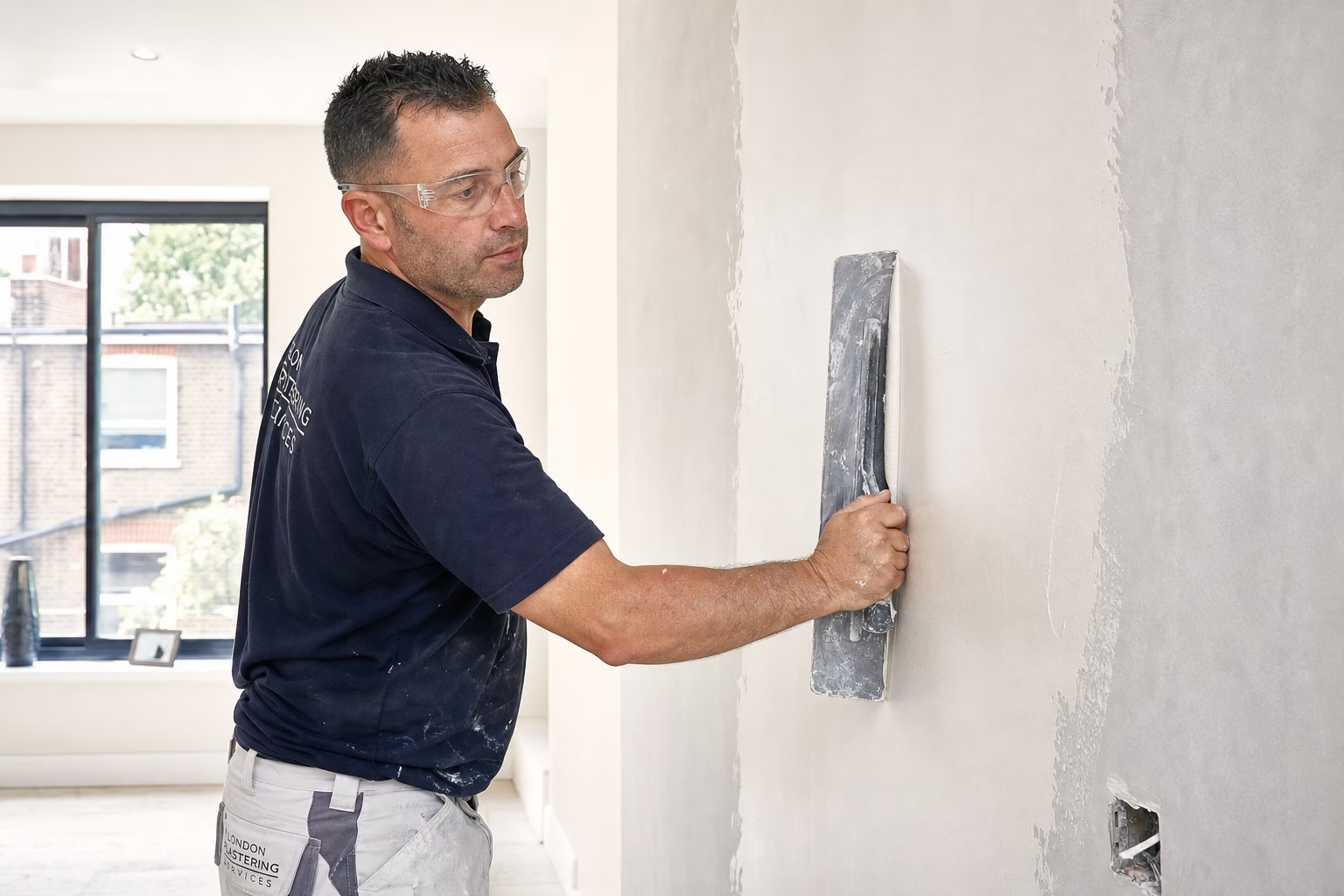
Plastering and Rendering Services in North London
Internal plastering from £450 · External rendering from £30/m² · K-Rend approved · Free quote: 020 7971 1318
What Is Plastering and What Is Rendering? The Key Difference
Plastering is an internal finish applied to walls and ceilings — creating a smooth, flat surface ready for painting or wallpapering. Rendering is the external equivalent — a protective and decorative coating applied to the outside of a building to weatherproof the structure and improve its appearance. Both require skilled tradespeople and the right materials for the substrate. Fixiz carries out both services across North London to the highest standard.
Internal Plastering Services in North London
Whether you need a single room skimmed after renovation work or a full house replastered, Fixiz provides a clean, precise finish every time. All plastering is carried out by experienced tradespeople using quality Thistle and British Gypsum materials.
Skimming Plaster
Skimming is a thin finish coat (2–3mm) of finishing plaster applied over an existing sound surface — whether old plaster, plasterboard or a bonding coat. It creates the smooth, hard finish needed before painting. A PVA bonding agent is applied first. Drying time is typically 2–3 days before a mist coat can be applied. Skimming is the most common plastering job in domestic properties and is significantly cheaper than full replastering.
Bonding Coat Plastering
A bonding coat is a thick undercoat (around 10–12mm) applied directly to brick, concrete, block or other masonry surfaces before the finish coat. It keys to the background and provides a flat, even base. The finish skim coat is applied over the bonding coat while it is still slightly green (not fully dry) to ensure adhesion.
Hardwall Plastering
Hardwall is a harder, more impact-resistant undercoat used in high-traffic areas such as hallways, stairwells and commercial properties. It resists knocks and scuffs better than standard bonding coat and is ideal where durability is more important than a fine finish.
Dot and Dab (Drylining)
Dot and dab is a drylining method where plasterboard is fixed directly to masonry walls using adhesive dabs, rather than wet plaster. It is faster and more cost-effective than traditional wet plastering and creates a cavity useful for concealing cables and pipework. It is not suitable for damp walls, below-ground rooms or areas subject to impact. Under BS 8212:2023, a continuous perimeter bead of adhesive is required to prevent air and fire movement behind the board.
External Rendering Services in North London
External rendering protects your property from wind-driven rain, frost and damp while transforming its appearance. Fixiz carries out all types of render systems across North London, from traditional sand and cement to premium K-Rend and silicone systems.
Sand and Cement Rendering
The traditional two or three-coat system using a sand and cement mix, applied by hand or machine. It is the most affordable render option and suitable for most substrates. Sand and cement render is hard and rigid — it can crack on older buildings with movement — and requires repainting every 5–10 years to maintain weatherproofing.
K-Rend Rendering
K-Rend is a premium silicone-based render system that is through-coloured (no painting required), water-repellent, breathable and self-cleaning. It is applied over a reinforced basecoat and finished with a scraped or smooth texture. K-Rend carries manufacturer warranties of up to 30 years when installed by approved contractors. It is the most popular modern render choice for North London properties due to its longevity and low maintenance.
Monocouche Render
Monocouche (“single coat”) is a factory-coloured cementitious render applied in one thick coat and finished with a scraped texture. It is most suitable for new-build or recently built properties with stable, consistent substrates. Because it is cement-based, it is less flexible than silicone render and can crack on older buildings subject to movement. An attractive, textured finish at a mid-range price point.
Silicone Render (Thin Coat)
Silicone thin-coat render is applied over a reinforced basecoat mesh system. It is highly flexible (ideal for older properties prone to movement), self-cleaning, water-repellent and breathable. The through-colour means no painting is needed. Silicone render typically lasts 20–30 years and is the premium choice for Victorian and Edwardian properties common across North London.
Plastering and Rendering Prices in North London
Internal Plastering Costs
| Service | Typical Price (London) |
|---|---|
| Skimming — small room (up to 10 m²) | £450 – £700 |
| Skimming — medium room (10–20 m²) | £700 – £1,100 |
| Skimming — large room (20 m²+) | £950 – £1,800+ |
| Plastering per m² | £8 – £12/m² |
| Full replaster — 3-bed house | £3,000 – £5,000 |
| Day rate — London plasterer | £150 – £250/day |
External Rendering Costs
| Render Type | Cost per m² | 3-bed semi (~90 m²) |
|---|---|---|
| Sand & Cement | £30 – £50/m² | £2,700 – £4,500 |
| Acrylic Render | ~£55/m² | ~£4,950 |
| Silicone Render | £65 – £80/m² | £5,850 – £7,200 |
| Monocouche Render | £80 – £90/m² | ~£7,200 |
| K-Rend System | £65 – £80/m² | £5,800 – £7,000+ |
What Affects the Price?
- Surface condition — hacking off old render or replastering damaged walls adds labour time
- Access — scaffolding costs for external rendering (typically £600–£1,500 for a house)
- Render system — silicone and K-Rend cost more in materials but last significantly longer
- Property size and complexity — bay windows, reveals and soffits add time
- Conservation area — additional requirements in Islington, Camden and Haringey conservation areas
When Do You Need Plastering or Rendering?
Signs Your Walls Need Replastering
- Hollow sound when tapped (blown plaster)
- Cracks wider than 2mm, or diagonal cracks from corners
- Damp patches or staining coming through
- Plaster crumbling or coming away from the wall
- Uneven surface that is affecting paint or wallpaper
- After removing old tiles or fitted furniture
Signs Your External Render Needs Replacing
- Cracks that allow water ingress
- Hollow or loose sections (tap test)
- Green algae or black mould growth
- Paint repeatedly peeling or bubbling
- Damp appearing on interior walls
- Render more than 20 years old with no maintenance
Our Plastering and Rendering Process
1. Free Survey & Quote
We visit, assess the substrate and scope, and give you a fixed written price. No hidden extras.
2. Surface Preparation
Hack off failed material, treat damp or contamination, apply bonding agents or basecoat systems.
3. Application
Coats applied to correct thickness using the right system for your substrate and requirements.
4. Finishing & Inspection
Final coat trowelled or textured to specification. We inspect every section before leaving.
5. Clean-Up & Aftercare
Full site clean on completion. Advice on drying times, mist coats and maintenance provided in writing.
Why Choose Fixiz for Plastering and Rendering in North London?
- Local North London specialists — based in N22, serving N and NW postcodes daily
- Fixed-price quotes — the price we quote is the price you pay
- 200+ projects completed — across residential, commercial and HMO properties
- All render systems covered — sand & cement, K-Rend, silicone, monocouche
- Full project management — we handle scaffold, materials and waste removal
- Guaranteed workmanship — written guarantee on all plastering and rendering work
Areas We Cover in North London
Fixiz covers all N and NW postcodes across North London, including:
- Archway & Highgate
- Barnet & New Barnet
- Camden & Kentish Town
- Crouch End & Hornsey
- East & North Finchley
- Enfield & Southgate
- Finsbury Park & Highbury
- Golders Green & Hendon
- Hackney & Stoke Newington
- Hampstead & Belsize Park
- Haringey & Wood Green
- Holloway & Tufnell Park
- Islington & Angel
- Mill Hill & Whetstone
- Muswell Hill & Palmers Green
Frequently Asked Questions — Plastering and Rendering
What is the difference between plastering and rendering?
Plastering is an internal finish applied to walls and ceilings to create a smooth surface for decorating. Rendering is an external coating applied to the outside of a building to weatherproof it and improve its appearance. Both use similar materials but are formulated differently for their environments.
How much does plastering cost in North London?
Skimming a single room typically costs £450–£1,800 depending on size. The rate per m² in London is £8–£12. A full replaster on a 3-bedroom house costs £3,000–£5,000. Day rates for a London plasterer run £150–£250. These are indicative figures — contact us for a free fixed-price quote for your specific job.
How much does external rendering cost per m² in North London?
Sand and cement rendering costs £30–£50/m². Silicone and K-Rend systems cost £65–£80/m². Monocouche render is £80–£90/m². For a typical 3-bed semi-detached house with ~90 m² of external wall, expect £2,700–£7,500+ depending on the system chosen. Scaffold is typically an additional £600–£1,500.
What is K-Rend and is it worth it?
K-Rend is a premium silicone-based render system that is through-coloured (no painting needed), self-cleaning, water-repellent and breathable. Manufacturer warranties run up to 30 years when installed by approved contractors. While more expensive upfront than sand and cement, K-Rend requires virtually no maintenance and will not need repainting — making it excellent value over its lifespan.
What is the difference between monocouche and silicone render?
Monocouche is a factory-coloured cement render applied in one thick coat — best for new-build or recently built properties with stable substrates. Silicone render is a thin-coat flexible system applied over a reinforced basecoat — best for older properties subject to movement. Silicone is self-cleaning and more flexible; monocouche is harder and slightly cheaper. Both are through-coloured and require no painting.
How long does external rendering last?
Sand and cement render: 10–20 years with maintenance. Monocouche: 20–30 years. K-Rend and silicone systems: 20–30+ years. The lifespan of any render depends significantly on substrate condition, application quality and exposure to the elements.
Can you plaster over existing plaster?
Yes — if the existing plaster is sound, clean and adhering well. The surface must be PVA-primed and any cracks taped with scrim before skimming over. If the existing plaster is blown (hollow-sounding), damp-contaminated or crumbling, it must be hacked off completely before replastering.
How long does plaster take to dry before painting?
New plaster typically takes 2–3 days to dry to a uniform pale colour in normal conditions. Always apply a mist coat first — a diluted emulsion (roughly 70% paint, 30% water) — before applying full finish coats. Applying full-strength paint too early causes the paint to peel and the plaster to crack.
Do I need planning permission for external rendering?
Generally no — for most domestic properties in England, rendering is permitted development. However, if your property is a listed building or in a conservation area (common in Islington, Camden, Haringey and Barnet), you will need consent before altering the external appearance. Fixiz will advise you on this at the survey stage.
What is dot and dab and when should it be used?
Dot and dab (drylining) is a method of fixing plasterboard to masonry walls using adhesive dabs rather than wet plaster. It is faster, cheaper and avoids long drying times. It is ideal for straightening uneven walls and concealing cables. It should not be used on damp walls, below-ground rooms or anywhere where direct impact resistance is needed. Under current best practice (BS 8212:2023), a continuous perimeter bead of adhesive is required.
Get a Free Plastering and Rendering Quote in North London
Covering all N and NW postcodes. Fixed prices. All systems. No obligation.