
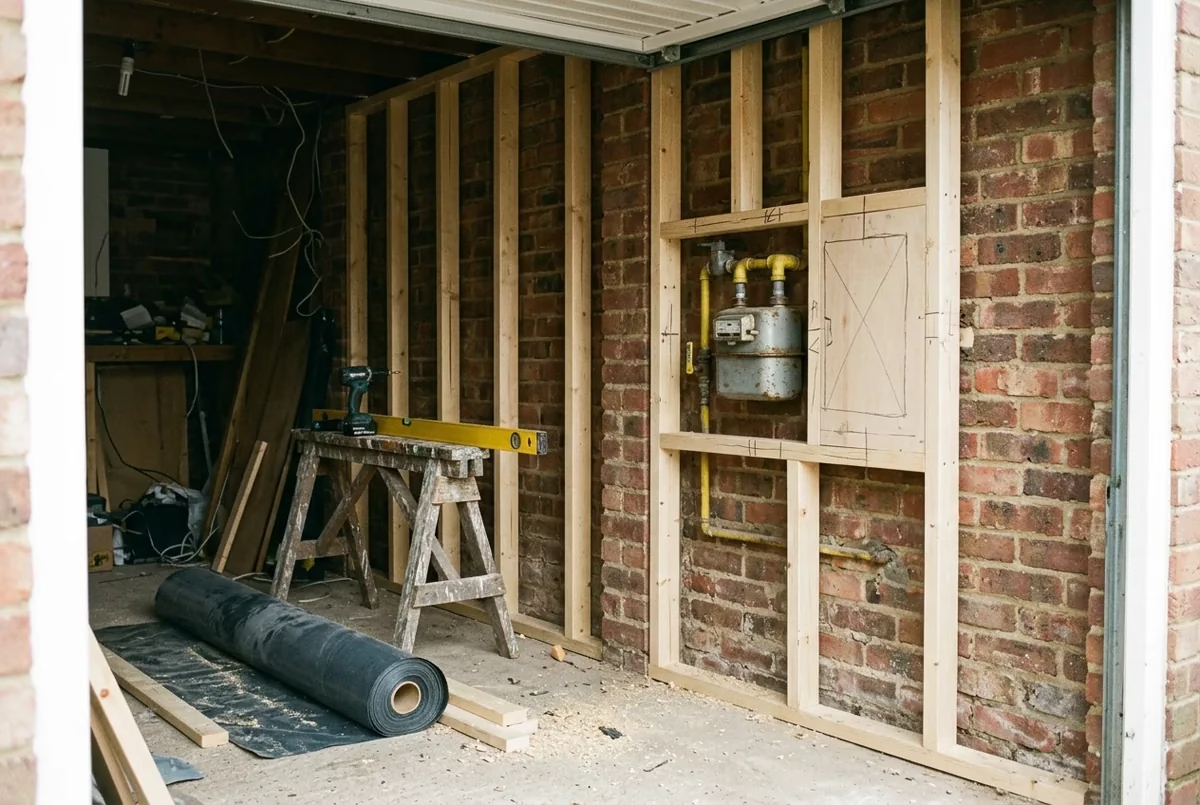
In a lot of London semis and 1960s–80s townhouses, the gas meter sits inside the garage, often with the electricity meter and fuse board beside it. When you start planning a garage conversion, that grey box suddenly becomes a problem: can it stay in what will be a bedroom or office, can it be boxed in, and who is actually allowed to move it?
The short answer: a meter in the garage rarely stops a conversion, but it has to be planned early. Moving it is not a builder’s job, it can take weeks to arrange, and the decision affects where walls, doors and cupboards go.
Can the gas meter stay where it is?
Often, yes. There is no blanket rule that a meter has to leave a converted garage. What matters is that the finished room still meets the gas safety rules for meters. Under the Gas Safety (Installation and Use) Regulations 1998, regulation 12, a meter must be in a readily accessible position for inspection and maintenance, and it must be sited so that it does not adversely affect the means of escape in a fire, so far as is reasonably practicable. Regulation 9 also requires an emergency control with adequate access.
In practice, keeping the meter usually means:
- A proper access cupboard, not a sealed box. The meter and the emergency control lever have to be reachable without tools or taking down plasterboard. A hinged door or a removable panel that is easy to open is the usual approach.
- Thinking about the escape route. If the converted garage becomes a bedroom or the room you pass through to get out, ask your designer and building control about the meter’s position early, so the layout doesn’t put it where it causes a problem.
- Keeping it clear of new electrics. Regulation 12 also says a meter must be placed so there is no risk of damage to it from electrical apparatus. New sockets, a consumer unit or cable runs shouldn’t be crammed right against it.
When moving the meter makes more sense
Keeping the meter can be awkward if it sits exactly where you want a new window, a fitted wardrobe, a shower room or the internal door. Some homeowners also simply don’t want a meter cupboard in a new bedroom. Common options are moving it a short distance along the same wall, or moving it outside into an external meter box.
It’s worth knowing who does what, because this is where projects lose time:
- Your energy supplier first. Citizens Advice explains that the meter is usually owned by your current supplier, so you ask them first. Whether they can do it depends on where the meter is, how far you want to move it and why. They may not be able to help with longer moves, for example to another room, or if the meter is outside.
- Your gas network operator for bigger changes. If the supplier can’t do it, you contact the local gas transporter. In London that is Cadent for north London and SGN for much of south London; Citizens Advice suggests checking yours on the Find My Supplier service. Citizens Advice says network operators usually charge at least £400 for this work and that it can be over £1,000, depending on what’s involved. Your own quote will depend on your house.
- A Gas Safe registered engineer for the pipework inside. Rerouting the pipes from the meter to the boiler and hob is gas work and must be done by a Gas Safe registered engineer.
You can’t move a meter yourself. Citizens Advice is clear that doing so is illegal, and a general builder can’t do it either. What a builder can do is prepare: plan the new position, form openings, fit an external meter box if the network operator asks for one, and make good afterwards.
Don’t forget the electricity meter and fuse board
If the electricity meter or consumer unit is in the garage too, treat it as a separate question for an electrician and, for the meter itself, your supplier or electricity network operator. The same principle applies: decide early whether it stays (with access) or moves, because it affects the layout and the order of works.
How the meter fits into the rest of the conversion
A garage conversion already involves a fair amount of design: the new floor and damp-proofing, insulating the walls, infilling the door opening and getting building control sign-off. The meter decision touches several of those:
- Door infill. If you’re bricking up the garage door opening, that’s often the obvious place for a new external meter box. Our guide to the garage door opening infill covers the wall itself.
- Wall insulation. A meter left on an external wall means the insulation and lining have to be detailed around the cupboard. If your walls are only one brick thick, see converting a garage with single-skin walls.
- Heating. If you’re extending the central heating into the new room, the gas engineer may be on site anyway, which can make timing the pipework changes easier. See heating a converted garage: central vs electric.
- Building control. The overall approvals process is explained in garage conversion building regs made simple.
Timing: start the meter conversation early
Because a meter move depends on outside organisations, it’s usually the item with the least control over its date. A sensible order is:
- At design stage, decide whether the meter stays or moves, and mark it on the drawings.
- If it moves, contact your supplier (and, if needed, the network operator) as soon as the layout is fixed, and ask what preparation they need from your builder.
- Book the Gas Safe engineer for the internal pipework to fit around that date.
- Only then close up walls around the old position.
If the meter is staying, make sure the access cupboard is drawn and agreed before plastering, so nobody has to cut into new walls later.
Frequently asked questions
Can I have a gas meter in a bedroom after a garage conversion?
There’s no general rule against it, but the meter must stay readily accessible for inspection and maintenance and must not adversely affect the means of escape in a fire. Discuss the layout with your designer and building control before you build.
Can I box in the gas meter?
You can enclose it in a cupboard or behind an easily opened panel, but you can’t seal it in. The meter and the emergency control must remain readily accessible.
Who moves a gas meter for a garage conversion?
Ask your energy supplier first. If they can’t do it, your gas network operator does the meter and service pipe work, and a Gas Safe registered engineer reconnects the internal pipework. Your builder prepares and makes good.
How long does it take to move a gas meter?
It depends on who does the work and how busy they are, so ask for a date as soon as your layout is fixed and plan the build around it.
Planning a garage conversion in London?
We’ll look at where your meters, fuse board and pipes are as part of the design, so their position is settled before work starts and nothing has to be redone. See our garage conversion service in London, try the cost calculator, request a project review, or call 020 7971 1318.
General information only. Gas work must be carried out by a Gas Safe registered engineer, and meters can only be moved by your supplier or gas network operator. Sources checked on 10 November 2026.