
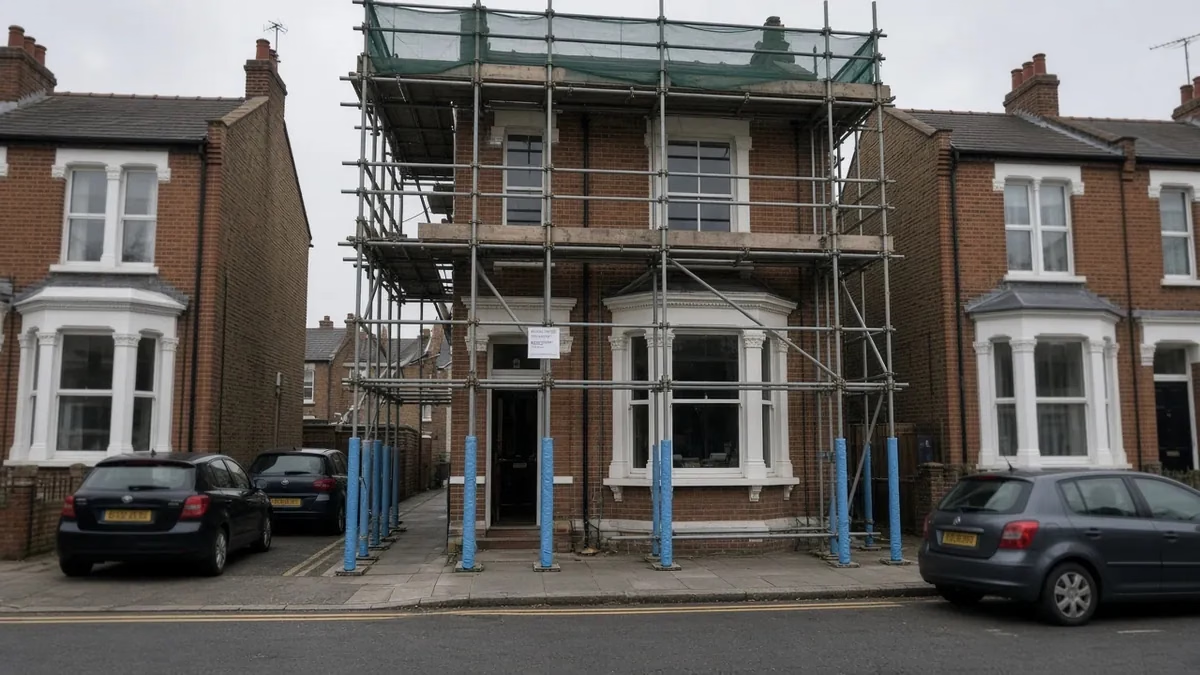
Almost every loft conversion needs scaffolding. It’s often the first sign to the street that work is starting, and it’s also where a lot of early delays come from: a licence that wasn’t applied for in time, a neighbour who wasn’t asked, or a scaffold that has to be redesigned because it can’t sit where everyone assumed it would.
This guide explains when scaffolding for a loft conversion needs a council licence, what you need to agree with neighbours, how the Party Wall Act fits in, the safety checks to expect, and how to plan it so the scaffold doesn’t hold up the build.
Why a loft conversion needs scaffolding
Any work that opens up or alters a roof needs safe access at height. For a rear dormer, the scaffold usually goes up at the back of the house so the roof can be stripped, the dormer framed and the new roof covering and cladding fitted. A hip-to-gable conversion normally needs scaffolding on the side as well, where the new gable wall is built. A mansard can need scaffolding front and back. Our guide to dormer vs hip-to-gable vs mansard lofts explains the differences between these types.
Scaffolding is also often used to protect the open roof with a temporary roof or sheeting, and to load materials up and take waste down through a chute into a skip.
When you need a scaffolding licence
In England and Wales, scaffolding or hoarding on the public highway needs a licence from the highway authority under section 169 of the Highways Act 1980. In London that’s usually your borough council, or Transport for London on red routes. “Highway” includes the pavement, so a front scaffold on a terraced street where the house sits close to the footway will normally need one.
If all of the scaffolding is on private land, for example at the back of the house in your own garden, a highway licence isn’t normally needed. Haringey Council’s guidance, for example, says that if all of the work is on private land or property you don’t need a licence, but you must have one to put scaffolding on a public road, pavement, path or footway.
Things to know about licences:
- The scaffolding company usually applies. Check that they’ve done it, and ask to see the licence before the scaffold goes up.
- Each council sets its own fees, deposits and processing times. Some ask for a refundable deposit against damage to the footway. Haringey also asks for a copy of public liability insurance of £5 million.
- Licences are for a fixed period. If the job overruns, the licence needs renewing before it expires.
- The licence has conditions. These typically cover the footprint, lighting, signage and keeping a safe route for pedestrians.
A scaffold licence only covers the highway. It doesn’t give you any right to put scaffolding on a neighbour’s land.
Scaffolding on or over a neighbour’s land
On London terraces and semis, the scaffold for a rear dormer often has to stand in, or overhang, a neighbour’s garden, especially where the back addition is narrow or the gardens are small. There’s no automatic right to do this. Putting scaffolding on someone else’s land, or letting it oversail their property, without permission can be trespass.
The practical answer is to ask early and agree it in writing. A good written agreement covers:
- where the scaffold will stand and for how long;
- how the neighbour’s garden, paving, plants and walls will be protected;
- access times for the scaffolders and the builders;
- security, such as alarms or removing ladders out of hours, since a scaffold can give access to upstairs windows;
- how any damage will be put right, with photos of the condition before the scaffold goes up.
How the Party Wall Act fits in
Many loft conversions involve work covered by the Party Wall etc. Act 1996, such as cutting steel beams into the party wall or raising it. In that case, notices need to be served, and the Act gives rights of entry. Section 8 allows the building owner and their workers to enter neighbouring land during usual working hours to carry out work under the Act, but only after giving notice: at least fourteen days except in an emergency. Where surveyors are appointed, the party wall award can deal with access and scaffolding arrangements.
Scaffolding in itself isn’t one of the works the Act regulates; it’s the work it supports that matters. If your loft work doesn’t fall under the Act, you can’t rely on it for access. The Access to Neighbouring Land Act 1992 lets you apply to court for access, but only for “basic preservation works”, such as maintenance, repair or renewal. A new loft conversion is an improvement, so in most cases it depends on the neighbour agreeing.
Our guides on party wall notices for loft conversions and party wall agreements for loft conversions explain the process in more detail.
Safety checks to expect
Scaffolding must be designed, put up and taken down by competent people. HSE guidance on scaffolds says that a scaffold from which someone could fall 2 metres or more should be inspected by a competent person after it’s put up and before it’s first used, then at least every seven days, and after anything that could affect its safety, such as high winds. Inspections should be recorded.
As a homeowner, it’s reasonable to ask:
- who the scaffolding contractor is, and that they have insurance;
- whether there’s a handover certificate and an inspection record;
- how the scaffold will be secured out of hours;
- whether sheeting or a temporary roof is included, and how it will be checked in bad weather.
Don’t let anyone, including family, climb the scaffold. Changes to the scaffold, such as moving boards or ties, should only be made by the scaffolders.
Planning it so it doesn’t delay the job
- Decide where the scaffold has to go early. Ask your builder at the quote stage whether the scaffold needs the pavement, the neighbour’s garden, or both.
- Talk to neighbours before the party wall notices go out. If the scaffold will affect them, explain it in person first.
- Allow time for the licence. Councils have their own processing times, so build the application into the programme rather than leaving it to the last week.
- Agree the skip and chute position. A skip on the road needs its own permit, and the chute has to discharge safely.
- Agree what happens if the job overruns. Find out who pays for extra scaffold hire and any licence renewal.
For a wider look at what scaffolding involves, see our guide to the price of scaffolding. And if you’re living at home during the works, our guide to living in a building site has practical tips on dust, noise and disruption.
Frequently asked questions
Do I need a licence for scaffolding at the back of my house?
Not normally, if all of it is on your own private land. A highway licence is for scaffolding on the road, pavement or footway. You still need your neighbour’s permission if it stands on or overhangs their land.
Can my neighbour refuse to let scaffolding in their garden?
Yes, unless the access is for work covered by the Party Wall Act, where section 8 gives rights of entry after notice. If they refuse, the scaffold may need to be designed differently, for example cantilevered or supported from your side.
Who applies for the scaffolding licence?
Usually the scaffolding company. It’s still worth checking that it’s been granted before the scaffold goes up.
How long will the scaffolding be up?
It stays up for the roof and external work, so it depends on the type and size of loft conversion and the weather. Ask your builder for the planned scaffold period and what happens if it’s extended.
Planning a loft conversion?
We plan the access, scaffold position and neighbour issues at the start, so the build isn’t held up once the roof is ready to open. See our loft conversion service in London, request a project review, call 020 7971 1318 or message us on WhatsApp.