
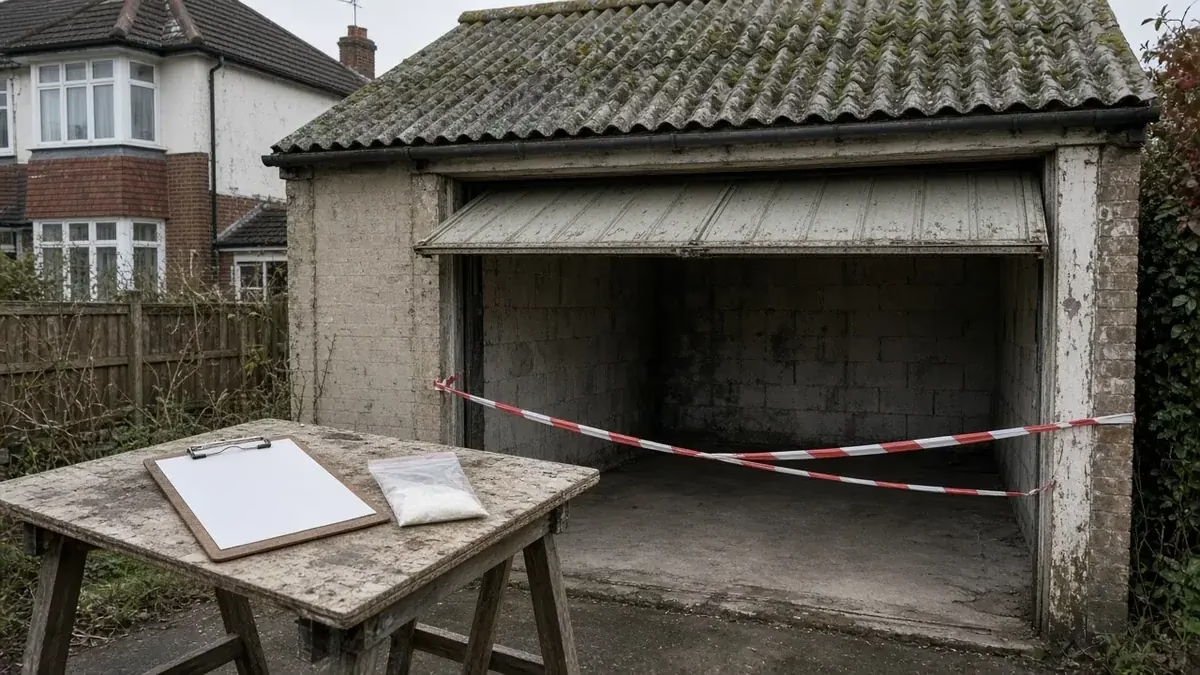
You’ve measured up the garage, pictured the home office or guest bedroom, and then you look up: a grey, corrugated roof that’s been there for decades. If you’re wondering whether it’s asbestos and what that means for a garage conversion, you’re asking the right question at the right time, before anyone starts drilling, cutting or stripping.
This guide explains how to approach a suspected asbestos garage roof when you’re planning a conversion in London: what to check, who should do what, and how it affects your scope and programme. It isn’t a DIY removal guide, and it doesn’t replace a proper survey.
Why garage roofs are a common place to find asbestos
Asbestos was widely used in buildings and homes until it was banned in the UK in 1999, according to the Health and Safety Executive (HSE). One of the most common forms is asbestos cement: ordinary cement mixed with asbestos fibres and pressed into products such as profiled roof sheets, wall cladding, gutters and downpipes. HSE describes it as a hard, grey material, and lists cement roofs among the typical places it turns up (HSE: locations of asbestos).
That’s why so many older detached and semi-detached garages, including plenty of post-war garages across outer London, have the classic grey corrugated roof. But appearance alone doesn’t confirm anything. Some sheets are non-asbestos fibre cement, and the only reliable answer comes from sampling and laboratory analysis.
Why a conversion changes the picture
Many councils’ guidance says asbestos cement in good condition can usually be left alone if it isn’t going to be disturbed. Bromley Council’s guidance note, for example, says not to remove it if it’s in good or fair condition and there are no plans to disturb it (Bromley asbestos guidance note).
A conversion is exactly the kind of plan that does disturb it. Turning a garage into a habitable room means meeting building regulations, including insulation, ventilation and weathertightness. In practice the roof is usually either replaced or substantially reworked, and services, fixings and new openings often go through or near it. So the question is rarely “can I leave it?” and much more often “how is it going to be dealt with safely, and by whom?”
What to check before you finalise the conversion scope
1. Get the material identified, not guessed
Ask for samples to be taken and analysed by a competent asbestos surveyor or analyst. HSE’s survey guidance (HSG264) describes a refurbishment and demolition survey as the type used before work that will disturb the fabric of a building. For a garage conversion that’s the relevant type, because the aim is to find what the works will actually touch.
2. Look beyond the roof sheets
The roof is the obvious suspect, but ask the surveyor to look at the whole garage: soffits and undercloaks, gutters and downpipes, any internal wall or ceiling linings, old flue pipes, and floor tiles if there’s a floor finish. This matters because HSE’s task sheet on removing asbestos cement sheets says it isn’t appropriate where other asbestos materials, such as insulating board or lagging, are present (HSE asbestos essentials sheet a14).
3. Record the condition
Weathered, cracked or broken sheets change the risk and the method. HSE notes that badly damaged asbestos cement may, in exceptional cases, need a risk assessment to decide whether a licensed contractor is required (HSE).
4. Put the findings into the quotes
Once you know what’s there, every builder can quote on the same basis. A conversion quote that simply says “remove roof” without mentioning asbestos isn’t a like-for-like comparison with one that includes proper removal, wrapping and disposal.
Licensed or non-licensed: what HSE actually says
This is where a lot of online advice goes wrong in both directions. HSE says most work on asbestos cement can be carried out without a licence, provided the workers have had appropriate information, instruction and training (HSE FAQs). Its guidance on non-licensed work lists the removal of asbestos cement products, such as roof sheeting and rainwater goods, where the material is carefully removed without breaking it up (HSE: non-licensed work).
That doesn’t mean “anyone can do it”. The same guidance and task sheets make clear that:
- a risk assessment must be carried out before any work on asbestos begins;
- the work should be done by people trained to recognise and work safely with asbestos;
- if the sheets start to break up and create significant dust, the job becomes notifiable non-licensed work;
- other asbestos materials found nearby may need an HSE-licensed contractor.
So the honest answer to “do I need a licensed contractor?” is: it depends on the material, its condition and the method, and the survey and risk assessment decide it, not a forum thread.
How it affects the order of works
On a conversion, the asbestos element normally comes first, before strip-out, before new openings are formed and before electricians or plumbers start chasing in. A sensible sequence looks like this:
- Survey and sample analysis.
- Agree the removal method and who carries it out, in line with the survey and HSE guidance.
- Remove and wrap the material, and have it taken away to an appropriate disposal route.
- Only then start the conversion works: new roof structure or covering, insulation, openings, services.
Disposal deserves its own line in your plan. Asbestos waste needs the correct route. Some London boroughs offer household arrangements: Bromley’s note, for example, describes a depot drop-off and a collection option. Check your own borough’s current rules, because arrangements and charges vary and change. When a contractor removes it as part of a job, ask how and where it will be disposed of.
Questions to ask any builder quoting your garage conversion
- Have you allowed for an asbestos survey, or do you want me to commission one first?
- If asbestos is confirmed, who removes it, and what training do they have?
- Is the removal method one that keeps the sheets intact?
- How will the waste be wrapped, transported and disposed of?
- What happens to the programme and price if the survey finds more than the roof?
Clear answers to these are a good sign. Vague ones, or “we’ll just take it off”, are a warning sign however low the price.
What not to do
- Don’t drill, cut, sand, jet-wash or break the sheets to “have a look”.
- Don’t use power tools on suspected asbestos cement.
- Don’t put broken pieces in a general skip or household bin.
- Don’t assume a newer-looking garage is clear. Only analysis confirms it.
If you’ve already disturbed something you think may contain asbestos, stop, keep people away, and get advice before carrying on. HSE’s guidance for anyone who finds suspected asbestos during work is to stop, confirm what it is (or assume it is asbestos) and assess the risk.
Where this fits in the wider garage conversion process
Asbestos is one item in a longer list of things to check early. If you’re still at the planning stage, these guides help you build the full picture:
- Garage conversion building regulations: the 2026 compliance checklist
- Garage conversion building regs made simple: inspections, insulation and headroom
- Garage conversion condensation: how to stop damp ruining your new room
- The hidden costs of home renovations
Frequently asked questions
Can I convert a garage with an asbestos roof?
Yes, a suspected or confirmed asbestos cement roof doesn’t stop a conversion. It means the material has to be identified and dealt with safely, in line with HSE guidance, before the works that would disturb it.
Is a grey corrugated garage roof always asbestos?
No. Many are, especially on older garages, but non-asbestos fibre cement looks similar. Sampling and laboratory analysis is the only reliable way to know.
Does asbestos cement removal always need a licensed contractor?
Not always. HSE says most work on asbestos cement can be done without a licence by suitably trained workers, but the risk assessment, the condition of the material and any other asbestos materials present decide what’s required.
Should I get the survey before or after I get quotes?
Ideally before, or at least before you sign a contract, so every quote covers the same scope and there are no surprises once work starts.
Planning a garage conversion in London?
We’ll look at your garage with you, including the roof, and explain what needs checking before the conversion is priced, so the scope is clear from day one. See our garage conversion service in London, request a project review, or call us on 020 7971 1318.
This article is general information, not a substitute for an asbestos survey or professional advice on your property. Sources were checked on 7 November 2026.