
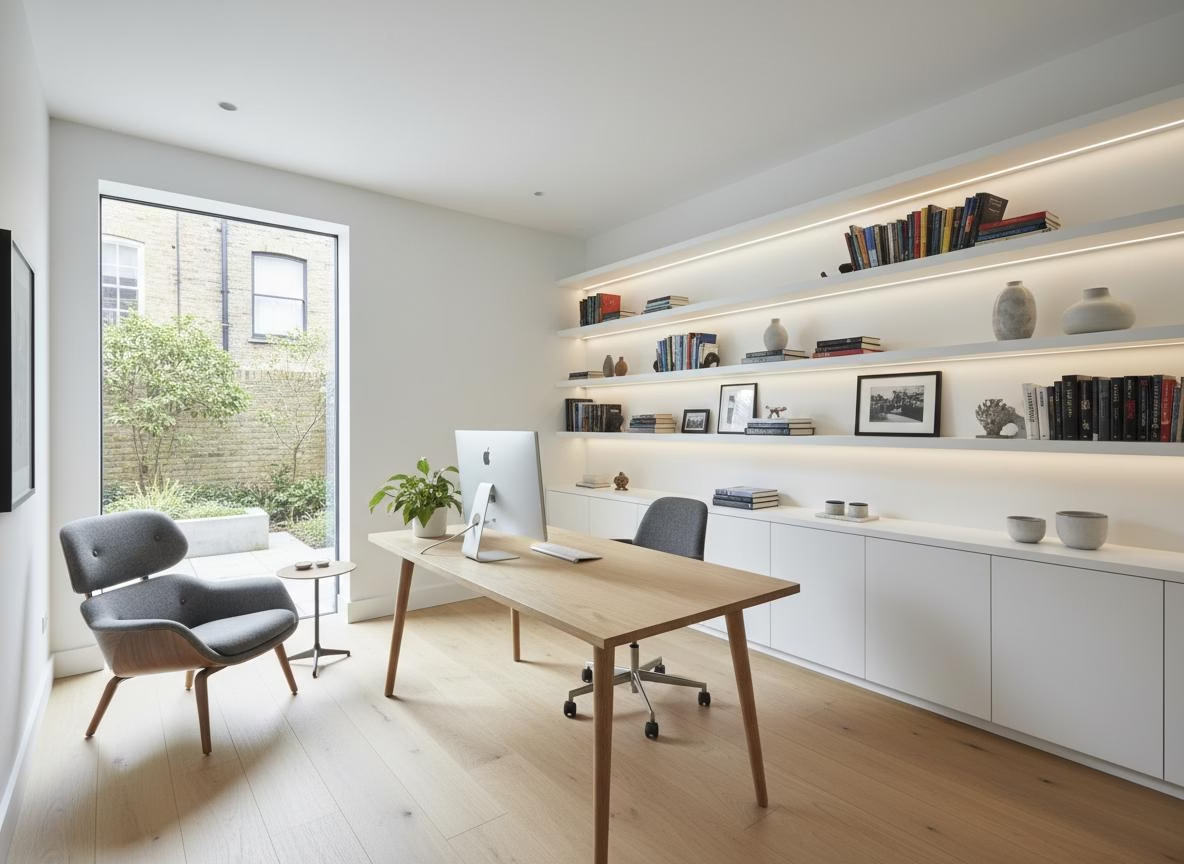
It is one of the first questions homeowners ask before converting a garage: “If I turn my garage into a room, will my council tax go up?” It is a sensible worry — you are adding usable living space, so it feels like the tax should follow. The good news is that the reality is more reassuring than most people expect, but there are a couple of important exceptions worth understanding before you start.
This guide explains exactly how council tax banding works with a garage conversion, when your band can and cannot change, the one scenario that genuinely does trigger a new band, and how to plan your conversion so there are no surprises.
How council tax bands actually work
In England, every home sits in a council tax band (A to H) based on what the property was worth on 1 April 1991 — not today’s value. In Wales the reference date is 2003, and Scotland uses 1991 like England. Your band is set by the Valuation Office Agency (VOA), an independent government body, not by your local council.
Because the valuation is anchored to a historic date, simply improving your home does not automatically bump you into a higher band while you continue to live there. This is the key fact that puts most homeowners’ minds at rest.
Will converting your garage raise your council tax now?
In the vast majority of cases, no — not while you own the property. Converting an attached or integral garage into a bedroom, home office, playroom or living room is an internal improvement. The VOA does not send someone round to re-band your house the moment you finish the work, and your monthly council tax will not suddenly jump because you gained a room.
So you can convert your garage, enjoy the extra space, and carry on paying the same band you always have. For the huge majority of homeowners, that is where the story ends.
The one scenario that does trigger a new band: when you sell
Here is the nuance most people miss. When you make a “qualifying improvement” such as a garage conversion or extension, the VOA records an improvement indicator against your property. Nothing changes for you — but when the property is next sold, the VOA can review the band and potentially move it up one, based on the added space and value.
In other words, the person who benefits from the extra room (you) does not pay more; the band is only reassessed at the point of sale, and it is the next owner who would inherit any higher band. It is worth being aware of because a higher band can be a minor consideration for buyers — though in practice the value a good conversion adds far outweighs a single band step. A well-executed garage conversion can add significant value to a North London home, which is the number that really moves the needle at sale.
The real exception: creating a self-contained annexe
There is one situation where a garage conversion can be given its own council tax band straight away: if you turn it into a self-contained annexe — a unit with its own kitchen, bathroom and, typically, separate access, capable of independent living. The VOA may treat that as a separate dwelling with its own band.
Before you worry, note two things. First, this only applies to genuinely self-contained accommodation, not an ordinary bedroom or office that shares the main house. Second, annexes often qualify for a 50% council tax discount when occupied by a relative or used as part of the main home, and annexes occupied by a dependent elderly or disabled relative can be exempt entirely. If an annexe is your goal, factor this in at the design stage rather than discovering it afterwards — and check with your local council on the reliefs available.
Don’t forget planning permission and building regs
Council tax is only one piece of the paperwork. Two others matter more day-to-day:
- Planning permission. Most garage conversions are permitted development and do not need a full planning application — provided the work is internal and you are not extending the footprint. Homes in conservation areas or under an Article 4 direction can be different, so always check first.
- Building Regulations. These are separate from planning and always apply. Your conversion must meet standards for insulation, fire safety, ventilation and structure, and you will need a completion certificate. That certificate is essential when you sell — buyers and lenders will ask for it.
Getting these right protects both the value of your conversion and your ability to sell smoothly later. It is exactly the kind of detail a professional builder handles for you.
How Fixiz helps you convert with confidence
At Fixiz we manage garage conversions across North London from first survey to final sign-off — including all Building Regulations applications and inspections, so your new room is fully certified. We give you a transparent, fixed-price quote after a free site survey, and honest advice on whether an ordinary conversion or a self-contained annexe best suits your plans and budget. If you are weighing up the numbers, including any council tax implications at sale, get in touch with Fixiz today for a no-pressure chat and a free quote.
FAQ — garage conversions and council tax
Will my council tax go up as soon as I convert my garage?
No. A standard garage conversion is an internal improvement and will not change your band while you own and live in the property. Your council tax stays the same.
When can a garage conversion change the council tax band?
The VOA records an improvement indicator and can review the band when the property is next sold. Any increase would apply to the new owner, not to you during your ownership.
Does converting my garage into an annexe change things?
Yes — a genuinely self-contained annexe with its own kitchen, bathroom and access can be given its own council tax band as a separate dwelling, though discounts or exemptions often apply for family annexes.
Do I need planning permission for a garage conversion?
Most are permitted development if the work is internal and within the existing footprint, but conservation areas and Article 4 directions can require an application. Always check before you start.
Do I need Building Regulations approval?
Yes, always. Building Regs cover insulation, fire safety, ventilation and structure, and you will need a completion certificate — which buyers and lenders require when you sell.
Does a garage conversion add value even if the band rises at sale?
Generally yes. A quality conversion typically adds far more value than the cost of a single band step, making it a strong return on investment for most North London homes.