Physical address:
128 City Road, EC1V 2NX, London,UK

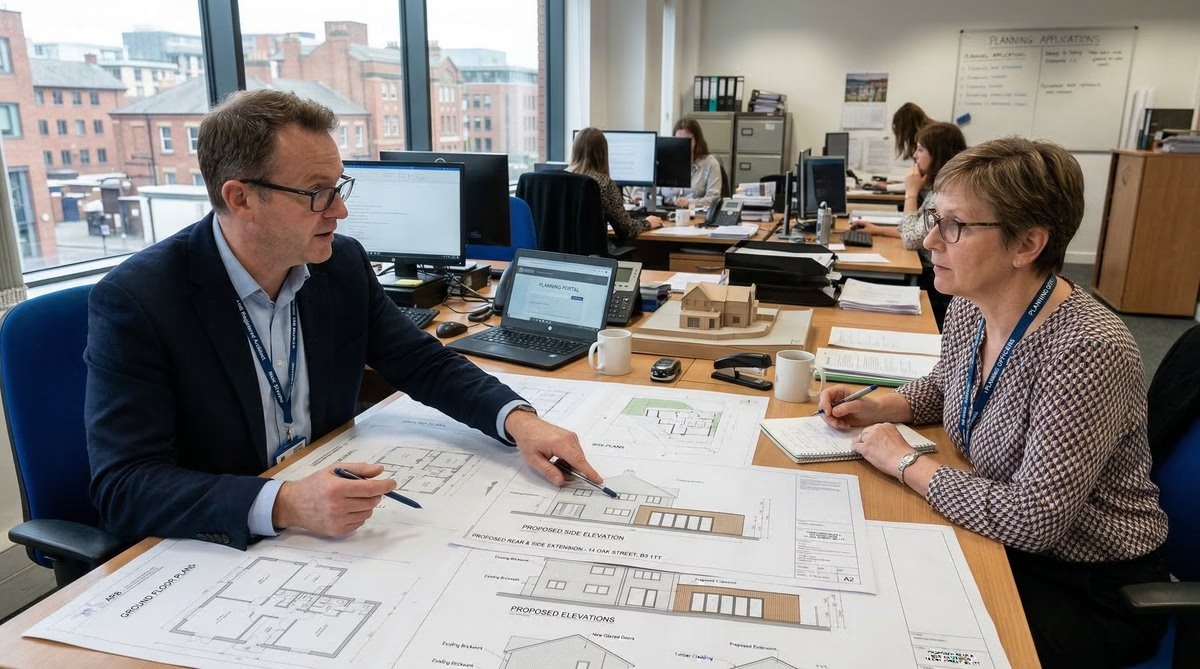
Getting a planning application refused is one of the most demoralising experiences a homeowner or developer can face — weeks of preparation, council fees paid, and then a decision notice lands telling you your project cannot go ahead. If your planning application refused UK story sounds familiar, you are far from alone. Nationally, around one in five householder applications is turned down at the first attempt, and many more are withdrawn when applicants realise the scheme is heading the wrong way. At Fixiz, we work with homeowners and small developers every week who come to us after a refusal, and in most cases the same handful of issues keep coming up. This guide walks through the most common reasons councils say no — and, more importantly, exactly what you can do to avoid them from the outset.
Why Planning Applications Get Refused — The Most Common Reasons
Planning officers are not looking for reasons to refuse. They are working through a checklist of material considerations set out in national planning policy (the National Planning Policy Framework, or NPPF) and your council’s own local plan. When a scheme fails, it almost always fails against one or more of those criteria. Understanding the criteria before you draw a single line is half the battle.
- Overshadowing and loss of light: Councils apply what is known as the 45-degree rule — a line drawn from the nearest window of an affected neighbour at 45 degrees in plan and elevation. If your proposed extension or new build breaks that line, the officer will likely conclude that the development causes unacceptable loss of daylight or sunlight to habitable rooms next door. This is probably the single most common reason residential extensions are refused.
- Out of character with the streetscape: Every local planning authority has policies requiring new development to be “in keeping” with the prevailing character of the area. That does not mean everything must look identical — but scale, massing, materials, roof pitch, and window proportions all need to sit comfortably alongside the existing street scene. A flat-roofed rear extension on a street of Victorian pitched-roof terraces, or an oversized dormer that dominates a roofline, will routinely attract a refusal on character grounds.
- Overbearing or dominant impact: Separate from character, overbearing impact looks at whether the proposal will loom over and dominate a neighbouring property or its garden. A two-storey side extension running the full depth of the house right up to the boundary, for instance, can create what officers describe as a “terracing effect” that is overbearing to the neighbour — even if it technically clears the 45-degree line.
- Loss of privacy through overlooking: First-floor rear extensions or raised terraces that introduce new windows or platforms with direct lines of sight into a neighbour’s garden or windows will be assessed for overlooking. Councils typically look for a minimum of 21 metres between directly facing habitable room windows in most suburban contexts. Anything less — or any new window positioned to look directly into an existing neighbour’s private amenity space — risks refusal.
- Insufficient parking provision: This catches many applicants off guard, particularly when a conversion or extension involves the loss of an existing garage or driveway. Local plans set out minimum parking standards, and if your proposal reduces on-plot parking below those standards — or creates a dwelling in an area where the council demands a certain number of spaces — it will likely be refused on highway grounds.
- Exceeding plot coverage: Most local plans specify a maximum proportion of the plot that can be covered by built structures — often around 50% in suburban residential areas, though it varies significantly by authority. Schemes that push plot coverage beyond policy thresholds, or that leave inadequate private amenity space, will fail even if every other criterion is met.
We reviewed a batch of refused householder applications last year as part of a training exercise, and without exception every single one had at least one of these six issues as the stated reason. In most cases, a modest redesign — pulling the scheme back by half a metre, repositioning a window — would have secured approval.
Design and Access Statements — Your Argument on Paper
A Design and Access Statement (DAS) is a document submitted alongside your planning application that explains the design thinking behind your proposal. For larger schemes it is mandatory, but even where it is not required we strongly recommend including one — because it is your opportunity to make the officer’s job easy.
A well-written DAS does several things at once. It demonstrates that you have studied the local character and explains how the proposed materials, scale, and form respond to the surrounding buildings. It sets out the access arrangements and shows how the scheme respects the needs of all users. And it pre-empts the most likely objections by addressing them head-on — explaining, for example, why the proposed ridge height is consistent with neighbouring extensions, or how the window positioning preserves the privacy of the adjacent property.
Tip: Do not treat a Design and Access Statement as a box-ticking exercise. Officers read dozens of applications a week. A DAS that reads like it was written in five minutes — or worse, copied from a template with the address swapped out — will do nothing to help your case. A genuinely considered statement that shows you understand the site, the street, and the policy context makes a measurable difference to how an officer approaches your application.
In our experience, the best statements are structured simply: a brief description of the site and its context, an explanation of why the design looks the way it does, a note on materials and how they relate to the surroundings, and a short section on how the scheme meets the relevant local plan policies. That structure alone puts your application in the top tier of what most councils receive from individual homeowners.
Pre-Application Advice — Is It Worth the Fee?
Most councils offer a formal pre-application advice service: you submit outline proposals and receive written feedback from a planning officer before lodging a formal application. Fees vary — a householder scheme might cost anywhere from £50 to £400 depending on the authority. So is it worth it? Our honest answer: yes, in most cases, particularly for anything more complex than a straightforward single-storey rear extension. Here is why.
- Early steer on principle: Pre-application advice will often tell you whether the principle of what you want to do is acceptable, saving you from spending money on full drawings for a scheme the council will never approve.
- Specific policy flags: Officers will flag the exact policies your proposal needs to address, allowing you to refine the design before you are committed.
- Named officer contact: Having a pre-application reference and a named officer who has seen your scheme in advance gives your formal application continuity — the officer knows the site and the evolution of the design.
- Reduced risk of refusal: Studies by the Planning Advisory Service have consistently shown that applications preceded by pre-application engagement have materially higher approval rates than cold submissions.
The one scenario where pre-application advice adds less value is a straightforward application that clearly complies with all local policies — a modest single-storey extension put through full planning for mortgage purposes, for example. In that case, the fee is hard to justify.
Tip: Even if you decide against formal pre-application advice, most councils allow you to telephone or email the duty planning officer for a brief informal conversation. That five-minute call can sometimes surface a critical policy issue you were not aware of — at no cost at all.
How to Read Your Council’s Local Plan
Every planning decision in England is made against the local plan — the suite of policies adopted by your local authority that sets out what development is acceptable, where, and in what form. Most homeowners never look at their local plan, and that is a significant disadvantage. Finding it is straightforward: go to your council’s website, search for “local plan” or “development plan,” and download the most recently adopted version. For a residential project, focus on the following chapters:
- Residential extensions and alterations policy: Most local plans have a specific policy on householder development setting out the criteria for height, massing, character, privacy, and amenity space. This is the policy your application will primarily be assessed against.
- Design policy: Look for the authority’s general design policies, which will tell you what they mean by “in keeping,” how they assess character, and whether they reference any supplementary planning documents (SPDs) on design that carry additional weight.
- Parking standards: Usually set out either in the local plan itself or in a transport supplementary document — these tell you the minimum number of spaces required for different types of development.
- Character area assessments: Some councils publish separate character assessments or design codes for specific neighbourhoods. If your area has one, it will be invaluable — it tells you exactly what materials, proportions, and styles the council considers appropriate for your street.
We always read the local plan for every project before we pick up a pencil. It sounds obvious, but you would be surprised how many applications are submitted by designers who have not looked at the relevant policies — and it shows in the outcome.
Dealing with a Refusal — What Happens Next
If your application is refused, the decision notice is your first port of call. It will set out the precise reasons for refusal, referencing the specific policies engaged and explaining, often in some detail, exactly what the officer found unacceptable. Read it carefully, because it is essentially a roadmap for what a successful revised scheme needs to address.
Amending and resubmitting
In England, you can submit one free revised householder application within 12 months of a refusal. This is almost always the right first move if the reasons are design-based and addressable. Pull the extension back, reposition the window, change the materials — whatever the decision notice identifies — and resubmit with a cover letter explaining how each reason for refusal has been addressed. Most officers will look at revised drawings informally before you commit to a formal resubmission.
Appealing the decision
If you believe the decision misapplied policy, you can appeal to the Planning Inspectorate within six months. Appeals are free to lodge but take six to nine months on average, and the majority are dismissed. Get an honest assessment from a planning professional before committing — appealing a well-grounded refusal is an expensive way to lose six months.
Tip: One thing many homeowners do not realise is that an appeal can only be decided on the application as submitted — you cannot introduce a revised scheme through an appeal. If the fix is simple, resubmit rather than appeal.
How an Experienced Architect or Designer Dramatically Improves Your Chances
The Planning Portal’s own data shows that applications submitted by agents — architects, planning consultants, or architectural technologists — have significantly higher approval rates than those submitted directly by homeowners. This is because a good designer will have done the homework before the application is lodged, not because councils favour professional submissions.
An experienced residential architect or designer will know your council’s local plan and precedents, will design around the 45-degree rule from the outset, will position windows to preserve privacy, and will present the scheme in drawings that make the officer’s assessment straightforward. They will also prepare a Design and Access Statement that actually makes your case rather than simply describing the proposal.
Beyond the drawings, a professional who works regularly in your local authority area will know which pre-application service is worth using and will have accumulated knowledge of which designs have been approved and refused on streets like yours — something genuinely hard to replicate without years of practice. We have seen clients come to us after spending thousands of pounds on a refusal — council fees, abortive drawing costs, months of delay — when a modest upfront investment in professional advice would have got the project through first time.
Frequently Asked Questions
How long does a planning appeal take in England?
Most householder planning appeals are handled by written representations and take between six and nine months to determine. Hearings and inquiries take longer. Given this timeline, it is worth exhausting the option of amending and resubmitting before lodging an appeal unless there is a compelling policy reason to do so.
Can I resubmit a planning application for free after a refusal?
Yes — in England, householder applications (works to an existing dwelling) attract one free resubmission within 12 months of the original decision, provided the revised application relates to the same site and development type. This right does not apply to new-build or change-of-use applications.
Does the local plan always override what my neighbours want?
Planning decisions are made against policy, not the wishes of individual neighbours. Objections are a material consideration but carry no automatic veto. If a scheme complies with all relevant local plan policies, an officer is unlikely to refuse it on the basis of objections alone — though a large number of objections may prompt more careful scrutiny.
What is the 45-degree rule and how strictly is it applied?
The 45-degree rule is a commonly used assessment tool that draws a line at 45 degrees in both plan and elevation from the nearest habitable room window of an affected neighbour. If a proposed extension crosses that line, it is likely to cause an unacceptable reduction in daylight or sunlight to that room. It is a guideline rather than an absolute rule — some councils apply it more strictly than others, and a well-argued Design and Access Statement can sometimes demonstrate that the impact is acceptable despite technically crossing the line — but in most authorities it is treated as a firm starting point.
Is pre-application advice confidential?
Yes — pre-application advice is confidential and not published on the planning register. It is also not binding: the officer’s view cannot commit the council to a formal decision. That said, it is unusual for a formal decision to contradict pre-application advice without good reason, and a written response on file is a useful reference point throughout the project.
How do I find out what my local plan says about extensions?
Go to your council’s website and search for “local plan” or “development management policies.” Download the relevant document — usually the most recently adopted version — and look for the section on householder development or residential extensions. Many councils also publish supplementary planning documents (SPDs) on residential design or extensions specifically, which give more detailed guidance on things like materials, scale, and proportions. These SPDs carry significant weight in decision-making and are well worth reading before you start designing.
Ready to move from confusion to construction? Get in touch with Fixiz today for a no-pressure chat about your project and the fastest route to full compliance.