
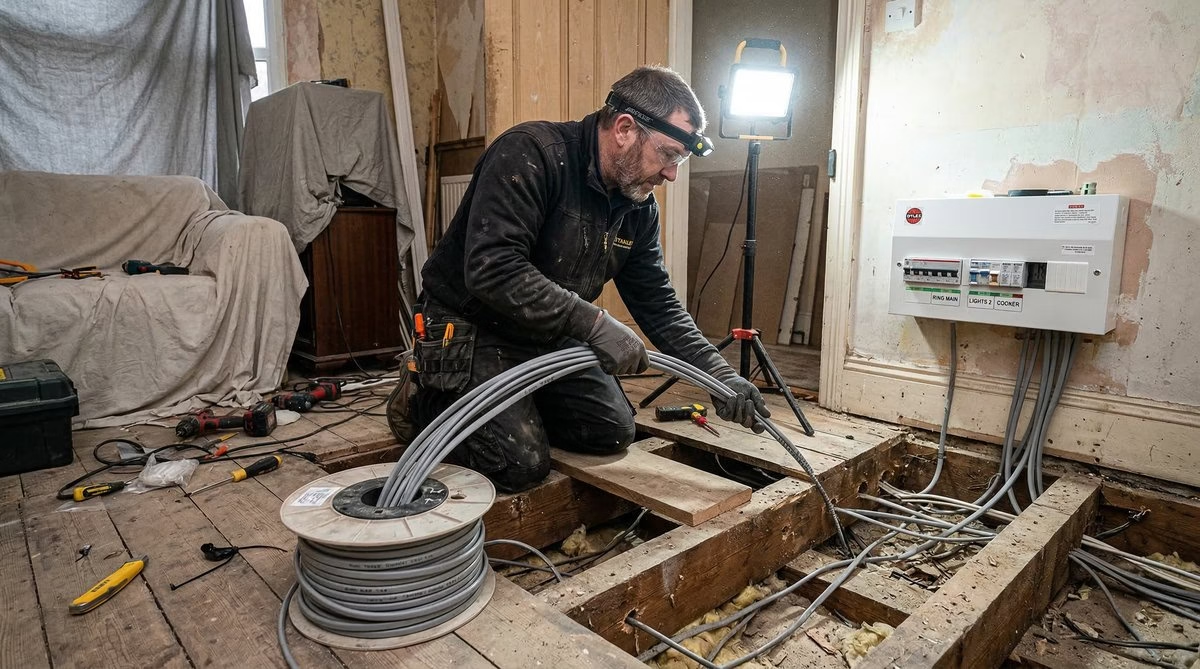
If you have ever typed “full house rewire cost UK” into a search engine, you already know how wide the price ranges are and how thin the practical detail is. One website quotes £3,000; another quotes £15,000; and almost none of them explain why the difference exists, what is actually included, or how on earth you live in the house while the walls are being chased out. At Fixiz, we carry out full rewires across London and the South East, and in this guide we want to give you a genuinely useful account of what the job involves, what it should cost, and how to get through the disruption without losing your mind.
What “rewire to modern specification” actually means
A full house rewire is not simply pulling out old cable and pushing in new cable along the same routes. Done properly, a modern rewire means bringing the entire installation into compliance with the current edition of the IET Wiring Regulations — BS 7671:2018 including Amendment 2 — which is a substantially more demanding standard than the regulations governing most installations built before 2000.
In practical terms, a compliant modern rewire covers the following.
- New cables throughout: All existing wiring is replaced with modern twin-and-earth cable, run in new routes where necessary. On upper floors this means lifting floorboards to run cable between joists; on solid walls it means either chasing channels into plaster or running surface-mounted conduit.
- Minimum socket counts per room: The IET Wiring Regulations and guidance published by Electrical Safety First specify minimum twin socket-outlet counts by room type. A main living area up to 12 m² needs at least four twin sockets; a medium living area (12–25 m²) needs six; a kitchen needs a minimum of six twin sockets with outlets no more than one metre apart along worktops. Single bedrooms need two to three depending on room size. We routinely install above these minimums, particularly in kitchens and living rooms.
- New consumer unit with RCBOs: The old fuse box is replaced with a modern consumer unit — ideally fully RCBO-protected, so a fault on one circuit does not knock out half the house. Surge protection devices (SPDs) are also required under Amendment 2 for most new installations.
- Earthing and main bonding: Main protective bonding conductors are installed to gas and water pipes at the point of entry. Many older properties have no functional earthing — a fact that is invisible but genuinely dangerous.
- Smoke and heat detectors: Building Regulations require interlinked mains-powered smoke alarms on each floor and a heat alarm in the kitchen, all wired as part of the rewire.
We recently rewired a 1970s mid-terrace in Catford where the original installation had no earth conductor at all — it relied entirely on metallic conduit that had corroded at multiple joints. The homeowner had no idea. A modern compliant rewire resolved all of that in a single project.
Realistic UK cost ranges for different property sizes
The ranges below are based on our own pricing across South London, cross-referenced with current industry data and recent discussions among working electricians. All figures are before VAT and before any plastering, redecoration, or floor reinstatement.
- 2-bedroom flat or maisonette — £3,000 to £5,000: Fewer circuits and lower labour time keep costs down. The upper end applies to flats with solid concrete floors requiring surface conduit, older fabric making access difficult, or a higher socket count specification.
- 3-bedroom semi-detached house — £5,000 to £8,000: The most common job we carry out. The lower end assumes straightforward suspended timber floors and a standard specification. The higher end reflects occupied properties (where work must be phased to leave the property safe each night), solid walls requiring plaster chasing, or a larger socket count. Working electricians on Reddit consistently cite £5,000 to £7,000 for a vacant 3-bed and £6,000 to £9,000 for an occupied one.
- 4-bedroom detached house — £8,000 to £12,000+: More floors mean more cable runs; larger kitchens may need dedicated circuits for range cookers or induction hobs; garages, outbuildings, and EV chargers each add a circuit. As one electrician noted in a Reddit discussion about a 4-bed rewire: “A full re-wire to a detached 4 bed in the North should be around £8–10k. I do this on a daily basis for a living.” In London and the South East, add 15–25% to those figures for regional labour rates.
- Bungalow (2–3 bedrooms) — £4,000 to £7,000: No upper floors to lift boards on, but solid or concrete floors often make routing harder. The same Reddit thread discussed costs of £8,000–£10,000 for a larger or more complex bungalow with difficult access.
Tip: Always clarify with your electrician whether their quote includes making good after chasing, plastering, and floor reinstatement — these are frequently priced separately and can add £1,000–£3,000 to the total project cost.
What drives the price differences
Understanding the cost variables helps you compare quotes intelligently.
- Number of circuits: A basic 3-bed house might need 12–14 circuits. A 4-bed with a garage, EV charger, and home office could easily reach 20 or more. Each additional circuit adds material cost and a way-position to the consumer unit.
- Number of floors: Each additional floor adds cable runs and the labour cost of lifting boards or chasing walls to route cable between levels.
- Occupied versus empty: Working in an occupied property adds days to the programme because the electrician must make the installation safe each evening, work around furniture, and phase the job to maintain access to key rooms.
- Chasing plaster versus surface mounting: In properties with solid walls, cable is either chased into plaster (neater but slower and requiring a plasterer to make good) or run in surface-mounted conduit (quicker and cheaper but visually prominent).
- Regional labour rates: As noted in West Yorkshire Electrical’s cost guide, electrician rates in the North of England are typically lower than in London and the South East — the same job will generally cost 15–25% more in the capital.
In our experience across South London, the single biggest driver of unexpectedly high quotes is the discovery of solid walls throughout a property. Chasing channels for cable into solid brick or block is significantly slower and more disruptive than running cable under suspended floorboards, and it directly increases both labour time and the follow-on plastering cost.
The disruption factor — what actually happens during a rewire
This is the section most cost guides skip, and it is often the part that catches homeowners most off-guard. For an average UK home, a full rewire takes between 5 and 10 working days. During that period, expect the following.
- Lifted floorboards: On upper floors with suspended timber construction, boards will be lifted in every room to run cable between joists. Boards are generally relaid as work proceeds, but you will be walking on exposed joists at times.
- Chased walls: Visible channels will remain open in walls until a plasterer follows on. Book your plasterer before the rewire starts — not after.
- Dust: Cutting channels and lifting boards generates significant dust. Move or cover anything you value before work begins.
- No power for periods: The supply will be isolated at various points. In an occupied property, a professional electrician will restore a working supply each evening, but expect several hours without power during the day.
- How to phase it: Work zone by zone — ground floor first while you live upstairs, then upper floors. Identify non-negotiable circuits (fridge-freezer, boiler, one bathroom) before work starts and plan those to be done first or kept live until last.
We recently helped a family in Lewisham stay in their 3-bedroom Victorian terrace throughout a full rewire. We phased the work floor by floor and restored a full working supply — including the kitchen — each evening. It added two days to the programme compared with an empty property, but avoided the cost of temporary accommodation entirely.
How to coordinate a rewire with other trades
If a rewire is part of a wider renovation, sequencing is critical. Getting it wrong costs real money.
- Rewire before plastering: All chasing, first-fix wiring, and inspections must be complete before any new plaster goes on. Plastering over uncertified first-fix work means the plaster has to come back off for the inspection.
- Rewire before kitchen and bathroom fit-out: Socket positions in a kitchen are determined by worktop layout. If units go in before sockets are positioned, you end up with outlets in the wrong place or hidden behind cabinets.
- Rewire before floor finishes: New screed, engineered timber, or tiles should go down after the rewire, not before — cable runs can be damaged by floor-laying operations if the sequence is reversed.
Tip: Ask your electrician for a clear description of what “first fix” and “second fix” mean for your project, and build those two stages into your overall programme before booking any other trade.
Signs your property needs a full rewire
- Rubber or cloth-insulated cables: Pre-1960s rubber-insulated or fabric-braided wiring degrades and becomes brittle. Discovery of these cable types means a full rewire is required — partial replacement is not adequate.
- Old rewirable fuse wire board: A board with rewirable wire fuses has no RCD protection and no consistent overcurrent protection. This is not a board that can simply be supplemented — the whole installation behind it needs updating.
- No earthing or incomplete earthing: Properties with older wiring may have no earth conductor, or earthing that relies on corroded metallic conduit. An earth continuity test by a qualified electrician will confirm this.
- Too few sockets: A property wired in the 1970s or 1980s will have far fewer sockets than current recommendations. Where the underlying wiring is also old, it is almost always more cost-effective to rewire the whole property at once rather than add circuits piecemeal.
- Round-pin sockets or five-amp round-pin lighting circuits: These are unambiguous indicators of very old wiring well beyond its serviceable life.
In our experience, properties built before 1970 that have never been rewired almost always need a full rewire rather than selective replacement. The cost of doing it properly the first time is always lower than the cost of repeated partial interventions followed eventually by a full rewire anyway.
Certificates you must receive — and why they matter
A full house rewire is notifiable work under Part P of the Building Regulations. On completion, you must receive two documents.
- Electrical Installation Certificate (EIC): The primary certificate for new installation work. It confirms the installation has been designed, constructed, inspected, and tested in accordance with BS 7671, and includes a Schedule of Inspections and a Schedule of Test Results. Per RCD Electrical, without this certificate you have no proof the installation is safe or compliant. An EICR (condition report) is for existing installations — it is not a substitute for an EIC on new work.
- Building Regulations compliance notification: The installer must either notify the local authority building control directly, or be registered with a competent person scheme (NICEIC, NAPIT, ELECSA) and self-certify the work. In the latter case, you receive a certificate from the scheme provider confirming notification. You will need both documents when you sell the property.
Tip: Store digital copies of all electrical certificates alongside your property deeds. Keep paper originals in a fire-safe location.
How Fixiz handles full rewires across South London
We carry out full rewires as a coordinated, managed service — not just an electrical trade in isolation. We assess the property before quoting, agree a phasing plan that works around your occupancy, coordinate with your plasterer, and produce all required certification on completion. We are registered with a Government-approved competent person scheme, which means we self-certify and notify building control on your behalf.
We recently completed a rewire on a 1930s 4-bedroom detached in Bromley — solid walls throughout, property occupied, kitchen renovation running in parallel. We coordinated the electrical first fix with the kitchen fitter’s programme so that back-box positions and socket layouts were confirmed before units were ordered. The project ran to programme, and the homeowner had certified compliant electrics, a new kitchen, and fresh plaster all signed off within three weeks.
Our quotes are itemised: you can see how many circuits, how many socket positions, and what consumer unit specification you are getting. We do not produce one-line quotes that leave room for additions once work has started.
Frequently asked questions
How long does a full house rewire take?
For an average UK home, a full rewire takes between 5 and 10 working days. A 2-bedroom flat in straightforward condition may take 4–5 days when empty. A 3-bedroom semi takes 5–8 days when empty and 8–10 days when occupied. A 4-bedroom detached typically takes 8–12 days depending on access and specification. These figures cover the electrical works only — plastering and redecoration follow on separately.
Do I need to move out during a rewire?
No — but staying in the property increases both the time and cost of the project because the electrician must make the installation safe each evening and phase the work around your routine. For most families, remaining in the property is manageable with good planning, but it requires clear daily communication with the electrician and realistic expectations about dust and disruption.
What is the difference between a full rewire and a consumer unit replacement?
A consumer unit replacement replaces only the distribution board — the existing cables, sockets, and switches throughout the property remain in place. A full rewire replaces all of that wiring from the board to every outlet and fitting. If the underlying cables are old or deteriorated, a consumer unit replacement alone does not make the installation safe.
What happens if my electrician does not notify building control?
If the rewire is not notified under Part P, the work is technically unauthorised. When you sell the property, your solicitor will ask for the electrical certificate and building control notification. If you cannot produce them, you may need a retrospective inspection (which can require opening walls), indemnity insurance, or a price negotiation with your buyer. Avoid this entirely by using a registered electrician from the outset.
Can I phase a rewire over time to spread the cost?
In principle, yes — but in practice, doing a rewire in stages is almost always more expensive overall because mobilisation costs (setting up, making safe, testing, and certifying) are incurred each time. It is usually better to complete the rewire as a single project and finance it if necessary, rather than incur duplicate costs across multiple visits.
Ready to move from confusion to construction? Get in touch with Fixiz today for a no-pressure chat about your project and the fastest route to full compliance.