Physical address:
128 City Road, EC1V 2NX, London,UK

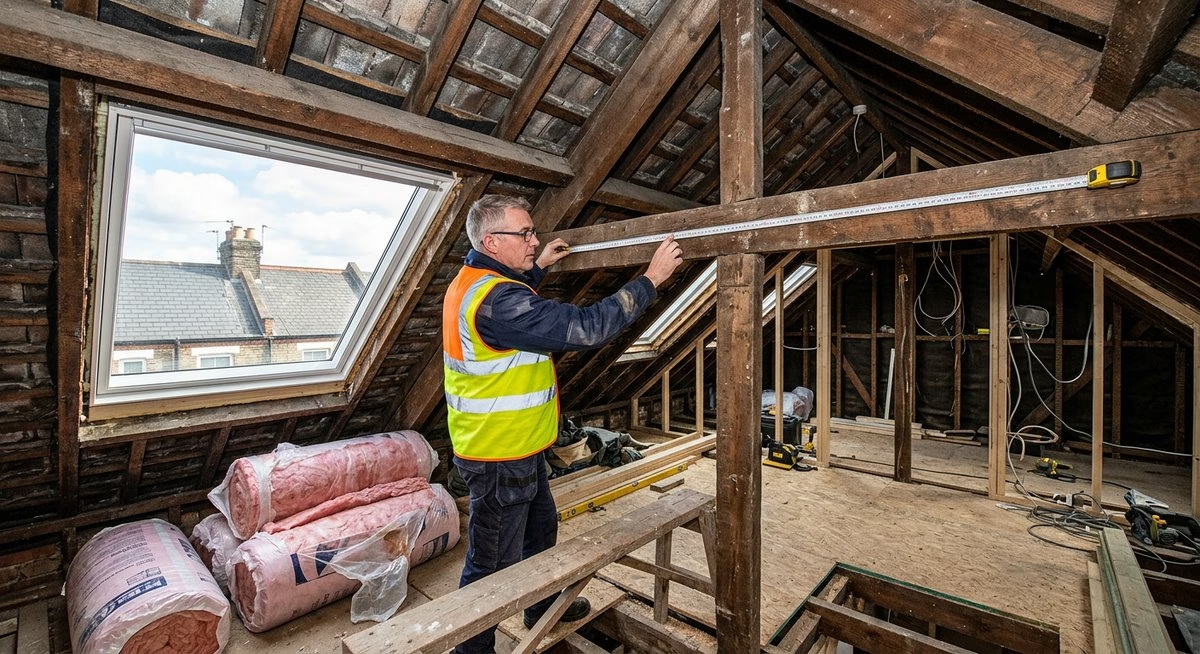
You’re not adding a bedroom — just an office, maybe a home gym. So surely the rules are lighter? This is one of the most common misconceptions we encounter at Fixiz. The truth is that loft conversion building regs UK requirements apply to virtually every conversion that creates usable space — regardless of what you plan to do in that room. Whether you’re setting up a standing desk or a rowing machine, Building Regulations approval is almost certainly required, and skipping the process can leave you with costly rework or a home that’s impossible to sell.
Planning Permission vs Building Regulations — and Why It Matters
Much of the muddle starts because homeowners conflate two entirely separate legal processes. Planning permission controls what you build and where — the external appearance, the size, the impact on neighbours and the streetscape. Many loft conversions fall within permitted development rights, meaning no formal planning application is needed. Building Regulations approval controls how you build — ensuring the finished space is structurally sound, fire-safe, energy-efficient, and healthy to occupy. As the Federation of Master Builders states: “loft conversions always need building regulations approval, irrespective of whether planning permission is required.”
Here’s where the trap lies. You check the permitted development rules, confirm your project fits, and assume you’re in the clear. But permitted development deals only with the planning side. Even a Velux-only conversion with no change to the roofline still requires Building Regulations sign-off the moment it creates a liveable space. We’ve visited projects in south London where homeowners had fully boarded, insulated, and furnished a loft — complete with a fixed staircase — without ever contacting Building Control. The fact that they didn’t need planning permission had convinced them no approvals were needed at all.
The consequences of this confusion can be severe. Without a Building Regulations completion certificate, your property becomes difficult to sell — conveyancers will flag the missing paperwork, and mortgage lenders may refuse to value the loft as usable space. Your home insurer may decline to cover the room. And if Building Control discovers non-compliant work that poses a health-and-safety risk, there is no time limit on enforcement action — they can require you to alter or remove the work at any point.
Tip: If you’re unsure whether your project needs planning permission, apply for a Lawful Development Certificate from your council. It costs around £100–£200 and gives formal written confirmation that your design falls within permitted development. But it does not replace Building Regulations approval.
What Triggers Building Regulations — Even for a Non-Bedroom Loft
The idea that a home office or gym faces lighter requirements is a myth. The Local Authority Building Control (LABC) is blunt: “If it looks like a room — it’s a room.” If your project involves adding a permanently fixed staircase or ladder, installing a floor, or lining walls and rafters, the work is considered a loft conversion and a Building Regulations application is required — irrespective of the proposed use of the room.
Even modest work can trigger the requirement. The Planning Portal notes that laying flooring boards over existing joists for storage may need approval because the original joists were never designed to carry significant load. Go further — add a staircase, board out, line the space — and approval is mandatory.
Here is a practical checklist of work that typically triggers Building Regulations:
- Structural alterations: Removing or modifying purlins, struts, or collar ties counts as a material alteration requiring structural calculations checked by Building Control.
- New or upgraded floor joists: Standard ceiling joists aren’t designed for furniture and people. Converting to a usable floor means new joists sized to carry at least 1.5 kN/m².
- Fixed staircase or ladder: A permanent means of access turns the loft from storage into habitable space in Building Control’s eyes.
- Insulation and energy performance: New walls must achieve a U-value of 0.18 W/m²K. Windows and rooflights must hit 1.4 W/m²K. Boarding over existing loft-floor insulation compresses it and reduces effectiveness.
- Rooflights and dormers: Installing a rooflight is a structural alteration. Dormers add volume and load, triggering both structural and fire-safety rules.
- Fire separation, escape routes, and alarms: Converting a two-storey house into a three-storey dwelling triggers the full suite of fire-safety requirements under Approved Document B.
We recently worked on a project in Lewisham where the homeowner had created a beautifully finished home studio — just a desk, shelving, and acoustic panels. But the floor joists hadn’t been upgraded, no fire doors had been fitted, and there was no protected escape route. Building Control required every one of those items before they would issue a completion certificate. The use of the room made no difference to the requirements.
Fire Safety and Safe Escape — the Rules That Surprise People Most
Fire-safety compliance is where the “it’s only an office” assumption falls apart most dramatically. Adding a usable storey above the first floor creates a three-storey dwelling. Approved Document B treats this differently from a standard two-storey house, and the requirements apply regardless of room function.
The protected escape route: Every occupant must be able to reach a final exit via a route protected from fire for at least 30 minutes. The staircase from loft to ground floor must be enclosed by fire-resisting construction. The Planning Portal confirms that “additional fire protection will be necessary in the existing parts of the house.” Walls, floors, and structural elements along the escape route typically need 12.5 mm fire-rated plasterboard or an equivalent treatment to achieve the required 30-minute resistance.
Fire doors: Every door opening onto the protected stairway — from the loft, bedrooms, and ground-floor hallway — must be upgraded to an FD20 fire door with intumescent strips and smoke seals. This often means six or seven new doors in a typical three-bedroom house, a cost that catches many homeowners off guard.
Smoke alarms: Mains-powered, interlinked alarms must be installed on every level. Battery-only detectors do not satisfy the regulations. If any one alarm triggers, they all sound throughout the property.
Open-plan ground floors: If the staircase descends into an open-plan kitchen-diner, the protected route is broken. The LABC warns this “causes means of escape issues that may require an additional escape route or the provision of sprinklers.” We’ve seen this catch out homeowners who removed a hallway wall years before any loft conversion was planned. Reinstating a partition or fitting a residential sprinkler system can add significant cost if it isn’t anticipated early.
Rooflights as escape: Escape via a window is only acceptable where the floor is no more than 4.5 metres above the lowest adjacent external ground level. At typical loft height, this threshold is exceeded, meaning a rooflight cannot substitute for a fully protected internal route. It may help you call for help or get fresh air, but Building Control will not accept it as your escape strategy.
Tip: If your property has an unusual layout — a split-level ground floor, a staircase opening into a living room — raise it with Building Control at the earliest stage. Alternative solutions exist, but they need agreement before construction, not after.
Height Rules, Ground Levels, and Conservation Area Nuances
Two separate height measurements matter in a loft conversion, and confusing them causes real problems on site.
Internal head height: You need a minimum of 2.2 metres of usable head height within the loft for the conversion to be viable. This must account for new floor joists and any insulation that lowers the ceiling line. Above the staircase and landing, 2 metres of clear headroom is required. Where a sloping roof is involved, the headroom at the centre of the stair must be at least 1.9 metres, with 1.8 metres at the edges. If your existing ridge doesn’t provide this, a dormer may be needed — which in turn could require planning permission.
External ground-level measurement: The 4.5-metre escape-window threshold is measured from the loft floor to the lowest external ground level adjacent to the building — not the ground directly below the window. On sloping sites, one side may sit well below 4.5 metres while the other is above it. Building Control uses the lowest point, which can push a seemingly straightforward project into a category where escape windows alone are insufficient.
We dealt with exactly this on a project in Crystal Palace. The rear garden sat nearly two metres higher than the front pavement. The homeowner assumed the loft floor was below the 4.5-metre line relative to the back garden. But the measurement from the front — the lowest adjacent ground — put it above the threshold, and the entire fire-safety strategy had to be redesigned around a fully protected internal route.
If your property sits within a conservation area, permitted development rights for roof alterations generally disappear. Planning permission is required, and the council will scrutinise the design’s impact on the area’s character. Dormer windows and roofline changes are often restricted; rear Velux rooflights tend to be more acceptable. Article 4 Directions — special controls imposed on some conservation areas — can remove permitted development rights entirely.
For listed buildings, any alteration — internal or external — requires Listed Building Consent, separate from both planning permission and Building Regulations. This applies even to seemingly minor changes like installing a rooflight or reinforcing joists. The process can take up to 13 weeks, and the conservation officer may impose conditions on materials and methods. Carrying out work to a listed building without consent is a criminal offence, not merely a civil matter, and can result in prosecution and substantial fines. We’ve worked on lofts in listed cottages across south-east London where the homeowner assumed internal work needed no consent — a dangerous assumption that can lead to costly reversal of completed work.
Tip: Before committing to a design, measure the distance from your proposed loft floor to the lowest ground level around the building. If it’s near 4.5 metres, assume Building Control will require a fully protected internal route. And if you’re in a conservation area or a listed building, speak to the planning department and Building Control separately — you may need three distinct approvals before a single joist is touched.
How Fixiz Keeps Your Loft Conversion Compliant
The single most effective thing you can do is contact Building Control before you finalise your design — ideally before spending money on detailed drawings. Both local-authority Building Control and approved private inspectors offer pre-application advice that prevents the kind of expensive surprises described above.
- Initial consultation: Describe your project in broad terms — property type, intended use, access arrangement, known constraints such as listed status or an open-plan ground floor. Building Control can flag issues before they become embedded in your plans.
- Full Plans application: Most loft conversions require a Full Plans submission rather than a simpler Building Notice. This involves detailed architectural drawings, structural calculations from a qualified engineer, and specifications for insulation, fire protection, and drainage. Building Control typically responds within five weeks.
- Stage inspections: A Building Control inspector visits at key stages — structural steel, first fix (before walls are closed up), and completion — verifying the work matches approved plans.
- Completion certificate: This document is essential for selling or remortgaging your property and confirms the conversion meets current safety and performance standards.
At Fixiz, we coordinate with Building Control from day one, ensure structural calculations are completed before any work begins, and manage stage inspections so nothing is closed up before it has been checked. We’ve found that raising tricky issues early — an open-plan kitchen, a sloping site, limited head height — almost always leads to a workable solution. Officers are generally pragmatic and solution-oriented; they want your project to succeed within the rules, not to obstruct it. Raising problems after the plasterboard is up rarely ends as well.
Tip: Keep a file of every communication with Building Control, every inspection note, and every approved drawing. When you sell, your conveyancer and the buyer’s solicitor will ask for this paperwork. Having it ready avoids delays and indemnity insurance negotiations.
Frequently Asked Questions
Do I need Building Regulations approval if I’m only using the loft as an office or gym?
Yes. Building Regulations apply based on the physical work and the creation of usable space — not the intended function. If you’re installing a fixed staircase, boarding out the floor, and lining walls, Building Control treats it as a loft conversion regardless of whether you call it an office, gym, or playroom. The LABC’s guiding principle is straightforward: if it looks like a room, it’s a room.
Can I use a rooflight as my fire escape from the loft?
Only if the loft floor is no more than 4.5 metres above the lowest adjacent external ground level — and even then, an escape window is a last resort, not a primary escape route. At typical loft-conversion height, the floor usually exceeds this threshold, which means you need a fully protected staircase enclosed by fire-resisting construction, fire doors on every opening along the route, and mains-powered interlinked smoke alarms on every level.
What happens if I complete a loft conversion without Building Regulations approval?
Your local authority can require you to alter or remove non-compliant work. Where there is a risk to health and safety, there is no time limit on enforcement — the council can act years after completion. You’ll also struggle to sell or remortgage the property, as conveyancers flag the missing completion certificate. Insurers may decline to cover the space, and mortgage lenders may not value it as a usable room.
Do I need planning permission as well as Building Regulations in a conservation area?
Almost certainly. Properties in conservation areas generally cannot rely on permitted development rights for roof alterations, so planning permission is required alongside Building Regulations approval. If the property is also listed, you’ll need Listed Building Consent as a third separate approval — each with its own application process, timeline, and conditions.
Ready to move from confusion to construction? Get in touch with Fixiz today for a no-pressure chat about your project and the fastest route to full compliance.