Physical address:
128 City Road, EC1V 2NX, London,UK

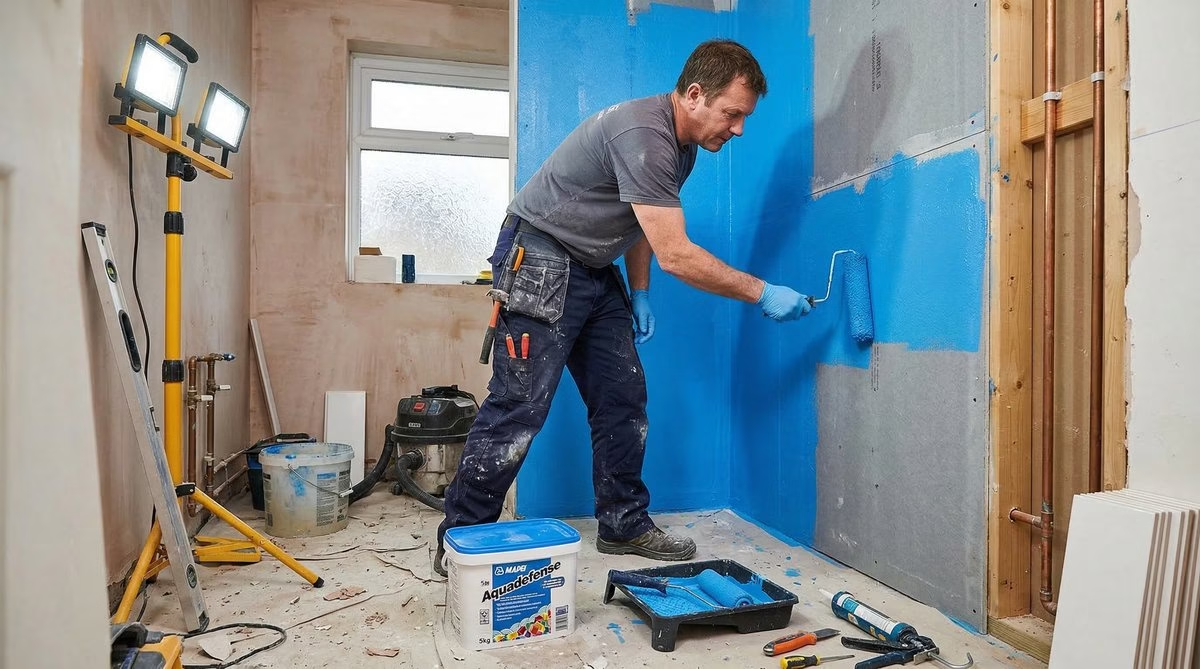
Every week we speak to homeowners in South London who have been through the same dispiriting experience: a bathroom ripped out after only a few years because water got behind the tiles and rotted the substrate, the joists, or the ceiling below. In almost every case, the root cause was the same — the fitter skipped tanking bathroom UK building regs-compliant waterproofing and relied on moisture-resistant plasterboard alone. That board is not sufficient for a wet zone, and this article explains exactly why — what the regulations say, what the British Standards require, and how to make your fitter contractually accountable before a single tile goes up.
What “Tanking” Actually Means in a Bathroom
Tanking means applying a continuous waterproof membrane to walls and floors in the wet zone, behind the tiles and adhesive, so that water penetrating the grout lines is stopped at the membrane rather than absorbed by the substrate. In practice that membrane is almost always a liquid-applied product — a polymer slurry or flexible elastomeric coating brushed or rolled onto the background in two coats, with reinforcing fabric bedded into internal angles and around pipe penetrations. Sheet membranes — polyethylene or fleece-backed products like the Schlüter KERDI range — achieve the same result through a different method and are particularly popular in full wet rooms.
Tanking is not moisture-resistant plasterboard — the green-faced board most fitters carry on their van. That board resists humid atmosphere and incidental splash, but it is not designed to be repeatedly saturated. It is also not the same as waterproof grout or silicone, which are maintenance items that degrade over time. A properly tanked substrate does not rely on the grout staying perfect for the next decade.
We recently helped a homeowner in Peckham whose bathroom was stripped entirely after just three years. The fitter had used green moisture-resistant plasterboard, tiled over it, and declared the job done. Within two years the grout around the shower head was cracking; within three years there was damp on the bedroom wall and a brown stain on the kitchen ceiling below. The remediation cost — strip out, dry out, reframe, re-board, re-tile — came to just over £9,000. A tanking kit for the shower zone would have added roughly £150 to the original job.
What UK Building Regulations Actually Say
Approved Document C — Site Preparation and Resistance to Contaminants and Moisture is the relevant Building Regulation. Requirement C2 states that “floors, walls and roof of the building shall adequately resist the passage of moisture to the inside of the building.” Approved Document C provides guidance on how to meet that requirement through damp-proof courses, membranes, and appropriate materials — but it does not mention tanking by name for internal shower walls or wet room floors.
This is the nuance many fitters miss. The regulation sets a functional requirement — adequate moisture resistance — but does not prescribe the method. The British Standards fill that gap by defining what “adequate” means in practice. Ignoring them makes it very difficult for a fitter to argue they met the functional requirement of the Building Regulations.
Most domestic bathroom work is not notifiable under the Building Regulations in England — there is no Building Control inspector checking the waterproofing. The protection comes from specifying the work correctly in the contract, not from statutory inspection. This places the burden squarely on the homeowner to know what to ask for — or to work with a firm that specifies it automatically.
What BS 5385 and BS 8000 Require
The 2018 revision of BS 5385-1 — the British Standard for wall and floor tiling — extended the tanking requirement from commercial wet areas to domestic wet areas. Clause 6.1.1.3 states that “in wet areas, e.g. showers, wet rooms and steam rooms, substrates should be protected with a suitable proprietary tanking membrane system.” The system can be “a proprietary sheet membrane or a liquid applied water impermeable product,” giving fitters flexibility in which they use but no flexibility about whether to use one.
Equally important is clause 6.2.3.4, which states: “Plasterboard, including moisture resistant plasterboard, is generally unsuitable for wet areas unless additional protection in the form of a waterproofing tanking system is used.” This ends the debate about whether green board is sufficient for a shower or wet room — according to the current British Standard, it is not, unless it has been tanked over. Clause 6.1.2.9 extends the same conclusion to gypsum plaster. Both the most common domestic wall substrates are explicitly called out.
BS 8000, the workmanship standard, reinforces the principle that waterproofing is a quality-of-workmanship obligation, not an optional extra. In our experience across South London, most disputes between homeowners and bathroom fitters come down to the same gap: the fitter quoted for a renovation, the homeowner assumed that meant a properly waterproofed bathroom, and the fitter assumed tanking was an extra not included in the price. Neither party discussed it. Courts and arbitrators increasingly treat compliance with BS 5385-1:2018 as the benchmark for proper workmanship, so a fitter who departs from it without the homeowner’s informed agreement is in a weak position if a claim is made.
Shower Enclosure vs Full Wet Room — The Critical Distinction
Not all bathrooms carry the same waterproofing requirement, and understanding the distinction matters for both specification and cost:
- Shower enclosure with a tray: The pre-formed tray is the primary waterproof element for the floor. Tanking is still strongly advisable for the walls within the wet zone — typically the three or four sides of the enclosure to at least 1800mm height — because grout is porous and will admit water over time. BS 5385-1:2018 recommends tanking the wall substrate in this zone.
- Walk-in shower without a tray: The floor itself forms part of the wet zone and must be fully watertight, laid to falls towards a drain. Tanking is mandatory across the entire shower floor area using a sheet membrane or a purpose-designed wetroom tray former system, combined with a liquid membrane on the walls. This is not a grey area.
- Full wet room: Where the entire floor is a continuous wet zone — no screens dividing dry from wet — tanking is mandatory across the whole floor and on all walls to splash height. The membrane must be continuous and uninterrupted at junctions with walls, around pipe penetrations, and at the door threshold. A wet room without full tanking will fail; it is a question of when, not if.
We see the most serious failures in full wet rooms. One Lewisham homeowner we helped had commissioned a disabled-access wet room conversion. The previous contractor had tanked only the immediate shower area and used moisture-resistant board on the rest of the floor. Within two years the timber subfloor had deteriorated to the point where tiles were moving underfoot, and the ceiling below had to be entirely replaced. Full floor tanking on a proper cement-board substrate would have added perhaps £400 to the original project.
When Fitters Skip Tanking — Liability and Redress
Under the Consumer Rights Act 2015, any trader providing a service to a consumer must carry out that service with reasonable care and skill. Where a British Standard exists for the type of work being done — as BS 5385-1:2018 clearly does for tiling in wet areas — reasonable care and skill will generally be interpreted by reference to it. A fitter who omits tanking from a shower wall or wet room floor has arguably not met the statutory obligation, regardless of whether tanking was explicitly mentioned in the quote.
To pursue a claim you will need to demonstrate three things: that the damage is caused by water ingress through the tile substrate; that the substrate was not waterproofed in accordance with the applicable standard; and that the fitter was responsible for the tiling work. A report from an independent tiling contractor or a member of the Tile Association (TTA) establishes whether the installation meets BS 5385-1 requirements and becomes your evidence for a formal complaint or small claims court referral.
Tip: If a fitter tells you moisture-resistant board is sufficient and tanking is unnecessary, ask them to put that in writing and confirm which standard they are working to. Most fitters who are cutting corners will not commit that statement to paper — and those who are genuinely confident in their method will be able to cite their authority.
How to Specify Tanking in Your Contract
The most effective protection is a clearly written specification before work starts. We always recommend that homeowners include the following points in any bathroom renovation contract where tiling is involved:
- Substrate specification: Name the substrate behind tiles in the wet zone — cement backer board or moisture-resistant plasterboard with tanking membrane. Do not leave this to the fitter’s discretion.
- Tanking system: Specify that a proprietary tanking membrane system compliant with BS 5385-1:2018 clause 6.1.1.3 is to be applied to all wet zone walls and the floor of any tray-free shower or wet room. Name the product, or require that a named system from an approved manufacturer is used.
- Coverage area: Define the wet zone — minimum all shower enclosure walls to 1800mm; for a wet room, the entire floor area and all walls to at least 1800mm.
- Corner and junction detailing: Require all internal angles and pipe penetrations to be reinforced with tape or fabric per the membrane manufacturer’s instructions. Most failures occur at corners and around drains, not in the open field of the membrane.
- Product record: Require the fitter to hand over the data sheet and batch number for the tanking product used, creating a warranty trail back to the manufacturer.
- Pre-tile inspection: Include a clause entitling you to inspect the completed membrane before tile adhesive is applied. Once tiles are up, there is no way to verify the substrate without taking them off.
Recommended Products and Systems
There is no single best tanking system — the right product depends on the substrate, tile format, and budget. Three manufacturer ranges are consistently specified by professional tiling contractors working to BS 5385-1:2018:
- Mapei: Mapelastic AquaDefense is a premixed liquid-rubber membrane applied by brush or roller, drying in 30 to 50 minutes and ready to tile within a few hours. It meets BS EN 14891 and integrates with Mapeband reinforcing tape for corners and penetrations. Mapei’s two-component Mapelastic Smart suits higher-demand applications. Both are widely available through UK builders’ merchants.
- BAL: The BAL two-part tanking system uses a cement-based waterproofing slurry mixed on site and trowelled or brushed onto the substrate. It cures harder than most liquid-polymer products, making it well suited to heavier tile formats, and integrates with BAL’s adhesive and grout systems to simplify specification.
- Schlüter Systems: The KERDI sheet membrane is embedded into tile adhesive and requires no separate drying time — apply and tile on the same day. KERDI-BOARD panels provide an integrated board-and-membrane system suited to wet rooms, and the KERDI-SHOWER-T tray system provides pre-formed falls and drain interface for tray-free walk-in showers.
All three satisfy BS 5385-1:2018 clause 6.1.1.3 when installed correctly. The difference is in application method, cure time, and cost per square metre — not in the level of protection provided.
Tip: Always cross-reference the tanking system with the tile adhesive being used. Some liquid membranes require a specific primer before adhesive is applied, and some manufacturers require their own adhesive system to maintain the product warranty.
How Fixiz Keeps Your Bathroom Renovation Compliant
We have seen enough rip-outs to make tanking a non-negotiable part of every bathroom project we oversee. When we manage or recommend bathroom fitters for our clients, we insist on a written specification that references BS 5385-1:2018, names the tanking product, defines the wet zone coverage, and includes a pre-tile inspection stage.
We recently helped a homeowner in Greenwich who received three quotes for a wet room conversion. Only one had included tanking; the other two listed “moisture resistant board” and made no mention of a membrane. When we helped the homeowner ask those two fitters to revise their quotes, one declined and one added a fair cost. That ten-minute conversation is often the difference between a bathroom that lasts twenty years and one that fails in three. If you are commissioning a bathroom or wet room in London and want certainty that the specification is correct before any fitter starts work, that oversight is precisely what we provide.
Frequently Asked Questions
Is tanking a legal requirement in a UK bathroom?
Approved Document C requires that walls and floors adequately resist moisture, but does not prescribe tanking by name for internal wet areas. BS 5385-1:2018 explicitly recommends tanking membrane in all domestic wet areas including shower enclosures and wet rooms — and courts use this standard as the benchmark for reasonable workmanship. For a full wet room floor in particular, tanking is effectively mandatory: without it the floor will leak.
Is moisture-resistant plasterboard sufficient behind shower tiles?
No — not on its own. BS 5385-1:2018 clause 6.2.3.4 states explicitly that “plasterboard, including moisture resistant plasterboard, is generally unsuitable for wet areas unless additional protection in the form of a waterproofing tanking system is used.” If a fitter tells you green board is sufficient for a shower, ask them to confirm this in writing and cite the standard they are working to.
Do I need to tank a shower that has a pre-formed tray?
The shower tray provides primary waterproofing for the floor within the enclosure, but the walls remain in the wet zone and should be tanked in accordance with BS 5385-1:2018. The most common failure point in shower enclosures is the wall substrate — water that reaches it through degraded grout or failed silicone at the tray junction will saturate whatever is behind the tiles.
Can I claim against a fitter who did not tank my shower?
Potentially yes. Under the Consumer Rights Act 2015, services must be carried out with reasonable care and skill. If your shower walls or wet room floor were tiled without a tanking membrane and you have suffered water damage as a result, you may have a claim. You will need evidence that the damage results from inadequate waterproofing — ideally an independent report confirming the installation did not meet BS 5385-1:2018. If you explicitly requested tanking and the fitter declined, your position is stronger still.
How much does tanking add to the cost?
For a standard shower enclosure, a liquid-applied tanking system adds roughly half a day to the programme and £100 to £250 in materials. For a full wet room floor, expect £300 to £600 in additional material and labour depending on floor area and system. Set against the cost of a rip-out and remediation — which rarely comes in under £5,000 for a small bathroom — the addition is negligible.
Ready to move from confusion to construction? Get in touch with Fixiz today for a no-pressure chat about your project and the fastest route to full compliance.