Physical address:
128 City Road, EC1V 2NX, London,UK

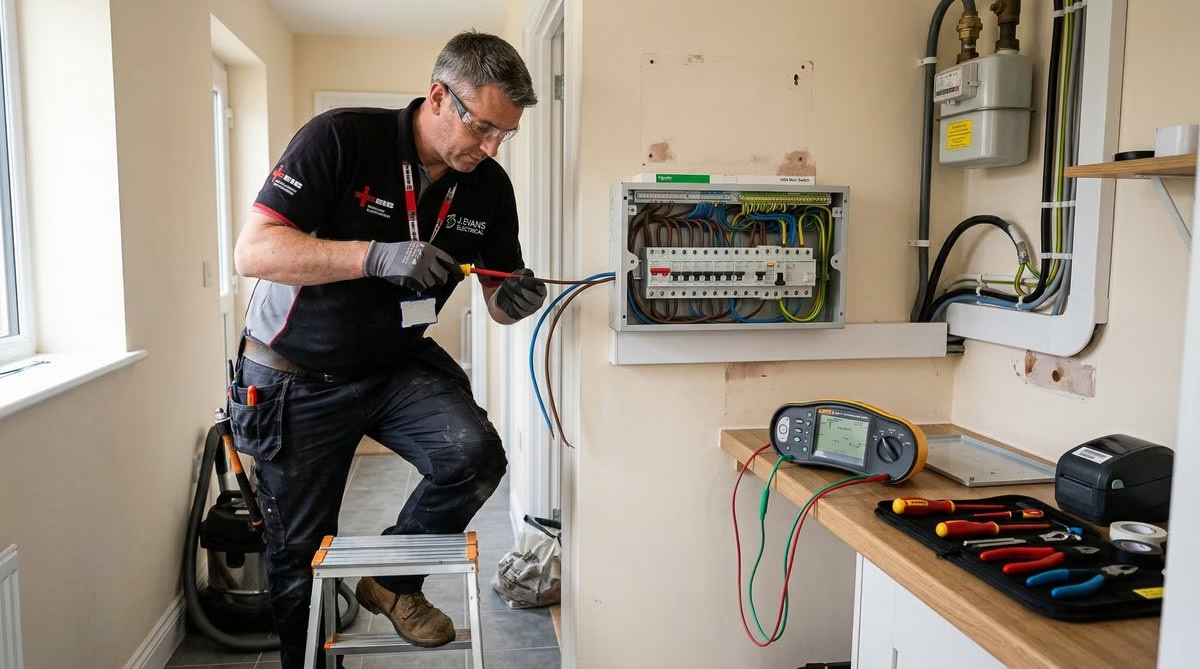
Most homeowners planning a consumer unit replacement UK have a rough sense of the cost—but few know what actually happens on the day, how long to clear their schedule for, or which certificates they should walk away with. This article walks you through each stage of installation, gives you realistic timelines, explains the documents you must receive, and shows you how to handle scope changes or upsell pressure once work has begun.
What Happens Step by Step on Consumer Unit Installation Day
A consumer unit replacement is notifiable under Part P of the Building Regulations—it must be carried out to a defined standard and formally recorded. Here is what each stage involves.
Isolation
The electrician isolates the supply at the meter tails before any work begins. In our experience across South London, isolation and a safe working check take around 15 to 20 minutes when done properly. If an electrician starts removing the board without this step, that is a red flag.
Removal and Circuit Documentation
Each circuit cable is labelled as it is removed—circuit labelling feeds directly into the schedule on your Electrical Installation Certificate. Old units often have unmarked cables or doubled-up neutrals. We recently helped a homeowner in Streatham whose 1980s board had seven unlabelled cables in a neutral bar designed for five; sorting that out added 40 minutes but was essential before a safe new installation could go in.
Installation, Testing, and Sign-Off
The new fully RCBO consumer unit with surge protection device (SPD) is fixed in the same position as the old one. Meter tails connect first, then each circuit is terminated on its allocated breaker, sized to match the cable rating it protects. Before the supply is reconnected, the electrician carries out dead tests: insulation resistance testing on every circuit, continuity of protective conductors, and polarity checks—all recorded numerically on the test schedule. We always carry out these tests circuit by circuit in real time; an electrician who cannot show you results as they go is not working to the required standard. Once dead tests pass, the supply is reconnected and live testing confirms each device trips within the correct time under load. The board is then closed, clearly labelled, and power is restored to every circuit. In our experience, the handover stage is often rushed on busy days; take five minutes to read the certificate before signing.
Realistic Timeline: How Long Does a Consumer Unit Replacement Take?
For a straightforward domestic replacement, allow four to eight hours. Here is a realistic breakdown:
- Isolation and preparation: 20–30 minutes, including safety checks and a pre-work walkthrough.
- Removal and circuit documentation: 30–60 minutes, longer if the old board is poorly labelled.
- New board installation and termination: 60–120 minutes, depending on circuit count.
- Dead testing (all circuits): 60–90 minutes for a typical 12–16 circuit board.
- Energisation and live testing: 30–60 minutes, including RCD trip time verification for every circuit.
- Documentation and handover: 20–30 minutes for the EIC schedule, labelling, and board walkthrough.
Jobs toward the eight-hour end typically involve older properties with mixed wiring colours, informally added circuits, or a board in an awkward location. Newer properties with clean, well-labelled installations come in at the four-hour end. We recently completed a replacement in a 1990s semi-detached in Bromley in four and a half hours; the same week, an Edwardian terrace in Peckham with original and modern wiring mixed together took the full seven hours.
Tip: Plan to be without power from early morning. Charge devices the night before, arrange to work on mobile data, and keep the fridge closed—food is safe for four to five hours in an unopened fridge.
Tip: If an electrician quotes you one to two hours including testing, treat that with serious scepticism. Thorough testing alone accounts for at least 90 minutes on a standard installation. A rushed job that skips the testing phase is not a compliant job—and the numerical test results on your certificate will tell you whether it was done properly.
Certificates You Must Receive—and What They Mean
There are two distinct documents you must receive after a consumer unit replacement, and both matter legally.
Electrical Installation Certificate (EIC)
The Electrical Installation Certificate is the primary technical document for any new installation—different from an EICR, which inspects an existing installation. It must include:
- Signed responsibilities for design, construction, and inspection/testing (can be the same person for domestic work).
- A schedule of circuit details: every circuit by type, cable size, protective device rating, and RCD protection.
- A schedule of test results: numerical values for insulation resistance, continuity, loop impedance, and RCD trip times—not tick-boxes.
- Declaration of compliance with BS 7671 (the IET Wiring Regulations, currently 18th Edition including Amendment 2).
The EIC is your evidence the work was done to the required standard. If an electrician offers a Minor Electrical Installation Works Certificate (MEIWC) instead, that is incorrect—a MEIWC covers only small additions to existing circuits, not a new board.
Building Regulations Notification — Part P
Consumer unit replacement is notifiable work under Part P of the Building Regulations in England. This means it cannot simply be done and documented privately—it must be formally notified to your local authority building control or self-certified by a registered electrician operating under a Competent Person Scheme.
The vast majority of domestic electricians are registered with a government-authorised Competent Person Scheme—primarily NICEIC, NAPIT, or ELECSA. Registration allows them to self-certify their own work; the scheme notifies building control on their behalf and issues you a Building Regulations Compliance Certificate within 30 days of completion.
This compliance certificate is separate from the EIC. Both documents should be in your hands before you consider the job fully closed. The compliance certificate confirms the work is formally registered on a national database—useful evidence for solicitors and surveyors when you sell or remortgage.
Tip: You can verify that a compliance certificate has been issued by checking the relevant scheme’s online register. NICEIC, NAPIT, and ELECSA all maintain searchable databases of registered contractors and completed notifications.
What to Check Before Signing Off the Job
The moment the electrician says the job is done is exactly the wrong time to be passive. Signing off too quickly—or making final payment before you have verified the key items—means you may only discover problems when you come to sell the property or make an insurance claim. Taking five to ten minutes now protects you for as long as you own the house.
Before the electrician leaves and before you make final payment, run through this checklist:
- Every circuit is working: Walk through the property and test sockets, lights, and fixed appliances. Do not assume everything is fine because the main lights are on.
- The consumer unit is labelled: Every breaker should be clearly identified. Vague labels like “downstairs” are not acceptable; “downstairs sockets” or “kitchen ring final” are.
- The EIC is complete with test results: Check that the schedule of test results contains actual numbers, not blanks or generic entries. A certificate without numerical test results is not a compliant EIC.
- The electrician’s registration details are on the certificate: Their registration number and scheme should be clearly printed. If it is missing, ask them to add it before you sign.
- You have been told when to expect the compliance certificate: It will come by post or email from the Competent Person Scheme, usually within 30 days. Ask the electrician which scheme they are registered with so you can follow up if it does not arrive.
- The installation area is clean and made good: Wall fixings, cable clips, and any surface conduit should be neat. The meter tails should not be strained or twisted. Debris from the old board should have been cleared away.
If anything on this list is missing or unclear, raise it before payment, not after. A professional electrician will welcome the conversation—it is evidence you are engaged and paying attention, which is exactly the kind of customer they want a good relationship with.
How to Verify Your Electrician Is Registered Before Work Starts
Of all the checks you can do before a consumer unit replacement, verifying registration is the one that takes the least time and gives you the most protection. An unregistered electrician carrying out notifiable work is not simply cutting corners on admin—they are carrying out work that cannot be legally self-certified. If this is discovered during a property sale or insurance claim, you may be required to pay for a local authority inspection and, in a worst case, for remedial work to bring the installation into compliance.
Checking registration before you book takes two minutes. Each major Competent Person Scheme runs a free public register: NICEIC at niceic.com/find-a-contractor, NAPIT at napit.org.uk/find-a-member, and ELECSA at elecsa.co.uk/find-an-electrician. Search by postcode or company name. If the electrician does not appear, ask them directly which scheme covers them and check that register. A legitimate registered electrician will not be offended—they will expect it, because registered tradespeople know their status is publicly verifiable and take it seriously.
It is also worth checking that the electrician’s registration is current, not lapsed. Schemes require annual renewal and ongoing assessment; a registration that expired last year gives you no protection. The online registers show current status, so a simple search before you confirm the booking is all it takes.
We are registered with NICEIC and encourage every customer to verify our registration before we start work. It takes less time than reading this paragraph.
Handling Scope Changes and Upsell Pressure on the Day
One of the most common fears we hear from customers is that the bill will double once the electrician is on site. That fear is legitimate—it does happen—and it is worth knowing how to handle it.
Distinguish Genuine Findings from Pressure Tactics
Some discoveries are genuine. If the existing meter tails are undersized, or a circuit cable is damaged, those are real safety issues. A proper quote process should have identified most risks in advance, but older properties do hold surprises. In our experience, genuinely necessary additional work is uncommon on a straightforward domestic job.
What is not acceptable is an electrician recommending additional work unrelated to safely completing the job you contracted—extra sockets, rewiring of functioning circuits, or upgrades to items that were visible at the time of quoting. If you are being pushed toward significant additional spend, pause and ask: “Is this necessary to safely complete the consumer unit replacement, or is it separate work?” Any competent electrician will answer that question directly.
Get Scope Changes in Writing Before Agreeing
If additional work is genuinely required and you want to proceed on the same day, ask for a brief written variation—even a text message confirming the additional scope and cost. Do not rely on a verbal agreement mid-job. We always confirm variations in writing before proceeding. We recently helped a homeowner in Lewisham who had been told verbally mid-job by a previous contractor that “a few extra things” were needed—by the end of the day, the invoice was 60% higher than the original quote with no written record of what had been agreed.
You Can Pause the Job
If you are uncomfortable with the direction of a conversation mid-installation, you are entitled to pause work and seek a second opinion. The electrician has a duty to leave the installation in a safe condition if work is paused—they cannot leave live conductors exposed. If you are being pressured to make a quick decision on significant additional expenditure, that pressure itself is a signal worth heeding.
How Fixiz Manages Installation Day for Our Customers
Every consumer unit replacement we carry out in London follows a consistent process designed to take the uncertainty out of the day. Before we arrive, we confirm the start time and estimated duration in writing, so you know exactly when to expect us and roughly when to expect the power back on. On site, we carry out a brief pre-work walkthrough with you to confirm the scope, show you the new unit before it goes in, and flag anything we have spotted that was not visible at the quoting stage—before work begins, not after it is too late to make informed decisions.
Our test results are recorded circuit by circuit on calibrated, certificated equipment and handed to you as part of your EIC on the day of installation. We do not fill in the schedule from memory after the event. The Building Regulations compliance certificate is submitted to NICEIC within 24 hours of completion, and we send you the submission reference so you know it is in the system and can track it yourself.
In our experience across South London and the surrounding boroughs, the jobs that generate callbacks and disputes are almost always ones where the testing was rushed, the documentation was incomplete, or the customer was not kept informed during the day. We treat each of those three things as non-negotiable. If you have had a consumer unit replacement done previously and realise you never received a full EIC or a compliance certificate, that is something we can help you understand and, where possible, address—contact us and we will advise you on the options.
Frequently Asked Questions
Can I use my kitchen and bathroom while the consumer unit is being replaced?
No. The entire property will be without power for most of the working day. Charge devices the night before, keep the fridge closed, and plan a contingency for any electrically dependent medical equipment. You may have partial power restored circuit by circuit during the testing stage, but do not rely on it.
Do I need to notify my energy supplier about a consumer unit replacement?
No notification is needed, but your electrician will work close to the meter tails. They must not touch the supplier’s equipment (the meter itself and the incoming service cable). If meter tails are too short or damaged, your electrician must arrange an extension with the Distribution Network Operator (DNO) in advance—not on the day. Note that smart meters are unaffected in most cases; if your in-home display loses its signal afterwards, your energy supplier can re-pair it over the phone.
Is the Electrical Installation Certificate the same as the Part P certificate?
No. The EIC is a technical record produced by your electrician. The Part P compliance certificate is issued by the registered Competent Person Scheme to confirm the work has been formally notified to building control. Both documents are required.
How long should I keep my consumer unit certificates?
Keep them permanently. Conveyancers and solicitors routinely request electrical certificates going back 20 or more years when a property changes hands. Store paper copies safely and scan them to a secure cloud folder as a backup.
What if the electrician says they will send the EIC later?
The EIC should be with you on or shortly after installation day—not weeks later. If test results were recorded properly at the time, producing the certificate is a formatting exercise. An electrician who cannot produce an EIC within a few days is giving you a strong signal about how the testing was conducted. Do not make final payment until you have it.
Ready to move from confusion to construction? Get in touch with Fixiz today for a no-pressure chat about your project and the fastest route to full compliance.