Physical address:
128 City Road, EC1V 2NX, London,UK

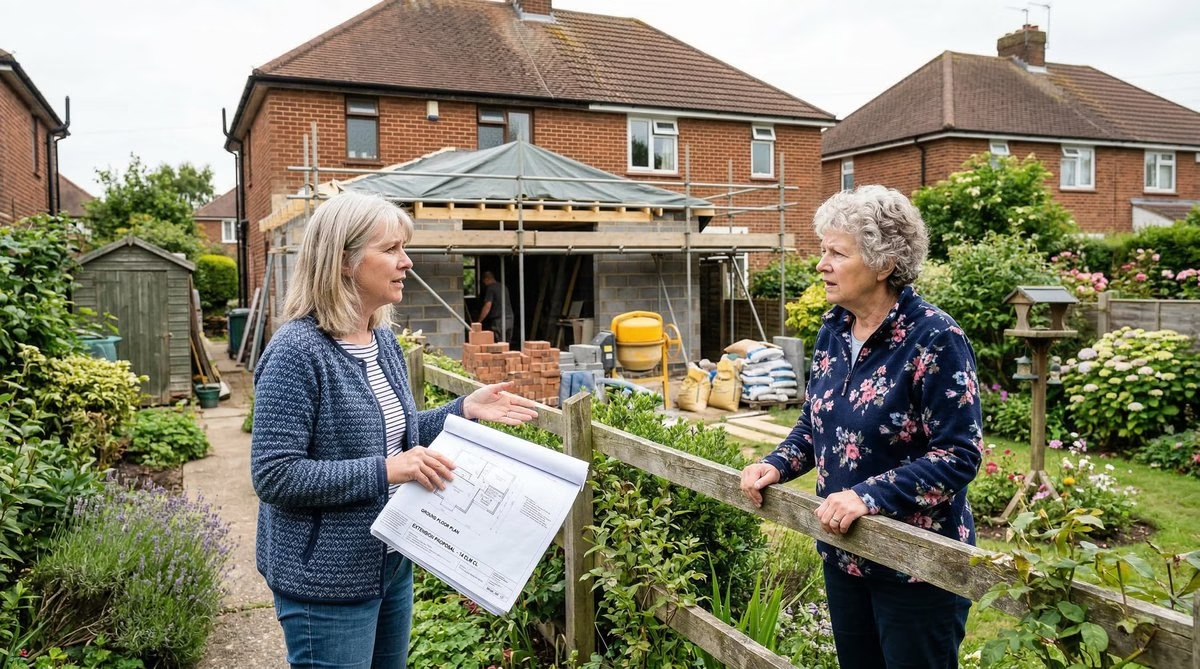
You’ve spent weeks planning your extension, chosen your builder, and then — the letter lands on the doormat. Your neighbour objects. If you’re wondering what actually happens when a neighbour objects to extension UK, the honest answer is: it depends on which legal process you’re in, and in most cases it is far less of a roadblock than people fear. At Fixiz, we guide homeowners through exactly this situation every week, and we want to give you a clear, practical picture of what comes next — and how to protect your project without turning your street into a war zone.
Understanding the Two Different Processes—and How Objections Work in Each
One of the most common misunderstandings we encounter is that a neighbour’s objection automatically stops an extension. It doesn’t — but the effect of an objection does differ depending on whether you are working under permitted development (PD) rights via the Prior Approval route, or submitting a full planning application. Understanding which process applies to your project is the very first thing to establish.
Prior Approval Consultation — When It Goes to the Council
Larger home extensions that exceed standard PD limits — typically a rear single-storey extension between 4m and 8m on a detached house, or 3m to 6m on any other type — fall under the Householder Prior Approval process. Under this route, your local council must notify adjoining owners and occupiers, who then have 21 days to raise objections.
Here is the critical point many homeowners miss: if a neighbour objects during this consultation period, the council does not automatically refuse the work. Instead, the council must consider whether the proposal has an unacceptable impact on the amenity of adjoining properties. The council weighs the objection, looks at factors such as loss of light and overlooking, and makes its own determination. We recently helped a homeowner in Lewisham who was convinced their entire rear extension project was dead after both neighbours wrote in — the council reviewed all submissions and granted prior approval within three weeks because the extension met the standard amenity tests. An objection triggers a review; it is not a veto.
If no objections are received within 21 days, the council is deemed to have given approval and you can proceed. If objections are received, the council has 42 days from the date of application to issue its decision. Failing to obtain prior approval confirmation before starting work is a serious compliance error — we see it trip up projects that could otherwise have sailed through.
Full Planning Applications — Material Considerations, Not Vetoes
When your extension requires a full planning application — either because it exceeds PD limits, the property is in a conservation area, or PD rights have been removed — the objection process is different again. The council advertises the application and neighbours have a fixed period (usually 21 days) to submit representations.
Objections submitted during this period are formally classified as material considerations. A planning officer must read and weigh them, but the number of objections — whether it’s one or fifty — does not determine the outcome. A valid planning objection must relate to land-use planning matters: impact on amenity, loss of natural light, overlooking, design out of keeping with the area, highway safety. Objections based on personal disputes, property values, or the neighbour simply disliking the idea carry very little weight. We always advise clients to read any objections submitted and, where they raise a planning point that can be addressed — such as altering a window position to reduce overlooking — consider whether a minor revision to the plans can neutralise the concern before the officer makes their decision.
In our experience across South London, the majority of residential extension applications that are properly designed and comply with local development plan policies are approved even when neighbours object.
The Party Wall Act — A Separate Legal Process Running Alongside Planning
Planning and the Party Wall etc. Act 1996 are entirely separate legal regimes. You can have planning permission and still need to comply with the Act — and a neighbour’s rights under the Party Wall Act are completely independent of any planning objection they may have raised.
When Are Notices Required?
The Party Wall Act requires you to serve formal written notice on any adjoining owner before you carry out certain categories of work. For extensions, the two most relevant triggers are:
- Work on or at the boundary: Any new building at the line of junction — such as a new wall built astride or up to the boundary — requires a Line of Junction Notice, typically served at least one month before work starts.
- Excavation within 3 metres of a neighbour’s structure: If your foundations will be within 3 metres of any part of a neighbouring building and will go deeper than their existing foundations, a Notice of Adjacent Excavation must be served at least one month in advance.
- Excavation within 6 metres: If your foundation excavation falls within 6 metres of a neighbouring structure and would, if projected downward at a 45-degree angle, cut a line drawn from the base of their structure, the 6-metre notice rule applies. This catches a surprising number of rear extensions with deep strip or pad foundations.
Many homeowners are caught out by the 3-metre or 6-metre rule. We recently worked alongside a homeowner in Greenwich whose builder had started digging before anyone had checked the proximity to the neighbouring terrace’s foundations. Serving a retrospective notice is legally possible but creates unnecessary ill-will and potential liability.
What If Your Neighbour Ignores the Party Wall Notice?
This is where many projects stall unnecessarily. If a neighbour fails to respond to a Party Wall Notice within 14 days, a dispute is deemed to have arisen — but this does not mean you cannot proceed. The Act’s dispute resolution mechanism kicks in: both parties appoint surveyors (or agree on a single agreed surveyor), who prepare a Party Wall Award setting out the rights of both sides, the pre-works condition of the neighbour’s property, and the agreed hours and method of working.
The Award protects you as much as it protects your neighbour. It provides a contemporaneous condition record so that, if the neighbour later claims damage was caused by your works, there is an agreed baseline to refer to. Once the Award is in place, you can proceed regardless of whether your neighbour is happy about it — the Act gives you the right to do the work, you just need to follow the process. In our experience, a calm approach to the Party Wall process — choosing a surveyor with good local knowledge — keeps projects moving without becoming adversarial.
Practical Tips for Keeping Good Relations While Protecting Your Project
Even when you are fully within your legal rights, a fractious relationship with a neighbour can create delays, inflated surveyor fees, and stress that outlasts the build itself. These are the steps we recommend to every client.
- Speak before you serve: Have a genuine conversation with your neighbours before submitting applications or serving notices. Show them the plans. People object to surprises far more than they object to extensions.
- Explain the planning process: Many people do not know that a planning objection is not a veto. Telling a neighbour that the council will consider their views — and that you will take reasonable concerns seriously — reduces conflict and sometimes leads to a withdrawn objection.
- Respond to concerns directly: If a neighbour objects on a specific issue — a window overlooking their garden — consider whether a small design change resolves it. This is almost always cheaper than waiting for a planning officer to deal with the objection.
- Keep them informed during the build: A neighbour who knows noisy work finishes at 5pm on Friday, or that scaffolding goes up Monday, is far less likely to call the enforcement line on Saturday morning.
- Document everything: Keep copies of all notices served, responses received, and any correspondence. If a dispute escalates, a clean paper trail is invaluable.
Tip: Ask your builder to introduce themselves to neighbours before work starts. A knock on the door and a business card costs nothing and is one of the most effective goodwill gestures for preventing complaints during a build.
Your Before-You-Start Compliance Checklist
Before any extension project breaks ground, every homeowner should work through this compliance checklist. We use a version of this with every client, and it has saved countless projects from avoidable delays, enforcement notices, and neighbour disputes.
- PD rights check: Confirm whether your extension falls within permitted development limits, whether your property has had its PD rights removed (common in conservation areas, Article 4 directions, or new-build estates), and whether prior approval or a Lawful Development Certificate is needed. Do not assume — check with your local planning authority or a qualified planning consultant.
- Full planning application check: If PD doesn’t apply, establish whether the design as proposed will comply with your council’s local plan policies on extensions — particularly on rear projection depth, height, eaves, and ridge lines.
- Party Wall Act check: Measure the distance from your proposed foundations to any neighbouring structure. If you are within 3 metres (or potentially 6 metres depending on excavation depth), notices must be served before works start. Allow a minimum of one month for the notice period, plus additional time if a surveyor and Award are required.
- Building Regulations application: Planning permission and PD approval do not mean the work complies with Building Regulations. A separate application — either Full Plans or Building Notice — must be submitted to your local authority building control or an approved inspector before structural work begins. Extensions require sign-off on structure, thermal performance, fire safety, drainage, and ventilation.
- Utility notifications: Check for the presence of gas, electricity, water, and drainage infrastructure in or near your excavation zone. Contact the relevant network operators — National Grid, UKPN, Thames Water or your regional equivalent — before any ground is broken. Striking a service is both dangerous and extremely costly.
- CDM regulations: For domestic projects, check whether the Construction (Design and Management) Regulations 2015 apply. If the project exceeds 500 person-days or 30 working days with more than 20 simultaneous workers, you must notify the HSE.
The projects that run into neighbour-related delays almost always have one thing in common: the compliance steps above were treated as afterthoughts rather than prerequisites. Getting them right before you start is not bureaucracy for its own sake — it is the fastest route to a completed extension.
How Fixiz Keeps Your Extension on Track
At Fixiz, we approach every extension project with compliance built in from the first conversation. We understand that for most homeowners this is the largest project they will ever undertake on their property, and the legal and procedural landscape can feel overwhelming — especially when a neighbour complicates things.
We recently helped a homeowner in Peckham who came to us six weeks into a dispute with their neighbour over a side-return extension. Their original builder had served the Party Wall Notice but had not followed up when no response came, and had then started work without an Award in place. We worked alongside a qualified party wall surveyor to regularise the situation, negotiate an agreed Award, and get the project back on programme — all while ensuring the client’s relationship with their neighbour didn’t deteriorate further. The extension completed on time and to budget.
What we offer is not just construction expertise — it is project confidence. We coordinate the planning, party wall, Building Regulations, and neighbour communication elements so that you are never discovering a compliance gap after the foundations are dug. We flag objection risks early, advise on design tweaks that address planning concerns, and manage the build in a way that treats your neighbours as stakeholders, not obstacles.
Frequently Asked Questions
Can a neighbour stop my extension in the UK?
Not unilaterally. A neighbour can object to a planning application or prior approval consultation, and their concerns must be formally considered by the council — but a planning objection is a material consideration, not a veto. The council decides based on planning policy, and if your proposal complies, it can be approved regardless of opposition. Under the Party Wall Act, a disputing neighbour can delay the process until an Award is made, but they cannot ultimately prevent you from carrying out work you are legally entitled to do.
What is the difference between a planning objection and a party wall dispute?
These are entirely separate legal processes. A planning objection is submitted to your local planning authority during the consultation period and relates to land-use planning matters. A party wall dispute arises under the Party Wall etc. Act 1996 and concerns the rights of adjacent owners when work affects a shared wall or involves excavation near their boundary. You can face both simultaneously, and each must be managed through its own process.
What happens if I don’t serve a Party Wall Notice?
Failing to serve a notice when one is legally required is a civil wrong that can expose you to an injunction halting your works, a court order to undo completed work, and liability for any damage caused. Insurers may also reject claims related to the works if the notice was not served. This is one of the most common — and most avoidable — compliance failures we see in extension projects.
My neighbour hasn’t responded to the Party Wall Notice. Can I still start work?
Not immediately. If no response is received within 14 days of service, a dispute is deemed to have arisen. You must then appoint surveyors and obtain a Party Wall Award before starting the notifiable works. Once the Award is in place — which typically takes four to eight weeks depending on the surveyors’ availability and the complexity of the project — you can proceed. The notice period and Award process are not optional; they are the legal mechanism that protects both you and your neighbour.
Do I need prior approval and Building Regulations approval separately?
Yes. Prior approval (or a Lawful Development Certificate) deals with planning law. Building Regulations approval is a separate process ensuring the construction meets safety and performance standards. Both are required — one does not substitute for the other. We always run both streams in parallel so there is no gap between planning sign-off and the ability to start building.
What planning objections actually carry weight?
Valid planning objections must relate to material planning considerations: impact on amenity (overlooking, loss of light, noise), design relative to the street scene, highway and access, ecology and trees, or drainage. Objections based on loss of property value, personal disputes, or general opposition to development are not material planning considerations and carry little weight.
Ready to move from confusion to construction? Get in touch with Fixiz today for a no-pressure chat about your project and the fastest route to full compliance.