Physical address:
128 City Road, EC1V 2NX, London,UK

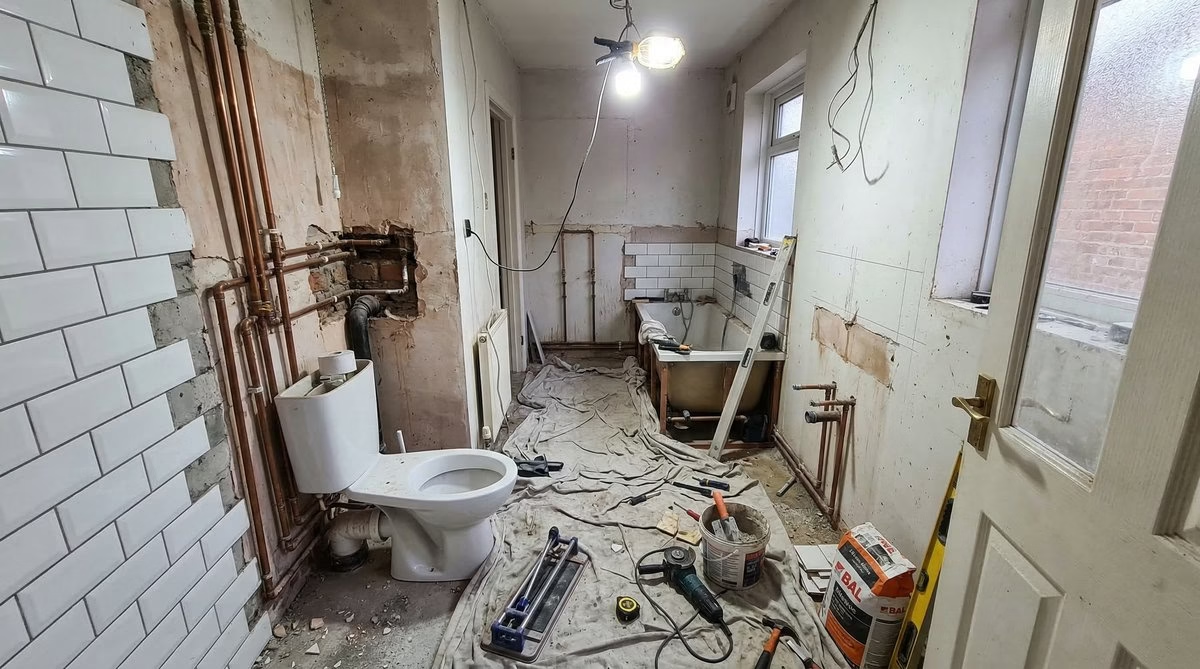
Few renovation nightmares are as stressful as a half-finished bathroom — no working shower, no usable toilet, tiles halfway up the wall — while your bathroom fitter delays in the UK grind the project to a halt. One of our recent clients in Lewisham found herself in exactly this position: quoted a 5–7 day bathroom refit, the fitter missed days from the outset, arrived late on others, then no-showed entirely before requesting a three-week pause — leaving the bathroom half-tiled and unusable. If this sounds familiar, you are not without options. The law is on your side, and there is a clear path from chaos back to a finished bathroom.
What the Consumer Rights Act 2015 Says About Tradesperson Delays
The Consumer Rights Act 2015 is the key piece of legislation protecting UK homeowners when they hire tradespeople. Its core provisions define both your rights and the leverage you have over a contractor who is failing to deliver.
Section 49 — reasonable care and skill. Any service provided by a trader to a consumer must be carried out with reasonable care and skill. This standard applies automatically, regardless of what appears in your written contract. If your bathroom fitter leaves work unfinished, tiles surfaces out of plumb, or cuts corners on waterproofing, those failures constitute a breach of this statutory right.
Section 52 — performance within a reasonable time. Where a specific completion date has not been contractually agreed, the trader must complete the work within a reasonable time. Even where a timeframe was discussed — such as a quoted 5–7 days — persistent no-shows, unexplained absences, and a unilateral request for a three-week pause all amount to the trader failing to meet that agreed or implied timeframe. This is a breach of section 52.
What remedies does the Act give you? If your contractor breaches either provision, the Act provides two statutory remedies. First, you can require the trader to repeat or complete the service at no extra cost, within a reasonable time, and without causing you significant inconvenience. Second, if re-performance is not possible, is not delivered within a reasonable time, or would cause further significant inconvenience, you are entitled to a price reduction of an appropriate amount — in serious cases, up to 100% of what you have paid.
In our experience across South London, many homeowners do not realise that verbal quotes and agreed timeframes carry full legal weight. A WhatsApp message confirming a start date and duration is frequently enough to establish what was agreed.
When Do You Have the Right to Terminate?
Understanding your termination rights is critical, because walking off the job yourself — or simply refusing to let the fitter back — without following the correct process can weaken your legal position. The right sequence matters.
- Send a formal written notice with a clear deadline: Before terminating, you must give the contractor a written deadline to return and complete. Send it by email or recorded post and be explicit: state that you require the work to resume by a specific date (typically 7–14 days), and that failure to comply will result in you treating the contract as terminated. Keep a copy of everything.
- Document the delays thoroughly: Photograph the unfinished work with timestamps. Log every missed day, late arrival, and unanswered message. Note exact dates on which the fitter failed to appear or postponed. This contemporaneous record is essential if the matter ends up before a small claims court.
- Terminate if the deadline passes: If the contractor fails to meet the deadline in your written notice, you are entitled to treat the contract as terminated by their breach. Citizens Advice confirms that a trader who fails to carry out work in a reasonable time, and then misses a final deadline you set, has not honoured their obligations — giving you a lawful basis to cancel and engage someone else.
- Claim your losses: Once terminated, you can pursue a claim for the difference between the original agreed price and the cost of having the work completed by a replacement, plus any additional losses caused by the delay. Keep all invoices from the replacement contractor.
Tip: If your fitter requests a three-week pause mid-project with no contractual justification, respond in writing — keeping a copy — stating that the agreed timeframe does not allow for such a pause and that you require them to return by a set date. That correspondence becomes part of your evidence file.
Protecting Yourself While the Project Is Still Ongoing
Once you sense a project going sideways — missed days, vague excuses, a fitter who is harder to reach than they were at quotation stage — there are immediate protective steps you can take even before you send a formal notice.
- Withhold any final or stage payment: Do not release any payment tied to work that has not been satisfactorily completed. If your contract specifies a final balance payable on completion, that payment is not yet due. Never pay in full upfront for any renovation job.
- Document everything immediately: Start your written record now, not later. Photograph the current state of the bathroom with date-stamped images. Screenshot WhatsApp conversations. Send a brief email to the fitter summarising what was agreed and what has happened — this creates a paper trail even if they do not reply.
- Do not touch the work yourself: This is a critical point that catches homeowners out. If you start completing or altering the unfinished work — re-laying tiles, connecting pipework — you risk being accused of having caused any subsequent problems yourself. Leave the work exactly as it is until either the original fitter returns or you have formally terminated and engaged a replacement who can assess the site independently.
- Send a formal written notice with a clear deadline: This notice is the legal mechanism that converts a difficult situation into a contract you have the right to exit. It also demonstrates to any future court or adjudicator that you acted reasonably and gave the contractor a fair opportunity to put things right.
We recently helped a homeowner in Clapham who had been photographing delays for weeks but had never sent a formal written notice. When she eventually wanted to terminate, the absence of that notice complicated her position significantly. Our advice from the outset would have been to begin the paper trail on day one of any missed attendance.
Finding a Replacement Tradesperson to Take On Someone Else’s Work
Taking on a half-finished bathroom is genuinely skilled work. A replacement fitter must assess what has been installed, identify what was done correctly and what needs correction, and then complete the job. Not every tradesperson is willing to do this, and not every willing one has the right experience.
- Commission a snagging assessment first: Before instructing anyone to continue work, ask a qualified plumber or bathroom installer to carry out an independent assessment of the current state of the job — identifying any work that needs correcting before new work is added on top. This assessment also gives you an independent record of the state in which the original fitter left the site, which supports any later claim against them.
- Look for mid-project experience: When obtaining quotes, ask specifically whether the tradesperson has experience taking over jobs abandoned by another contractor. Matching existing tiles, understanding someone else’s layout choices, and ensuring new work bonds correctly to existing substrates all require adaptability.
- Verify qualifications for specialist elements: A bathroom refit typically involves plumbing, tiling, and potentially electrical work. In the UK, any work to electrical circuits in a bathroom must be carried out or certified by a Part P-registered electrician. Verify that your replacement contractor holds the relevant qualifications or will use certified subcontractors.
- Get everything in writing before work restarts: Agree start date, expected completion date, a staged payment schedule, and what happens if there are delays. Ask for a separate breakdown of costs for completing remaining work versus any remediation needed — this distinction matters for your claim against the first contractor.
- Use vetted platforms: Look for fitters listed on Which? Trusted Traders or TrustATrader, or registered with relevant trade associations. These platforms carry moderated reviews, reducing the risk of selecting another unreliable operator.
In our experience, the homeowners who recover most smoothly from an abandoned bathroom project are those who commission an independent snagging assessment before allowing anyone to continue work. It provides clarity, protects your legal position, and gives the replacement fitter a clear scope to price against.
How to Prevent This Happening in the First Place
The right contractual protections significantly reduce your exposure — and give you much stronger legal footing if things do go wrong.
- Use staged payments tied to defined milestones: Pay no more than a modest deposit (10–15% of the project value) upfront. Structure remaining payments against specific verifiable stages — first fix plumbing complete, tiling complete, second fix and finishing complete. Hold the final payment until you are satisfied with the completed work and any snagging issues have been addressed.
- Agree a written schedule with start and completion dates: This does not need to be a formal legal document, but it must be in writing and agreed by both parties before work begins. If the fitter will not agree a written schedule, treat that as a red flag.
- Include a delay clause: A clause specifying that a daily deduction (for example £50–£100 per working day) applies for each day the project overruns — unless the delay is caused by factors outside the fitter’s control — creates a direct financial incentive to stay on schedule. Under English law, such a clause is enforceable provided the amount is a genuine pre-estimate of your loss rather than an arbitrary penalty.
- Request insurance and qualification evidence upfront: Ask for proof of public liability insurance and trade association membership before signing. A professional tradesperson will provide these without hesitation.
- Actually call the references: Ask specifically about punctuality, communication, and how the contractor handled any problems that arose mid-project.
We recently helped a homeowner in Greenwich who came to us after a painful experience with a bathroom fitter who had excellent online reviews but no written contract and no staged payment structure. A deposit representing 50% of the job value had been paid upfront, leaving her with no financial leverage when the fitter began missing days. A staged payment structure would have given her the control she needed from day one.
How Fixiz Handles Bathroom Renovations Differently
At Fixiz, we understand that a bathroom renovation is a significant disruption to daily life, and you are placing real trust in the people you invite into your home. Every project we undertake begins with a written scope of works that includes a realistic schedule, a staged payment structure, and clear communication protocols. We do not quote 5–7 days and then disappear mid-tile.
Our team attends when we say we will. If something genuinely changes — a materials delay, an unforeseen structural issue — we communicate it promptly and in writing, explain the impact on the schedule, and agree a revised timeline with you. In our experience, that level of communication should be standard across the industry; it is still far less common than it ought to be.
When clients come to us having been let down by a previous contractor — and we see this regularly across South London — our first step is always an independent assessment of what has been installed: what is structurally and aesthetically sound, what needs correcting before work can continue, and what the honest cost of putting things right looks like. We put that assessment in writing before we ask anyone to commit to anything. There are no surprises mid-project, and no requests for a three-week pause after you have already been without a functioning bathroom for a week.
We operate within the Consumer Rights Act framework as a matter of course — not because we are obliged to, but because transparency, clear timelines, and high standards of workmanship are simply how professional renovation work should be done. Whether you are starting a new bathroom project or have been left stranded by a contractor who will not return your calls, we are here to help you find the fastest and most cost-effective route to a finished result you are proud of.
Frequently Asked Questions
Can I withhold final payment if my bathroom fitter keeps not showing up?
Yes — provided the payment corresponds to work not yet completed or not completed to a satisfactory standard. Under the Consumer Rights Act 2015, payment is due for services performed with reasonable care and skill and within a reasonable time. If neither condition is met, you can withhold payment tied to the unperformed or defective work. Do not withhold payment for work that has been satisfactorily completed.
Does the Consumer Rights Act apply to bathroom renovation work?
Yes. The Act applies to all contracts between a trader and a consumer for services, including bathroom fitting. Sections 49 and 52 require the work to be carried out with reasonable care and skill and within a reasonable time. Any term attempting to exclude these rights is unenforceable.
What counts as a “reasonable time” for a bathroom renovation?
It depends on the scope and what was agreed. Where a specific timeframe was quoted — for example, 5–7 days for a standard refit — that period is strong evidence of what “reasonable” looks like. A unilateral request for a three-week pause on a one-week project would, in most circumstances, be very difficult to justify under section 52.
My fitter has left the bathroom half-tiled — can I get someone else to finish it without losing my legal claim?
Yes, provided you follow the correct process. Send a formal written notice giving the original contractor a reasonable deadline to return. If they fail to meet it, treat the contract as terminated by their breach and instruct a replacement. Keep all documentation — photographs, correspondence, and replacement invoices — to support a claim for additional costs incurred.
Should I finish any of the bathroom work myself while waiting for the fitter to return?
No. Leave the work exactly as it is. Altering unfinished work can complicate your legal position — the original fitter may argue that problems were caused by your intervention. Document the unusable bathroom with photographs and keep records of any additional costs incurred, as these may form part of your compensation claim.
What if the fitter demands payment for work already done before they will return?
If the completed work meets the standard of reasonable care and skill and corresponds to a defined payment stage in your agreement, you may owe that stage payment — but not beyond it. If the work is defective or no payment schedule was agreed, seek advice from Citizens Advice before making any further payment.
Ready to move from confusion to construction? Get in touch with Fixiz today for a no-pressure chat about your project and the fastest route to full compliance.