Physical address:
128 City Road, EC1V 2NX, London,UK

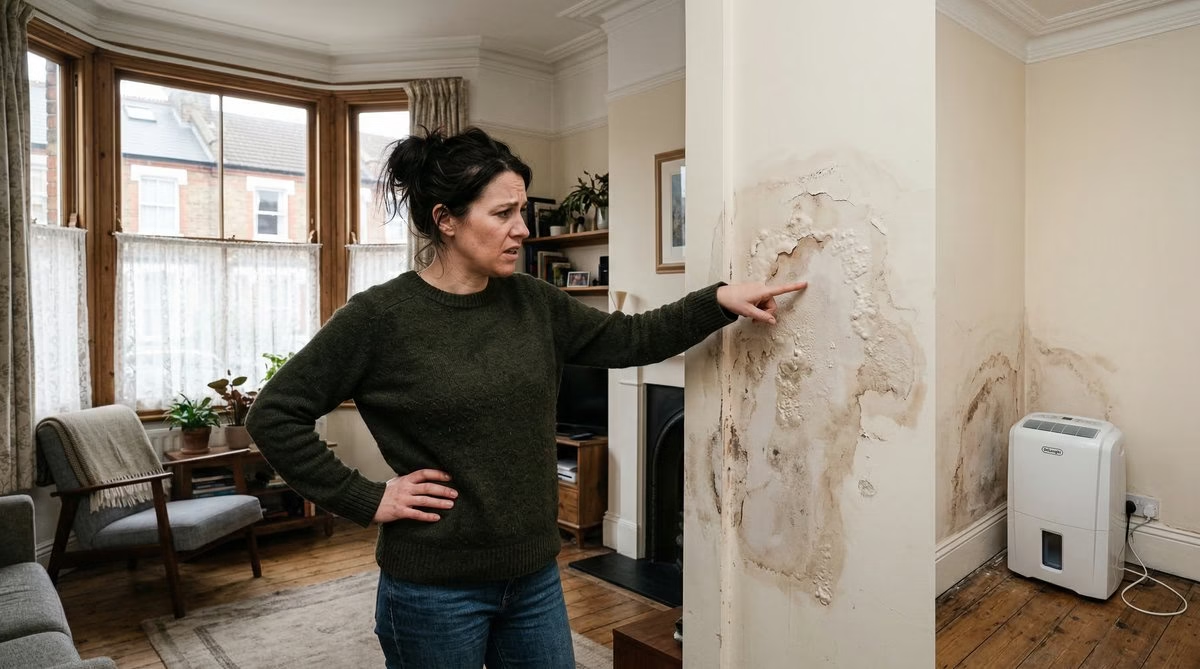
You paid a specialist. You endured weeks of disruption, replastering dust, and the chemical smell of injected cream. You waited. And then — there it was again. The dark tide mark on the wall. The bubbling paint. The musty smell you thought you had banished for good. If this sounds familiar, you are not alone: damp proofing failed treatments are one of the most common complaints we encounter at Fixiz, and understanding why they fail is the first step to getting a lasting fix.
Why Damp Treatment Fails — The Real Reasons
The damp proofing industry has a problem most companies would rather not discuss: a significant proportion of treatments do not work long term. In our experience, the failures almost always trace back to the same handful of root causes — none of them mysterious, and all of them avoidable with the right approach.
Wrong diagnosis — treating the symptom, not the source
The single most common reason damp returns after treatment is that the original diagnosis was wrong. This happens more often than you might expect, because many damp proofing companies send out surveyors who are, in reality, salespeople operating on commission. A moisture meter reading on a lower wall is taken as proof of rising damp — and a chemical damp-proof course injection is sold. But that same moisture meter reading can be produced equally well by condensation, by penetrating damp from a failed render or leaking gutter, or by a bridged external ground level. Injecting a chemical DPC does precisely nothing to solve any of those problems. The damp returns because the actual cause was never addressed.
External defects left unresolved
Even when rising damp is the correct diagnosis and a chemical DPC injection is appropriate, the treatment will fail if external defects are not corrected at the same time. A chemical damp-proof course creates a barrier inside the wall, but it cannot stop water that is being driven in from outside by defective pointing, a raised external ground level bridging the original DPC, a broken downpipe depositing water against the wall, or a solid concrete path laid flush against the masonry. These external routes simply bypass the new chemical barrier entirely.
Tip: Before accepting any damp treatment quote, ask the surveyor to list every external defect they have identified and to confirm which of those defects will be rectified as part of the works. If the answer is vague or the remedial scope covers only the internal injection and replastering, push back — the treatment is likely to fail.
Replastering done before walls had dried out
This is a failure mode that causes enormous frustration, because the treatment itself may have been correct — but the follow-on work was done too quickly. After a chemical DPC is injected, the wall still contains a significant amount of residual moisture. That moisture needs to migrate outward and evaporate over a period of months. The industry rule of thumb is one month per inch of wall thickness — meaning a standard 225mm solid brick wall will take between nine and twelve months to reach safe moisture levels.
When replastering is done too soon — within a matter of weeks, as is common — the residual moisture becomes trapped behind the new plaster. It pushes salts through to the surface, causes the plaster to blow, and eventually results in visible damp patches that look identical to the original problem. Homeowners understandably conclude the treatment has failed. In truth, the injection may have worked perfectly — but the replastering schedule undid it.
Ventilation not improved alongside treatment
Rising damp treatment in isolation rarely produces lasting results in properties with inadequate ventilation. Where rooms are poorly ventilated — particularly kitchens, bathrooms, and older solid-wall properties without trickle vents — warm moist air condenses against cold wall surfaces and produces moisture levels indistinguishable from rising damp. If that ventilation problem is not corrected as part of the treatment programme, the walls will remain wet regardless of what has been injected into them.
Tip: Ventilation is not an afterthought. If your surveyor does not discuss it as part of the damp treatment plan, that is a significant warning sign.
Tanking applied without addressing hydrostatic pressure
Tanking — applying a cementitious or slurry waterproof coating to basement and below-ground walls — can be highly effective when used correctly. But it fails consistently when the underlying hydrostatic pressure is not properly understood and addressed. Hydrostatic pressure is the force exerted by groundwater against the wall from the outside. If that pressure is significant and the tanking system is not engineered to withstand it, the coating will simply be pushed away from the wall substrate, delaminate, and allow water ingress through the resulting gaps.
In many cases the correct solution is a cavity drain membrane system that allows water to pass through in a controlled way and drain to a sump pump — rather than attempting to hold it back by force. We always assess hydrostatic pressure conditions before recommending a tanking specification, because getting this wrong means expensive repeat remediation.
How Long Should Damp Treatment Take to Show Results?
One of the most common sources of anxiety after damp treatment — and one that sometimes leads homeowners to incorrectly conclude that treatment has failed — is the timeline. The damp proofing industry does not communicate this well. Walls do not dry overnight. They do not even dry within a few weeks in most cases.
The accepted industry standard, consistent with guidance from the Property Care Association and broader building surveying practice, is as follows: a solid brick wall (225mm) will take between nine and twelve months to dry to safe moisture levels after a chemical DPC injection. Older stone walls or walls in properties with limited heating and ventilation can take longer. Cavity walls may reach acceptable levels in three to six months. Basements should be assumed to need twelve months or more.
If your walls still appear damp six months after treatment, this does not automatically mean failure — the drying process may simply still be underway. The key is to track moisture meter readings at regular intervals, not to make judgements based on visual appearance alone. That said, readings that are static or rising, new damp patches in untreated areas, or replastering that is blowing or cracking all warrant investigation rather than patience.
Tip: Ask your damp proofing company to provide moisture meter readings at the point of treatment completion, and agree a schedule of follow-up readings at three and six months. Any company confident in their work should welcome this.
What Damp Guarantees Actually Cover — and What They Don’t
The word “guarantee” is used extensively in damp proofing marketing. Ten-year guarantees, twenty-year guarantees, thirty-year guarantees — they feature prominently in quotations and are frequently cited as evidence of quality and confidence. In our experience reviewing the complaints that homeowners bring to us, the reality of these guarantees is considerably more limited than the marketing implies.
The critical distinction is this: most damp proofing guarantees cover the chemical injection itself — the product and the application of that product. They do not automatically cover the replastering, the remediation of external defects, or the root cause of the moisture problem. If damp returns because the replastering was done too soon, or because a leaking gutter was never repaired, the company may legitimately argue that these falls outside the guarantee scope.
Guarantees also commonly exclude condensation as a moisture source — meaning that if an independent surveyor were to establish that returning damp is condensation-related, the guarantee may be voided entirely. They often exclude problems arising from subsequent building works, changes to external ground levels, or any redecoration carried out by the homeowner before the wall has fully dried.
Additionally, guarantees issued by the company itself — rather than backed by an independent insurance provider with Financial Conduct Authority registration — are only as good as the company’s continued existence. If the company ceases trading, a non-insurance-backed guarantee is worthless. Always check whether the guarantee is underwritten by a named, FCA-regulated insurer. The Property Care Association operates a conciliation service for disputes, which can be a useful first step if you believe work has not met the required standard.
Getting an Independent Surveyor to Assess a Failed Treatment
If damp has returned after treatment and you are not getting satisfactory answers, commissioning an independent damp survey is the most important step you can take. An independent surveyor — one who does not sell remedial treatments and has no financial interest in the outcome — will carry out a diagnostic assessment using calibrated moisture meters, thermal imaging where appropriate, and a thorough external inspection.
The resulting report will establish what is actually causing the damp, whether the original treatment was appropriate and correctly carried out, and what remediation is now required — giving you both clarity and the documented evidence needed for any dispute.
Costs typically range from £150 to £400. Look for a Chartered Building Surveyor (MRICS/FRICS) or a specialist holding the Certificated Surveyor in Remedial Treatments (CSRT) qualification. Avoid asking the original company to assess whether their own work has failed — the conflict of interest is obvious.
Tip: Keep all documentation from the original treatment: the survey report, the specification, the contract, all correspondence, and any photographs taken before works began. This evidence is essential if you need to make a claim.
Your Rights Under the Consumer Rights Act 2015
If damp proofing work has been carried out and it has not resolved the problem, you have legal rights that many homeowners are not aware of. Under the Consumer Rights Act 2015, services must be carried out with reasonable care and skill. Where a service fails to meet this standard, the trader is obliged to either redo the work — or, if that is not possible or they refuse — to provide a price reduction or refund.
The Act applies to contracts between consumers and traders, which covers the vast majority of domestic damp proofing work. If the work has not been carried out with reasonable care and skill — for example, if the diagnosis was incorrect, if the treatment specification was inappropriate, or if replastering was completed before the wall had dried — you have grounds to require the company to make it right.
In practice, the process begins with a formal written complaint giving the company 28 days to respond and propose a remedy. If they are a Property Care Association member, the association’s dispute resolution process may be faster than litigation. For unresolved disputes, small claims court (up to £10,000) is accessible without legal representation. An independent surveyor’s report is central to any claim — without documented evidence from a qualified independent expert, it is difficult to establish your case.
How Fixiz Approaches Damp Differently
At Fixiz, every assessment starts with a thorough diagnostic process — checking moisture readings at multiple heights and depths, inspecting external details, reviewing construction and ventilation, and ruling out condensation and penetrating damp before any treatment is recommended. We have seen too many properties where expensive chemical DPC injection was carried out when the real problem was a broken render detail or a blocked air brick.
When we do recommend treatment, we are explicit about what it covers and what it does not. We specify the replastering schedule in writing, with moisture meter readings as the threshold for when replastering can begin — not an arbitrary number of weeks. We have found that the most common driver of dissatisfaction in this sector is not bad workmanship but bad communication. Homeowners are told a job will take two to three days and then discover the drying and replastering process runs to months. That is not a surprise if it is communicated clearly from the start.
We also make clear from the outset what our guarantees cover and what they do not. We would rather lose a customer to a competitor offering an inflated thirty-year guarantee than sell a promise we cannot keep. If damp has returned after treatment elsewhere, we can give you an honest assessment of what went wrong and what correct remediation looks like.
Frequently Asked Questions
How do I know if my damp proofing treatment has genuinely failed or just needs more time?
Track moisture meter readings over time. A correctly treated wall should show a gradual reduction in readings month by month. Static or rising readings, new patches in untreated areas, or blowing plaster all suggest a genuine problem. Visual appearance alone is unreliable — walls can look damp for many months after successful treatment as residual moisture evaporates.
Can I claim a refund if my damp treatment has failed?
Yes. Under the Consumer Rights Act 2015, services must be carried out with reasonable care and skill. If they are not, you can require the trader to redo the work, or claim a price reduction or refund. Start with a formal written complaint, then use the Property Care Association’s conciliation service if applicable, or small claims court for unresolved disputes up to £10,000.
Does a damp proofing guarantee cover replastering?
This varies between companies and contracts, and the answer is often no — or only partially. Many damp proofing guarantees are limited to the chemical injection product and its application, excluding associated replastering, external repairs, or the root cause of moisture. Read the guarantee document carefully before signing any contract, and ask specifically whether the replastering is covered and under what circumstances the guarantee can be voided. If the guarantee is not backed by a named, FCA-regulated insurer, it may be worthless if the company ceases trading.
How long after damp treatment should I wait before replastering?
The industry standard is one month per inch of wall thickness — meaning a 225mm solid brick wall needs nine to twelve months before conventional replastering. Moisture meter readings, not the calendar, should determine when the wall is ready. Replastering too soon traps residual moisture, pushes salts to the surface, and causes the plaster to fail.
What type of surveyor should I use to assess failed damp treatment?
Use an independent surveyor with no financial interest in selling treatments — a Chartered Building Surveyor (MRICS/FRICS) or a specialist holding the Certificated Surveyor in Remedial Treatments (CSRT) qualification. An independent assessment costs £150–£400 and provides the documented evidence needed to understand what went wrong and pursue any dispute.
Can damp return even after a correctly installed chemical DPC?
Yes. A chemical DPC addresses only one moisture pathway: capillary rise from ground-level moisture. It does not address penetrating damp, condensation, or hydrostatic pressure. If any of these other sources were present and untreated, damp will return regardless of how well the injection was carried out — which is precisely why correct initial diagnosis matters so much.
Ready to move from confusion to construction? Get in touch with Fixiz today for a no-pressure chat about your project and the fastest route to full compliance.