Physical address:
128 City Road, EC1V 2NX, London,UK

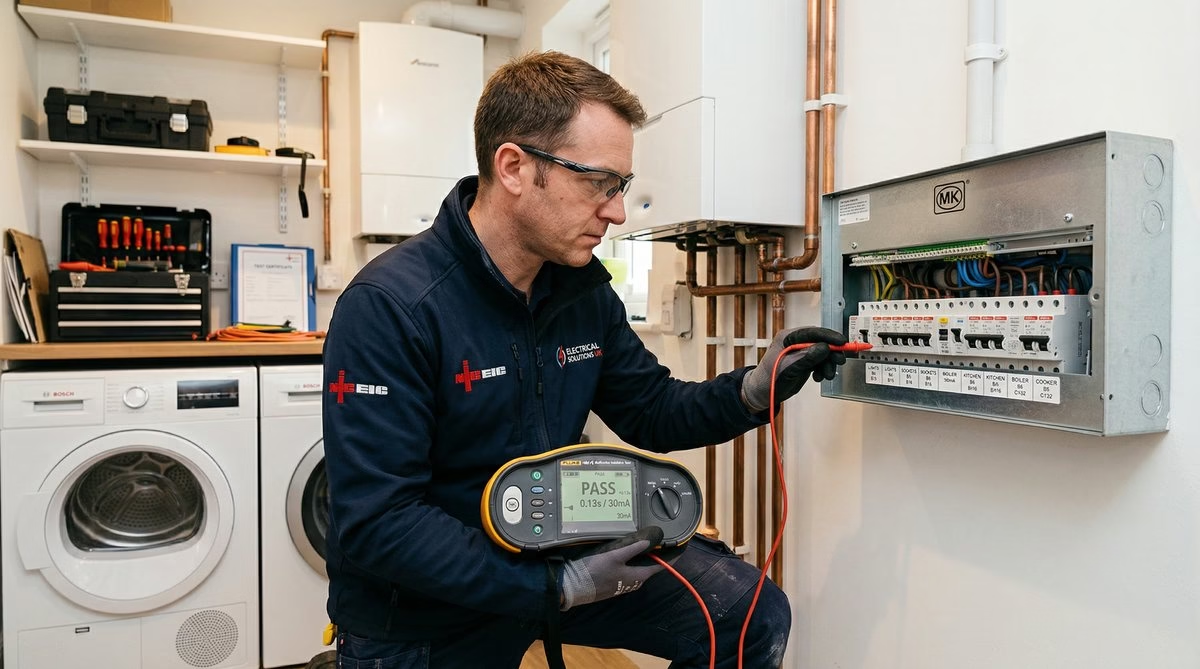
We’ve been getting calls from landlords across London panicking about the same thing: their EICR renewal is coming up, and they’re worried the property is going to fail. The concerns aren’t unfounded. A wave of five-year renewals is now hitting properties that were first tested in April 2021 — right when the Electrical Safety Standards in the Private Rented Sector (England) Regulations 2020 came into force. That means April 2026 is a crunch point for thousands of landlords simultaneously.
On top of that, the rules changed in November 2025. The maximum fine for non-compliance jumped from £30,000 to £40,000. Councils are actively enforcing, and the financial stakes have never been higher. Whether you’re a landlord managing a portfolio, a first-time buy-to-let owner, or a homebuyer whose surveyor flagged electrical concerns — this guide covers exactly what happens if your property has an EICR failed result, and what you need to do about it.
Tip: If your property had its first EICR in spring 2021 under the new regulations, your 5-year renewal falls due in April 2026. With updated BS 7671 18th Edition standards now in force, many properties that passed first time are likely to receive C2 codes on re-inspection. Book early — qualified electricians are getting booked out weeks in advance across London.
What Does an EICR Failed Result Actually Mean?
Let’s clear something up right away, because we explain this to clients constantly: your property doesn’t “fail” an EICR the way a car fails an MOT where the whole thing is condemned. An EICR — Electrical Installation Condition Report — is a detailed assessment of your fixed wiring, consumer unit, earthing and circuit protection. The electrician goes through everything methodically and assigns observation codes to anything that doesn’t meet the current standard.
The report as a whole comes back as either Satisfactory or Unsatisfactory. An Unsatisfactory result doesn’t mean your house is about to burst into flames — it means one or more observations have been graded at a level that requires action. The grading system is what most people find confusing, and frankly, most guides don’t explain it clearly enough.
Here are the four observation codes in plain English:
- C1 — Danger Present: An immediate risk of injury or death exists. Examples include live conductors exposed, a socket with no earth, or badly scorched wiring. The circuit may need isolating on the spot. This causes the report to be Unsatisfactory and requires immediate remedial action — sometimes within 24 or 48 hours rather than the standard 28 days.
- C2 — Potentially Dangerous: Not an immediate hazard but could become one. Common examples are no RCD protection on socket circuits, inadequate earthing, a plastic consumer unit, or missing main bonding. The installation isn’t about to hurt anyone today, but it poses a genuine risk over time. This causes the report to be Unsatisfactory and must be fixed within 28 days.
- FI — Further Investigation Required: The electrician suspects a problem but can’t confirm it without more investigation — for example, inaccessible wiring, suspected buried junction boxes, or a tripping circuit with no obvious cause. This is not a pass; it’s a deferred judgement. It causes the report to be Unsatisfactory and must be investigated within 28 days.
- C3 — Improvement Recommended: The installation is safe but below modern best practice — for example, older-style wiring that still functions safely. C3 does not fail the report. There is no legal obligation to act, though sensible landlords often address C3 items during the same visit to avoid them escalating at the next inspection.
A C2 means the installation is in a grey zone — it’s not going to hurt someone tomorrow, but it’s not acceptable to leave it long-term. The 28-day window is the law’s way of saying: fix it quickly, but we’re not asking you to down tools and rewire overnight.
The Landlord Track — Your Legal Obligations After an EICR Failed Result
For private landlords in England, the rules are crystal clear and the consequences of ignoring them are now severe. Under the Electrical Safety Standards in the Private Rented Sector (England) Regulations 2020, as amended on 1 November 2025, here is exactly what you are required to do if your EICR comes back Unsatisfactory.
Step 1 — Arrange and complete remedial work within 28 days
Any C1, C2 or FI observation must be resolved within 28 days of receiving the EICR — or within whatever shorter timeframe the electrician has specified on the report itself. A C1 observation, for example, might stipulate the work must be done within 24 or 48 hours. You cannot simply note the finding and move on.
Step 2 — Obtain written confirmation of completed work
Once the remedial work is done, the electrician who carried it out must issue written confirmation that the work has been completed. In practice, this is typically a Minor Electrical Installation Works Certificate or, if a full consumer unit replacement was carried out, a new Electrical Installation Certificate. Keep this document — you’ll need it.
Step 3 — Provide copies to tenants and the local authority
The EICR itself — along with written confirmation of any remedial works — must be provided to your existing tenants within 28 days of the inspection. New tenants must receive a copy before they move in. Any prospective tenant who requests it in writing must receive it within 28 days of that request. If the local authority asks for it, you have 7 days to provide it.
Tip: As of 1 November 2025, local authorities can issue financial penalties of up to £40,000 for each breach of the electrical safety regulations — increased from £30,000. They can also arrange the remedial work themselves and recover the cost from you. Enforcement is increasing: councils retain the revenue from fines, which creates a direct financial incentive to pursue non-compliant landlords.
Can tenants stay in the property?
In most cases, yes. Unless a C1 fault requires immediate circuit isolation, your tenants can remain in the property while remedial work is arranged and carried out. Where a circuit has been isolated as a precaution — which we’ll often recommend on a C1 involving the cooker circuit or bathroom wiring — we work with landlords to get that circuit back live within 24–48 hours as a priority.
What if the tenant won’t allow access?
The November 2025 amendments introduced a statutory “reasonable steps” defence. If a tenant actively refuses entry for the EICR inspection or remedial work, you won’t automatically be in breach — provided you can evidence that you took all reasonable steps to gain access. That means written requests, documented phone calls, and dated emails. You are not required to bring legal proceedings to prove this defence, but you must have a paper trail. Keep everything.
The Homebuyer Track — What Happens When a Survey Flags Electrical Issues
Homebuyers sit in a very different legal position to landlords — but the practical stakes can be just as significant. There’s no legal obligation for homeowners to hold a current EICR, but in 2026, most competent conveyancers and surveyors will flag electrical concerns during a property purchase, and the consequences for your purchase price or completion timeline can be considerable.
One property we evaluated in Islington recently had an EICR failed result commissioned as part of a pre-purchase survey because the consumer unit was a 1990s plastic board with no RCD protection on any circuit. The buyer was looking at a £700 upgrade minimum — and that’s a relatively straightforward fix. The surveyor had noted the age of the installation but hadn’t estimated costs. The buyer used our written quote to negotiate £1,200 off the purchase price, covering the consumer unit and a few additional remedial items we identified.
How to use a failed pre-purchase EICR as negotiating leverage
If a survey recommends an EICR and the property fails, you have several options:
- Ask the seller to fund remedial work before completion: This is the cleanest outcome — you take ownership of a property with a current satisfactory EICR.
- Negotiate a price reduction: Get written quotes from a qualified electrician (we provide these free of charge for buyers in London) and use the remedial cost figures to reduce the offer.
- Retain funds in escrow until completion: Your solicitor can arrange for the cost of works to be held back from the seller’s proceeds until you have confirmation the work is done.
- Walk away: If the property is older and the EICR reveals widespread C2 observations or a likely full rewire, the remedial cost could exceed £6,000–£9,500 in London. That changes the purchase economics significantly.
The remortgage scenario
Some mortgage lenders — particularly for older properties — are now requesting evidence of a current satisfactory EICR as a condition of advancing funds. If your existing EICR has lapsed and the renewal fails, you may find your remortgage offer conditional on remedial works being completed. Plan your EICR renewals ahead of any planned remortgage, not after you’ve received your mortgage offer.
Why Properties That Passed 5 Years Ago Are Now Failing an EICR
This is the question we get more than any other right now, and it genuinely confuses landlords. “Nothing has changed at the property — why is it failing?” The answer lies in how electrical compliance standards have evolved, not in anything your tenants have done.
The current wiring regulations standard is BS 7671:2018 + Amendment 2:2022 — commonly called the 18th Edition. All EICR inspections must assess your installation against this standard. Here’s what changed and why it’s catching properties out:
1. Expanded RCD protection requirements
Under the 18th Edition, all socket outlet circuits rated 32A or less in domestic installations require 30mA RCD protection. Older properties often have consumer units with a single RCD protecting some — but not all — circuits, or no RCDs at all. If your board doesn’t provide the required RCD coverage, that’s typically a C2. In our experience, this is the single most common fail point we see across London properties built before 2010.
2. Metal consumer units as standard
The 18th Edition requires consumer units in domestic premises to be housed in a non-combustible enclosure — in practice, a metal case. Older plastic consumer units are now C2. This change alone is responsible for a significant proportion of the EICR failed results we’re currently dealing with on renewal inspections.
3. Stricter interpretation of earthing and bonding
Requirements for main protective bonding — connecting gas and water service pipes to the earth — have been tightened in their application. Many older installations have bonding that was adequate under previous editions but now receives a C2 or C3 observation under 18th Edition assessment.
4. Surge Protection Devices (SPDs)
Amendment 2 introduced mandatory risk assessment for SPDs. While the absence of an SPD doesn’t automatically result in a fail, the risk assessment must be documented. In practice, many older boards are flagged with at least a C3 for SPD consideration.
Tip: A property that passed its EICR in 2021 and now has an EICR failed result in 2026 has not necessarily developed new faults. In many cases, the same installation that was compliant under the 17th Edition framework is now non-compliant under 18th Edition assessment. The standard has moved; the wiring hasn’t. This means the remedial work is often a straightforward upgrade — typically a consumer unit replacement — not a sign of systemic electrical failure.
London Remedial Costs — What You’re Actually Looking At
One thing that’s missing from almost every EICR guide is an honest, location-specific cost breakdown. Labour costs in London are higher than the national average, and parts costs vary by property type and age. Here’s what we charge — and what comparable firms charge — for the most common remedial work arising from EICR failed results in London properties.
- Consumer unit upgrade (metal enclosure, full RCD protection): Typically £400–£900. Addresses C2 codes for a plastic consumer unit and missing RCD coverage. Usually a half to full day’s work.
- RCD retrofit / split-load board installation: Typically £300–£600. Addresses C2 codes for partial or missing RCD protection. Usually 3–5 hours.
- Main bonding to gas and/or water services: Typically £100–£250. Addresses C2 codes for inadequate main bonding. Usually 1–2 hours.
- Socket replacement (damaged, no earth, exposed terminals): Typically £80–£150 per socket. Addresses C1 and C2 codes. Usually 30–60 minutes per socket.
- Light fitting replacement / rewire of lighting circuit: Typically £80–£300. Addresses C2 and C3 codes. Usually 1–3 hours.
- Surge Protection Device (SPD) installation: Typically £150–£350. Addresses C3 codes for SPD risk assessment. Usually 1–2 hours.
- Partial rewire (e.g., single floor, extension, loft conversion): Typically £1,500–£3,500. Addresses multiple C1 and C2 codes. Usually 1–3 days.
- Full rewire — 2-bed flat, London: Typically £4,500–£6,500. Addresses widespread C1 and C2 codes and outdated wiring. Usually 3–5 days.
- Full rewire — 4-bed house, London: Typically £6,500–£9,500. Addresses widespread C1 and C2 codes and outdated wiring. Usually 5–10 days.
The good news: the vast majority of EICR failed results we deal with require only a consumer unit upgrade — not a full rewire. In our experience, more than 70% of properties receiving a first-time EICR renewal failure need nothing more than a new metal consumer unit with proper RCD protection fitted. That’s a half-day job, typically costing £400–£700 in London, and the property is back to compliant before the working day is out.
Full rewires are reserved for properties with aluminium wiring, rubber-sheathed cables in very poor condition, or installations that are so extensively modified and undocumented that a fresh start is the only safe option. If a property needs a full rewire, we’ll tell you clearly and honestly in our initial assessment — you’ll never get a rewire recommendation from us when a consumer unit upgrade will suffice.
How Fixiz Handles EICR Failures Across London
We’ve handled hundreds of EICR renewals and remedial jobs across London — from Victorian terraces in Hackney to purpose-built flats in Canary Wharf. Our electricians are NICEIC-registered, we carry out all compliance paperwork, and we always explain exactly what we’re doing and why.
When a landlord calls us with an EICR failed result, our process is straightforward. We review the report, identify the exact observations, provide a written quote the same day, and schedule the remedial work — typically within the same week. Once the work is complete, we issue the appropriate certification immediately so you can provide copies to your tenants and local authority without delay.
For homebuyers, we offer free pre-purchase EICR inspections across London. If the property fails, we provide a detailed written remedial scope and cost estimate that your solicitor can use in negotiations before exchange.
Tip: Don’t wait until you receive an Unsatisfactory EICR to start planning. If your 5-year renewal is approaching in 2026, book the inspection now. With the April 2026 deadline wave in full effect, availability with qualified NICEIC-registered electricians across London is tightening week by week.
What to Do Right Now if Your EICR Failed
If your EICR is due for renewal in 2026 — or you’ve just received an Unsatisfactory result — here’s the short version of what we’d tell you face-to-face:
- Don’t panic: Most EICR failed results are resolved with a consumer unit upgrade. It’s a half-day job, not a rewire.
- Act quickly: The 28-day clock starts from the date you receive the report, not from when you accept a quote. Book your remedial electrician the same week.
- Document everything: Keep the original EICR, all written quotes, the electrician’s completion certificate, and records of all tenant communications. This protects you if the council ever asks questions.
- Don’t delay your renewal inspection: With the April 2026 deadline wave, qualified electricians in London are booking out weeks in advance. If your renewal is due soon, get in touch today.
Ready to move from confusion to construction? Get in touch with Fixiz today for a fast, professional EICR test or remedial electrical work across London.
Frequently Asked Questions — EICR Failed: What Happens in the UK
What happens if a rental property fails an EICR in the UK?
If your property receives a C1, C2 or FI code on its EICR, the report is classified as Unsatisfactory. As a landlord, you are legally required to arrange and complete remedial or investigative work within 28 days — or sooner if the report specifies. You must then obtain written confirmation of completed works and provide copies to your tenant and the local authority on request. Failure to comply can result in a fine of up to £40,000.
What is the difference between C1, C2, C3 and FI on an EICR?
C1 means danger is present and the circuit may need isolating immediately. C2 means a potentially dangerous condition that must be fixed within 28 days. FI means further investigation is required — a suspected fault that also causes an Unsatisfactory result. C3 means an improvement is recommended but the installation is safe and the report passes. Only C1, C2 and FI observations result in an Unsatisfactory EICR.
Can I still rent out my property if it fails an EICR?
You cannot legally grant a new tenancy with an Unsatisfactory EICR in place. Existing tenants can generally remain during remedial work, unless an immediate C1 danger requires isolation of a circuit. Once remedial work is complete and written confirmation is obtained, the property is compliant and can be let.
Why is my property failing now when it passed 5 years ago?
The BS 7671 18th Edition wiring regulations — updated by Amendment 2 in 2022 — raised the bar for what constitutes a safe installation. Installations that met the previous standard may now receive C2 codes for lacking full RCD coverage, having a plastic consumer unit, or missing bonding. The installation hasn’t deteriorated; the compliance threshold has been raised. A consumer unit upgrade typically resolves these issues.
What is the April 2026 EICR deadline for landlords?
Properties that had their first EICR under the Electrical Safety Standards in the Private Rented Sector Regulations in April 2021 are now hitting their mandatory 5-year renewal deadline. This creates a concentrated wave of inspections in spring 2026. Landlords with properties in this renewal window need to book promptly — availability with qualified NICEIC-registered electricians in London is tightening.
What are the new EICR fine amounts in 2026?
As of 1 November 2025, the maximum financial penalty for breaching the Electrical Safety Standards regulations increased from £30,000 to £40,000 per breach. Local authorities can also arrange remedial work and recover the cost from the landlord separately. Enforcement activity is increasing, with councils retaining fine revenue.
How much does it cost to fix a failed EICR in London?
The most common remedial job following an EICR failed result is a consumer unit upgrade: typically £400–£900 in London. An RCD board upgrade costs £300–£600. Individual repairs — sockets, bonding, fittings — are usually £80–£250 each. Full rewires range from £4,500 for a 2-bed flat to £9,500 for a larger house. The majority of EICR failures only require a consumer unit replacement.
Does a homebuyer need an EICR?
There is no legal obligation for homeowners to hold a current EICR. However, if a home buyer’s survey flags electrical concerns, commissioning an EICR provides clarity and — if the property fails — creates leverage to negotiate on price. We regularly carry out pre-purchase EICR inspections across London for buyers who want certainty before exchange.
Do I need a full new EICR after remedial work?
Not always. In most cases, the electrician who carries out the remedial work issues written confirmation — a Minor Works Certificate or Electrical Installation Certificate — that resolves the Unsatisfactory findings. A full new EICR is only required if major new work was carried out, or if the original report recommended one. Your 5-year clock continues to run from the original inspection date.
What is the EICR 28-day rule?
The 28-day rule refers to the legal obligation for private landlords in England to complete all remedial and investigative work identified in an Unsatisfactory EICR within 28 days of receiving the report — or within a shorter period if the report specifies it. This deadline is a hard legal requirement, not a guideline. Missing it exposes you to enforcement action and fines of up to £40,000.