Physical address:
128 City Road, EC1V 2NX, London,UK

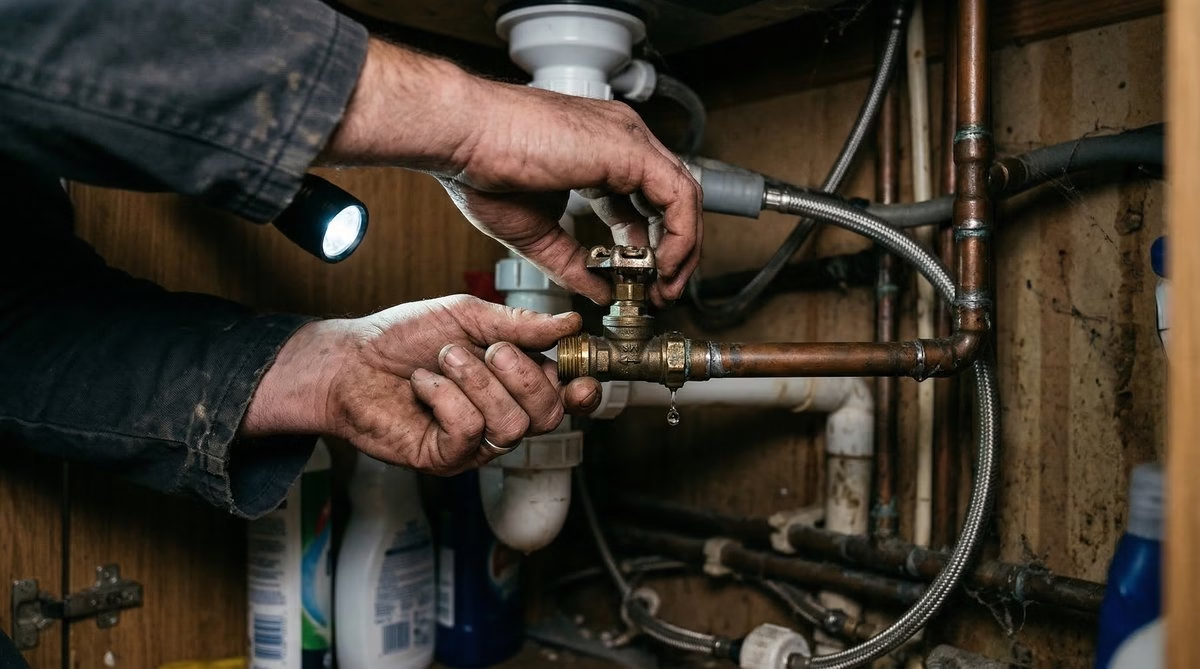
If you’ve noticed your water meter spinning even when everything looks “off”, you’re not being dramatic — in the UK it can mean you’ve got a hidden leak somewhere between the street and your internal pipework, or a problem on your side of the supply. Either way, every hour matters because a small underground leak can turn into a big bill, damp patches, and even structural issues if water starts tracking under floors.
We’re Fixiz Ltd in London. We deal with leaks in real homes — Victorian terraces, 1930s semis, flats with shared risers — and the first thing we do is slow the situation down, then work methodically so you don’t dig up half the property for guesswork.
Why a water meter can spin when you can’t see a leak
A meter only measures flow. If it’s moving, water is passing through it — but the leak might be underground, behind finishes, or feeding something you didn’t realise was connected. In London and the wider UK, common scenarios include a split service pipe in the front garden, a leaking stop tap, a pinhole in a pipe under a solid floor, or a faulty appliance fill valve quietly topping up.
What makes this stressful is that the leak often isn’t “wet” on the surface. Water can follow backfilled trenches, run along the outside of a pipe, or soak into sub-base under paving. By the time you see staining, you’ve already paid for a lot of water.
- Underground routing: Supply pipes often run under paths, drives, or flower beds, so the leak is hidden.
- Capillary spread: Water can travel under screeds and reappear far from the source.
- Intermittent leaks: Some leaks only show when pressure changes or when a valve opens.
- Appliance top-ups: Toilets, boilers, and heating systems can “sip” water continuously when a valve fails.
Tip: If the meter is spinning fast, treat it as urgent — turn to isolation tests immediately rather than waiting to “see if it stops”.
Step-by-step: how to isolate where the leak is (UK method)
Before any specialist kit comes out, we start with isolation. The goal is to answer one question: is the leak inside your home, or on the supply between the meter and your internal stop tap? That single answer determines whether you call your water supplier, an insurer, or a leak detection specialist — and it stops you paying for the wrong work.
Here’s the process we follow (and what you can do safely as a homeowner):
- Stop using water completely: No washing machines, dishwashers, showers, or taps while you test. Even a small use makes results unreliable.
- Check the meter “leak indicator”: Many UK meters have a small triangle/star wheel that moves with tiny flows. If it’s moving, there’s flow.
- Turn off the internal stop tap: This is usually under the kitchen sink, in a downstairs WC, or in a service cupboard.
- Re-check the meter: If the meter stops, the leak is likely inside the property after the stop tap. If it keeps moving, the leak is likely between the meter and your stop tap (often underground).
- Document the reading and time: Take a photo of the meter reading and the indicator. Repeat after 30–60 minutes.
Once we know which side it’s on, we narrow it down without guesswork. For internal leaks, we’ll isolate circuits (kitchen cold, bathroom cold, heating fill loop) and look for pressure drops or thermal anomalies. For external supply leaks, we plan the least disruptive route to confirmation.
- If the meter stops with the internal stop tap off: Focus on internal pipework and appliances.
- If the meter still moves: Suspect the incoming supply pipe, boundary valve, or buried fittings.
- If movement is tiny: A slow leak is still a leak — it just means you need longer observation and better isolation.
Tip: If your internal stop tap doesn’t fully shut off, don’t force it. We can replace stop taps and add better isolation valves as part of a proper leak plan.
Who is responsible in the UK — water company or homeowner?
Responsibility is often split. In most UK setups, you’re responsible for the supply pipe on your land up to the point it enters your property, and the water company is responsible for the main and sometimes parts of the connection. The detail varies by region and property type, which is why isolating the leak location matters before you start paying contractors or opening an insurance claim.
From a practical point of view, this is how we advise clients:
- Leak between meter and internal stop tap: Often still the homeowner’s issue (private supply pipe), even though it’s “before” your indoor plumbing.
- Leak on the street side or shared main: Usually the water supplier’s responsibility, but you still need evidence and a clear description.
- Flats with shared risers: Responsibility can sit with the freeholder/managing agent, not an individual flat owner.
- New builds: There may be warranty routes, but you still need accurate leak location and reporting.
We can help you create a clean evidence pack — meter readings, isolation test results, photos, and a clear description — which speeds up conversations with suppliers and insurers and reduces “bounce-back” between parties.
What leak detection involves (and how to avoid expensive guesswork)
Proper leak detection is not “let’s dig where it feels wet”. It’s a combination of tests that narrow down the leak to a zone, then confirm the exact point before invasive works. The right approach depends on the leak type — pressurised cold supply behaves differently to a heating leak, and both behave differently to a waste pipe leak.
Depending on the situation, we may use:
- Acoustic tracing: Listening for turbulence at fittings and along buried runs.
- Thermal imaging: Identifying temperature differences where water is cooling or heating finishes.
- Moisture profiling: Mapping affected materials to see how water is spreading.
- Pressure testing: Confirming whether a circuit holds pressure over time.
- Targeted opening-up: Small inspection points in sensible locations, not random holes.
Our priority is always the same: confirm the leak location before you pay for reinstatement. London reinstatement is often the most expensive part — paving, timber floors, screeds, tiles, decorating — so the “find” stage must be accurate.
Tip: If someone can’t explain their method beyond “we’ll have a look”, pause. A good leak plan should describe the tests, what each test proves, and what counts as confirmation.
How we help you get control quickly (London-focused)
When you call us about a spinning meter, we aim to get you from panic to a controlled plan in a single visit or two. We start with isolation and evidence, then we confirm the leak location, and only then do we recommend the most cost-effective repair route.
- Fast triage: We help you isolate the leak and stop unnecessary flow.
- Non-destructive focus: We prioritise methods that reduce opening-up and reinstatement costs.
- Clear next steps: You’ll know whether to call the water company, claim on insurance, or proceed with repair.
- Repairs and making good: If you want one contractor to handle the full chain — locate, repair, reinstate — we can do that.
FAQ — water meter spinning and hidden leaks
How long should I monitor my meter to confirm a leak?
If the leak indicator is moving continuously, you already have confirmation. For very slow leaks, take a photo, wait 30–60 minutes with no water use, then compare the readings. Longer monitoring makes small leaks easier to prove.
Could it just be a faulty meter?
It’s possible but uncommon. In practice, most spinning meters reflect real flow. Do the internal stop tap test first — it gives you a strong answer without arguing about the meter.
Will turning off the internal stop tap stop the leak?
Only if the leak is inside the property after that valve. If the leak is between the meter and the stop tap, you may need the external boundary valve or water supplier support.
Can a leaking toilet make the meter move?
Yes. A toilet fill valve that doesn’t shut properly can cause constant top-up flow. That’s why we isolate the internal stop tap and then check individual appliances if the meter stops.
Ready to move from confusion to construction? Get in touch with Fixiz today for a no-pressure chat about your leak symptoms, the quickest isolation checks, and the most cost-effective route to a confirmed repair.