Physical address:
128 City Road, EC1V 2NX, London,UK

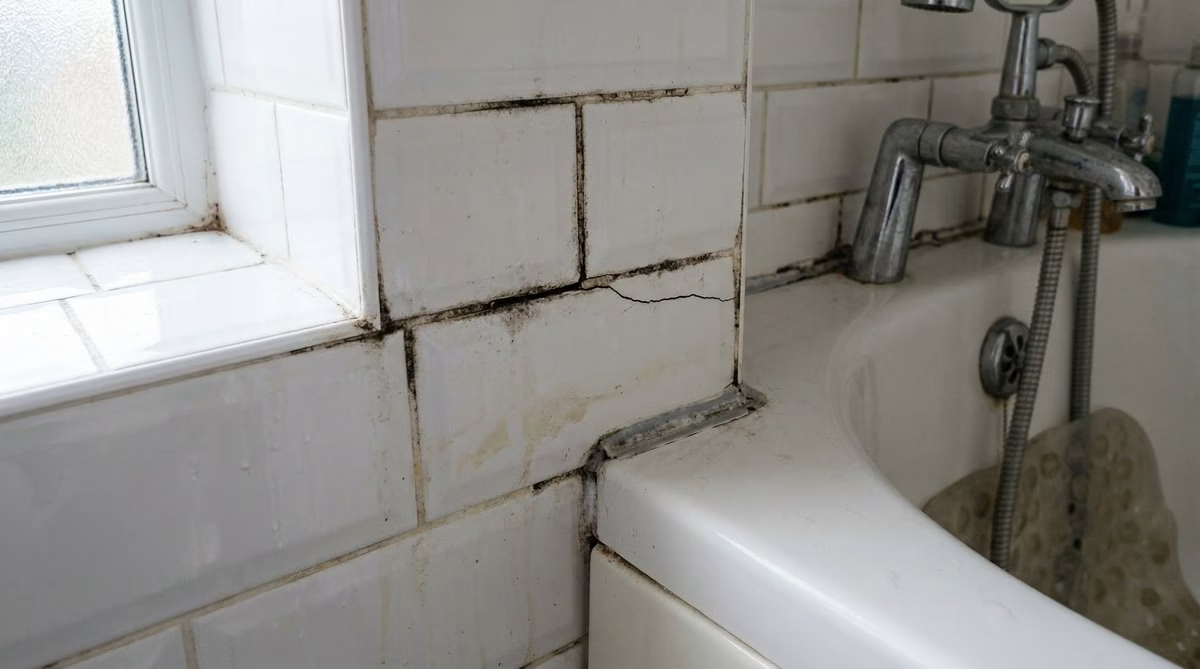
Few bathroom problems are as demoralising as watching a damp patch spread across the ceiling of the room below — and knowing that somewhere behind your tiles, water is finding a way through. The question of whether to water leaking behind bathroom tiles regrout or remove tiles is one we hear constantly at Fixiz, and the honest answer is: it depends on exactly where and why the water is getting in. This guide cuts through the noise, explains what the different symptoms mean, and gives you a clear framework for deciding between a surface repair and a full strip-back — without wasting money on a fix that will fail within a year.
Understanding where bathroom water ingress actually comes from
The first and most important step is identifying the true source of the water. In our experience, homeowners often assume the problem is the grout joints — and sometimes they’re right — but there are several other failure points that produce identical symptoms and require completely different treatments.
Grout joint failure
Grout is a cementitious or epoxy material that fills the joints between tiles. Standard cement-based grout is not inherently waterproof — it is water-resistant when new and sealed, but over time the sealant degrades, the grout itself can crack or shrink as the substrate moves, and biological growth (black mould in the joints) creates micro-channels that allow water to penetrate. This is the most common cause of water ingress in older bathrooms and is often correctable without full tile removal.
Silicone seal failure at junctions
The junction between the tile field and the bath, shower tray, or floor is always sealed with silicone rather than grout — because this junction is subject to constant movement as the bath or tray flexes under load. Silicone degrades over time: it splits, peels away from one surface, or develops mould throughout its depth that cannot be cleaned. Failed silicone is extremely common and is responsible for a large proportion of the “water behind tiles” calls we receive. The good news is that silicone replacement is straightforward and cheap — but it must be done correctly or it will fail again within months.
Substrate or waterproofing failure
Behind the tiles lies a substrate — typically either a sand-cement render on blockwork, or (in more modern installations) a cement board or tile backer board such as Wedi, Hardie Backer, or similar. In a wet zone (shower enclosure, around a bath), there should also be a tanking layer: a brush-applied or sheet membrane applied directly to the substrate before tiling. If the substrate is plasterboard (still found in many pre-2000 bathrooms), if the tanking is absent or poorly applied, or if the substrate has been damaged by previous water ingress and has begun to delaminate, surface re-grouting will achieve nothing. The water will continue to penetrate because the problem is behind the adhesive, not in the grout joint.
Plumbing leaks
An underfloor waste pipe, a compression joint on a supply pipe in the void behind the wall, or a leaking shower valve cartridge can all produce symptoms that look identical to tile joint failure from the outside. Before committing to any tile work, it is worth ruling out a plumbing source — sometimes an acoustic or moisture-detection survey can do this non-invasively, and sometimes a borescope inspection through a drilled access hole is needed.
Tip: Run a simple test before spending any money. Dry the affected area thoroughly, then run the shower or fill the bath and drain it — but do not use the room for 48 hours. If the damp patch grows during the 48 hours, the problem is almost certainly water ingress through the tile zone. If it stays static or appears only after someone has used the room, a plumbing leak is more likely.
Re-grouting — when it works, when it doesn’t
Re-grouting is the least invasive and least expensive intervention. It involves raking out the existing grout to a depth of at least 6 mm, cleaning the joints thoroughly, and applying fresh grout followed by a penetrating sealer. In the right circumstances, it is a genuinely effective solution. In the wrong circumstances, it is money wasted.
When re-grouting is appropriate
- Grout-only deterioration: The grout joints are visibly cracked, discoloured, or friable, but the tiles themselves are sound and bonded firmly to the wall. No hollow spots when you tap across the tile faces.
- No substrate damage: There is no sign of mould behind the tiles (which would indicate moisture has been reaching the substrate for some time), and the tiles at the lowest course are not showing any salt efflorescence or soft adhesive.
- Correct silicone joints at junctions: The perimeter silicone joints are being addressed at the same time, not left in place. Re-grouting without replacing the silicone seals is a partial fix that will fail quickly.
- Short water exposure duration: The leak is relatively recent — within the last year or two — rather than a long-standing issue that has allowed water to saturate the substrate.
When re-grouting is not appropriate
- Hollow or debonded tiles: If tapping across the tile face produces a hollow sound (rather than a solid thud), the adhesive bond has failed — often because water has broken down the tile adhesive behind. Re-grouting these tiles achieves nothing; the water is already past the grout line.
- Visible mould at tile edges: Black mould that reappears within weeks of cleaning, or mould growth visible at the back edge of tiles that have lifted slightly, indicates persistent moisture in the substrate. Re-grouting addresses the symptom, not the cause.
- Plasterboard substrate: If the tiles are on plasterboard (common in bathrooms built before the mid-2000s), any significant water ingress will have degraded the board. Re-grouting won’t restore the substrate, and the tiles will eventually begin to loosen regardless.
- Damp patch growth: If the damp patch on the ceiling or adjacent wall is actively growing, the volume of water penetrating is beyond what a simple grout repair can address.
Tip: Use a screwdriver handle or a coin to tap systematically across every tile in the affected zone before deciding on a repair strategy. Mark hollow tiles with a pencil. If more than 10–15% of tiles are hollow, the economics usually tip decisively in favour of strip-back and re-tile.
Cladding over tiles — a false economy
One option that circulates on home improvement forums is to install PVC or acrylic cladding panels directly over the existing tiles. The appeal is obvious: no demolition, no mess, no specialist trades. The reality is considerably less reassuring.
Cladding over wet or damaged tiles traps existing moisture in the void between the cladding and the tile surface. That moisture has nowhere to go — it cannot evaporate, and it creates an ideal environment for mould growth. Over time, the adhesive or mechanical fixing holding the cladding may also fail if the substrate behind the tiles continues to deteriorate. Meanwhile, the original problem has not been fixed; it has been concealed.
There is one scenario where cladding can be a reasonable interim solution: where the tiles are fully sound, the grout is merely discoloured or slightly porous (not cracked or missing), the substrate is not damaged, and the homeowner explicitly needs a short-term cosmetic improvement before a planned full renovation. Even then, the silicone joints must be replaced first. We do not recommend cladding as a permanent fix for any bathroom where water has been getting behind the tiles.
When strip-back and re-tile is the right answer
A full strip-back involves removing all tiles, scraping the substrate, assessing and remedying any damage (including full replacement of plasterboard substrate with cement board or Wedi board), applying a tanking membrane to the wet zone, and re-tiling with new adhesive and grout. It is more expensive and more disruptive than a surface repair — but it is the only intervention that genuinely fixes substrate damage and guarantees a waterproof result.
What a proper strip-back and re-tile involves
- Substrate replacement: Any plasterboard must be replaced with a moisture-resistant cement board or tile backer board, properly fixed and with joints taped and sealed.
- Tanking: A brush-applied waterproof membrane (such as BAL Tanking Slurry, Mapei Mapelastic, or equivalent) applied to the full wet zone — floor, walls, and junctions — before tiling. This is the single most important step that many budget tilers skip.
- Movement joints: Perimeter joints between the tile field and the bath, tray, or floor must be left as silicone, not grouted. Every internal corner in a tiled wet area should technically be silicone, not grout.
- Correct adhesive specification: In a shower enclosure or wet room, use a flexible, S2-classified tile adhesive rather than a rigid adhesive — this accommodates the minor substrate movement that occurs with temperature cycling.
Tip: When getting quotes for a strip-back and re-tile, ask each contractor specifically whether their price includes tanking and substrate replacement if required. A quote that excludes these items is not a like-for-like comparison with one that includes them — and the contractor who omits them is almost certainly the one whose work will leak again within two or three years.
How Fixiz assesses and resolves bathroom water ingress
When we visit a bathroom with a reported leak, we follow a diagnostic sequence before recommending any works. We test for plumbing sources first. We tap-test every tile in the affected zone and record the results. We inspect the silicone joints and grout condition carefully. If there is any doubt about the substrate condition, we recommend a targeted removal of a small number of tiles — typically at the lowest course or at the junction with the tray — to inspect the substrate directly. The cost of this diagnostic step is trivial compared to the cost of applying the wrong fix.
We then present options with clear guidance on longevity: a re-grout and silicone replacement might be a five-to-ten-year solution in the right circumstances; a full strip-back and re-tile with correct tanking should last twenty-plus years if maintained. You choose with full information, not with a builder’s preference for the more expensive option.
All our bathroom tiling work is carried out to BS 5385 standards, with documentation of the tanking system used — which matters if you ever need to make a claim under a building warranty or a homebuyer survey flagged the issue.
Frequently asked questions
How much does re-grouting a bathroom cost in the UK?
For a typical family bathroom — around 5–8 m² of tiled wall — professional re-grouting (including raking out, cleaning, re-grouting, sealing, and replacing the perimeter silicone) typically costs between £300 and £600 in London and the South East, depending on tile size and joint complexity. Smaller bathrooms or shower enclosures only will be at the lower end of this range.
How long does re-grouting last?
A professionally done re-grout with a quality penetrating sealer applied correctly should last between five and ten years in normal use, provided the substrate is sound and the silicone joints are also in good condition. In a high-use family shower, the lower end of that range is more realistic.
Can I re-grout my bathroom myself?
The task is physically straightforward but time-consuming — raking out the existing grout is the tedious part, and it must be done thoroughly or the new grout will not bond correctly. The most common DIY mistake is failing to rake deep enough, leaving the new grout sitting on top of the old rather than bonded to the tile edges. The second most common mistake is grouting the silicone joints at corners and perimeters rather than replacing them with silicone.
What is the typical cost of a bathroom strip-back and re-tile in London?
For a medium-sized bathroom, a full strip-back (tiles, adhesive, and plasterboard substrate), supply and fit of cement board, tanking, and re-tile with mid-range tiles typically ranges from £2,500 to £5,000 in London, excluding the cost of sanitary ware replacement. The range reflects tile choice, accessibility, and the extent of substrate damage found on opening up.
Ready to move from confusion to construction? Get in touch with Fixiz today for a no-pressure chat about your project and the fastest route to full compliance.