Physical address:
128 City Road, EC1V 2NX, London,UK

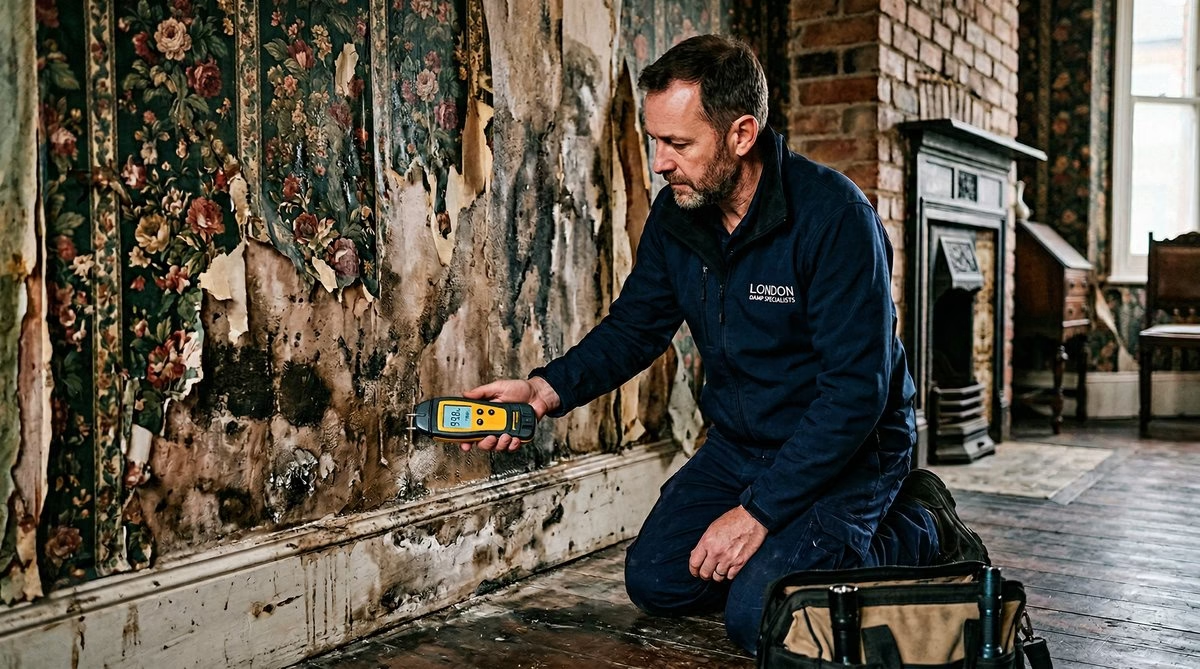
I’ve inspected hundreds of London homes for damp over the years, and there’s a pattern I see constantly: homeowners who’ve already spent thousands on a treatment that didn’t work. Nine times out of ten, the issue wasn’t the treatment — it was the diagnosis. Someone told them they had rising damp vs penetrating damp was the wrong way round. And the remedies for each are so different that treating the wrong one is the same as doing nothing at all.
The frustration of walking into a property where a homeowner shows you freshly injected DPC holes in walls that are still wet — not because the injection failed, but because the water was never coming up from the ground in the first place — is hard to describe. It’s avoidable. And yet it keeps happening, largely because the damp industry in the UK has a structural problem: the people diagnosing the issue are often the same people selling the fix.
This article is our attempt to give you a clear, honest framework for understanding the rising damp vs penetrating damp distinction. Whether you’re buying a property, dealing with a damp problem at home, or trying to make sense of a survey report, this is what you need to know.
What rising damp and penetrating damp actually are—and why the difference matters
Before you can tell them apart visually, it helps to understand what’s physically happening inside the wall.
Rising damp
Rising damp occurs when groundwater is drawn upward through the porous fabric of a wall via capillary action — essentially the same mechanism that lets a paper towel absorb water. This only happens when a building’s damp-proof course (DPC) has failed, is absent, or has been bypassed. The DPC is a horizontal barrier — historically slate, now usually a chemical or physical membrane — that sits just above ground level and prevents ground moisture from climbing the wall.
Crucially, capillary action can only pull water so far. Physics imposes a ceiling: rising damp cannot travel above approximately 1 to 1.5 metres from floor level. If a damp patch is higher than that, it isn’t rising damp. That’s probably the single most useful thing in this entire article. If someone is quoting you for rising damp treatment on a wall that’s wet two metres up, be very suspicious.
The other defining feature of rising damp is the salt profile. As groundwater travels up, it carries dissolved salts with it. These crystallise on the wall surface as the water evaporates, leaving behind distinctive white deposits — called efflorescence — and a visible tide mark. The tide mark tends to have a fairly consistent height around the base of the affected wall, not random patches at varying heights.
Penetrating damp
Penetrating damp — sometimes called lateral damp — is water entering the building from outside through the building fabric. The source is almost always at the same height or above the damp patch, because water travels horizontally or downward through the structure before it shows up on the internal surface.
Common causes include defective pointing (the mortar between bricks), cracked or failed render, blocked or overflowing gutters, faulty flashing around chimneys and dormers, leaking window or door lintels, and — increasingly — saturated cavity wall insulation. The patches tend to be irregular, appear at mid-wall or higher levels, and are almost always made worse by rain. If a damp patch appears or gets significantly larger after heavy rainfall, you’re almost certainly dealing with penetrating damp.
Unlike rising damp, penetrating damp can appear almost anywhere on an external-facing wall: behind a radiator, above a window, in a corner. It doesn’t respect the 1.5-metre rule because it’s not driven by capillary action — it’s driven by water pressure and gravity.
Key distinction: Rising damp appears below 1.5m, produces a consistent tide mark and white salt deposits, and is not weather-dependent. Penetrating damp appears at any height, creates irregular patches, worsens after rain, and is linked to a specific external defect.
How to spot each type—the visual checklist
What we always check first is height and pattern. Get a measuring tape and stand in front of the damp patch. Is it below knee height? At skirting board level? Is there a clear horizontal line above it where the wall is dry? That’s your first big clue. If the patch is concentrated below 1 metre and has that characteristic staining — wetter at the bottom and tapering off as it rises — rising damp is a real possibility worth investigating further.
Height alone isn’t enough, though. Here’s a more complete checklist for a proper visual assessment.
Signs pointing to rising damp:
- Height: damp patches concentrated below 1–1.5 metres from floor level.
- Tide mark: visible horizontal line on the plaster above the damp area.
- Efflorescence: white powdery salt deposits on the wall surface.
- Plaster damage: crumbling or detaching plaster at skirting level.
- Metal staining: rusting nails or staining from skirting board fixings.
- Weather independence: not significantly worse after rain.
- Consistency: appears around the base of multiple walls rather than one localised spot.
- Ground levels: external ground level outside higher than the DPC line.
- Age: property pre-dates 1920 with solid wall construction.
Signs pointing to penetrating damp:
- Height: patches at mid-wall, above 1.5 metres, or near the ceiling.
- Pattern: irregular, spreading patches rather than a clean horizontal tide mark.
- Rain correlation: appears or gets noticeably worse within 48 hours of rainfall.
- Location: near a window, chimney breast, parapet, or external door.
- Localisation: confined to one area rather than a consistent band at the base of walls.
- External render: bubbling or staining paint on the outside face.
- Gutters: recent overflow or blockage visible outside.
- Insulation history: cavity wall insulation installed in the last 10–20 years.
- Cracking: visible cracking in external brickwork or render.
This visual check gives you a working hypothesis — it does not give you a definitive diagnosis. That still requires a proper physical inspection with a calibrated resistance moisture meter and, in many cases, a carbide (Speedy) test to confirm actual moisture content rather than surface conductivity. Any qualified surveyor should be doing both, not just waving a cheap pin-type meter at the plaster.
Tip: Monitor the damp patch over a couple of weeks and note whether it expands after rain. Rising damp doesn’t have that seasonal pattern — it’s driven by groundwater levels which change slowly. If your damp patch changes noticeably within 48 hours of heavy rain, treat it as penetrating damp until proven otherwise.
Why Victorian and Edwardian terraces are a special case
A significant proportion of London’s housing stock dates from the Victorian and Edwardian periods — roughly 1840 to 1914. If you’re in Hackney, Islington, Lewisham, Peckham, Streatham, Brixton, or Stoke Newington, there’s a good chance your home falls into this category. One Victorian terrace in Hackney we surveyed had been passed between three different damp companies, each telling the owners they had rising damp, each injecting the walls, and none of them fixing the problem — because the actual issue was a blocked parapet gutter at roof level causing penetrating damp that tracked down the front wall.
These properties have a set of characteristics that make them particularly prone to misdiagnosis.
Solid wall construction
Victorian terraces are typically solid-walled — two leaves of brick with no cavity. This matters because there’s no air gap to interrupt the path of water through the wall. Penetrating damp from a defective external surface can travel straight through to the interior plaster, and because the wall is thick, there can be a significant time lag between external weather and internal symptoms. This delay is why homeowners often don’t connect a missing piece of pointing with a damp patch that appears weeks later.
Original DPCs that still work
Many Victorian terraces were built with slate DPC layers. Slate is extremely durable and resistant to decay. Unless the physical DPC has been damaged, bridged by raised external ground levels, or bypassed by internal plaster applied below the DPC line, these houses often don’t have genuine rising damp at all. The walls may be damp — but from condensation or penetrating sources, not from groundwater rising.
Breathable materials
Original Victorian buildings were designed with lime mortar, lime plaster, and breathable construction. Water was expected to enter and exit. Problems arise when modern, impermeable materials — cement render, gypsum plaster, modern masonry paint — are applied to these walls. This can trap moisture inside, accelerating decay and creating damp symptoms that look alarming but are really a symptom of inappropriate modern interventions, not a failed DPC.
A client called us after spending £4,000 on a DPC injection that hadn’t fixed the problem. When we inspected the property — a 1900 terrace in Streatham — the walls were still saturated. The injection had been carried out competently. But the source was a failed valley gutter between the main roof and the back addition. The rising damp diagnosis had been completely wrong from the start.
Cavity wall insulation failure—the hidden culprit
If your home was built between roughly 1930 and 1985, it likely has a cavity wall construction. And if it was built before the 1990s, there’s a decent chance it has had cavity wall insulation (CWI) installed at some point — either during a government energy efficiency scheme or by a previous owner. The UK has seen millions of homes fitted with CWI over the past four decades.
Here’s the problem. CWI works by filling the gap between the inner and outer wall leaves with mineral wool, polystyrene beads, or foam. When it works, it reduces heat loss significantly. When it fails — and it does fail, often — it can cause severe penetrating damp that’s genuinely difficult to identify if you don’t know what you’re looking for.
How CWI causes penetrating damp
The cavity in a cavity wall serves two purposes: thermal insulation and moisture management. When the outer leaf gets wet during rain, the cavity allows that moisture to drain away rather than transferring to the inner wall. Once you fill that cavity with insulation, you change the physics completely. If the outer brickwork is in anything less than perfect condition — cracked pointing, spalled bricks, failed render, or simply porous brickwork on an exposed elevation — water can now soak the insulation.
Saturated insulation sits against the inner leaf of the wall and transfers moisture directly to it. The result is damp patches on internal walls that can appear anywhere from skirting height to window level, are worse after rain, and often have no visible explanation unless you know to look for CWI failure. UK rainfall has increased significantly over the past decade, making CWI failure more common and more severe.
Why CWI failure gets misdiagnosed as rising damp
CWI failure produces damp patches at low-to-mid wall height that can look remarkably similar to rising damp. An inexperienced or incentivised surveyor with a moisture meter will get high readings at the base of the wall and diagnose rising damp without asking the critical question: is there cavity wall insulation present? We’ve seen this pattern repeat across dozens of properties.
The fix for CWI failure is removal of the insulation and repair of the external fabric. That typically costs £1,500–£4,000 and is covered by a government-backed compensation scheme in many cases — the Cavity Wall Insulation Guarantee Agency (CIGA) handles claims. It is emphatically not fixed by a DPC injection.
Tip: If your home has cavity wall insulation and you develop damp on external-facing walls, insist that any surveyor specifically considers CWI failure as a cause before recommending any treatment. Ask them directly: “Have you ruled out saturated cavity insulation?” If they haven’t checked, they shouldn’t be diagnosing.
The ‘free survey’ problem—and how to protect yourself
We want to be direct about this because we’ve seen it cause real financial harm to homeowners. A significant proportion of “free damp surveys” in the UK are not independent professional assessments — they are sales calls. The person visiting your home may present themselves as a damp surveyor, carry professional-looking equipment, and produce a typed report. But if they work for, or are paid commission by, a company that sells DPC injection treatments, their financial interest is directly opposed to yours.
The structure of the industry creates this problem. Many companies that provide “free surveys” cover their costs through the treatments they sell. The treatment most likely to be recommended is DPC injection, because it’s high-margin, difficult for a layperson to evaluate, and comes with a 20- or 30-year guarantee backed by an insurance scheme. That guarantee sounds reassuring. But if the diagnosis was wrong, the guarantee is meaningless — the damp will return through a different route.
What a legitimate independent damp inspection looks like
A proper independent damp inspection should include:
- Resistance moisture meter readings at multiple heights on affected walls, including comparative readings on internal walls not facing the exterior.
- Carbide (Speedy) test or similar to confirm the actual moisture content of the wall, not just surface conductivity.
- Salt profile assessment — specifically, whether hygroscopic salts are present, which can absorb atmospheric moisture and give false positive moisture meter readings even on dry walls.
- External fabric examination — gutters, pointing, render, flashings, and ground levels.
- Condensation consideration as an alternative or contributing cause.
- Written report identifying the most probable cause and differentiating between possible causes with clear reasoning.
How to check whether a surveyor is genuinely independent
The Property Care Association (PCA) is the UK trade body for the damp proofing and timber preservation industry. PCA membership does provide some quality assurance — members must hold relevant qualifications and carry insurance. However, PCA membership alone doesn’t mean a survey is independent. If the PCA member is also the company selling you the treatment, there is still an inherent conflict of interest.
For a genuinely independent assessment, look for:
- A fee-charging surveyor who typically charges £200–£600 for the inspection and does not sell treatments themselves.
- RICS-regulated surveyors with a specialism in damp and building pathology.
- Separation of diagnosis from treatment — they give you a written report and you then seek quotes from separate remediation contractors.
- No commission on any work they recommend.
If someone knocks on your door offering a free damp survey, the answer is no. If a company calls you after you’ve flagged a damp concern and offers to do a free assessment, treat that as a sales visit and nothing more. The £200–£400 you spend on an independent survey is almost always the cheapest money you’ll spend on a damp problem.
Cost comparison—getting the diagnosis right vs getting it wrong
The maths here becomes very clear, very quickly. A homeowner who spends £3,000 on an unnecessary DPC injection and then £400 on a gutter repair that actually fixes the problem has spent £3,400 on a problem that should have cost £400. That’s the real-world impact of a misdiagnosis. We’ve seen individual cases where this has cost homeowners over £6,000 in total wasted expenditure before the actual problem was identified and fixed.
Common misdiagnosis scenarios and their typical costs:
- Low-level damp, Victorian terrace (actual cause: penetrating damp from gutters or pointing): wrong treatment (DPC injection) £1,500–£3,500; correct fix £150–£600; total if misdiagnosed £1,650–£4,100.
- Mid-wall patches, post-1945 cavity home (actual cause: failed cavity wall insulation): wrong treatment (DPC plus re-plastering) £2,000–£5,000; correct fix (CWI removal) £1,500–£4,000; total if misdiagnosed £3,500–£9,000.
- Damp around chimney breast (actual cause: failed flashing): wrong treatment (DPC injection) £800–£2,000; correct fix (flashing repair) £200–£600; total if misdiagnosed £1,000–£2,600.
- Damp patches after rain, upper floor (actual cause: roof or parapet): wrong treatment (DPC injection) £1,000–£2,500; correct fix (roof repair) £300–£1,200; total if misdiagnosed £1,300–£3,700.
- Independent damp survey — the cost of getting it right first: £200–£600, saving £1,000–£8,000 or more.
The cost of getting the diagnosis wrong isn’t just the cost of the incorrect treatment — it’s that, plus the cost of the correct treatment you still need to do.
When DPC injection is the right answer
Chemical DPC injection is a legitimate, effective treatment when rising damp is correctly diagnosed. It involves drilling a series of holes along the base of an affected wall and injecting a silane or siloxane-based fluid that creates a hydrophobic barrier, preventing further capillary rise. Done correctly — with appropriate re-plastering using salt-resistant plaster — it addresses genuine rising damp effectively. The problem is not the treatment. It’s the overdiagnosis. True rising damp is actually relatively uncommon in the UK housing stock, particularly in Victorian properties with intact slate DPCs, but it represents the majority of diagnoses from commercial damp proofing companies.
When to get an independent survey—and when a RICS report matters
Not every damp issue requires an independent specialist survey. Some situations call for a straightforward visual check and a competent contractor. But there are specific trigger points where spending £200–£600 on a proper independent report is the smartest money you’ll spend.
Get an independent specialist damp survey if:
- Treatment quote over £1,000: you’ve been quoted more than £1,000 for any damp treatment based on a free or company-provided survey.
- Recurring problem: you’ve had damp treatment done before and the problem has returned.
- Varying heights: the damp patches appear at varying heights on the same wall — a classic sign of a more complex cause.
- Cavity wall insulation: you have CWI and are experiencing new damp symptoms.
- No external check: the free survey report doesn’t mention the external fabric at all — gutters, pointing, render, etc.
- Pre-purchase: you’re buying a Victorian or Edwardian property and any damp has been flagged.
When a RICS report should trigger specialist input
A RICS HomeBuyer Report (Level 2) or Building Survey (Level 3) will typically flag damp issues as a condition rating and recommend further specialist investigation. If a RICS surveyor has flagged an amber or red condition on damp, that’s a professional opinion that the issue warrants specialist attention — but it isn’t itself a diagnosis of the cause. Use it as a trigger to commission an independent specialist damp survey before you exchange contracts.
Do not, at this point, call the company the selling agent recommends or accept a free survey from a remediation contractor. Instruct your own independent specialist. The survey cost is usually fully negotiable off the purchase price once you have a documented repair estimate.
We’ve seen buyers accept free surveys from damp companies after a RICS report flagged moisture, then go on to spend thousands on treatment that was either unnecessary or wrong. The independent survey fee at that stage is tiny compared to what you’re risking. It’s the single most protective thing you can do.
Our professional damp inspection service covers independent moisture mapping, cause diagnosis, and a written report without any tied remediation work — so you get a genuinely impartial assessment of what’s happening and what needs to happen next. We also work alongside RICS surveyors where complex cases require both structural and specialist damp input.
Ready to move from confusion to construction? Get in touch with Fixiz today for an honest, independent damp inspection—no sales pressure, just expert diagnosis.
Frequently asked questions
How can I tell rising damp from penetrating damp?
The height and pattern of damp patches are your best clues. Rising damp stays below 1.5 metres, appears as a consistent tide mark at the base of walls, and usually comes with white salt deposits (efflorescence). Penetrating damp appears higher up the wall or near specific features like windows, chimneys, or guttering, and gets noticeably worse after heavy rainfall. Try a rain correlation check: monitor the patch for two weeks and note whether it expands after rain. If it does, you’re very likely dealing with penetrating damp.
Are free damp surveys worth anything?
Usually not. Most free surveys are carried out by sales reps or commission-based staff employed by companies that sell DPC injection treatments. They are incentivised to diagnose rising damp regardless of what the wall actually shows. An independent damp survey from a RICS-qualified surveyor or a genuinely independent specialist typically costs £200–£600 and is nearly always worth it before committing to any treatment over £500.
What does a DPC injection cost in the UK?
DPC injection typically costs between £800 and £5,000 depending on the number of walls treated, property size, and whether re-plastering is included. For a typical London Victorian terraced house, expect £1,500–£3,000 as a ballpark. If the diagnosis is wrong, this money is entirely wasted — and you still need to pay to fix the actual problem.
Can cavity wall insulation cause penetrating damp?
Yes — and it’s more common than many people realise. When cavity wall insulation becomes saturated due to damaged brickwork, failed pointing, or a poorly exposed location, it can act as a moisture bridge from the outer wall to the inner leaf. This creates damp patches on internal walls that look remarkably similar to rising damp but require completely different treatment: insulation removal and external fabric repair, not DPC injection.
Do Victorian terraced houses in London commonly get rising damp?
Genuine rising damp in solid-walled Victorian properties is less common than many salespeople suggest. Most were built with slate DPC layers that remain functional. What looks like rising damp in a Victorian terrace is more often penetrating damp from failing gutters or defective pointing, a bridged DPC caused by raised external ground levels, or condensation from inadequate ventilation. An honest, independent assessment is the only reliable way to know which you’re dealing with.
When should I get a RICS survey for damp?
If a RICS HomeBuyer Report or Building Survey flags a damp issue, treat that as a trigger to commission a specialist independent damp survey before exchanging contracts. Do not rely on a free survey from a remediation company at that stage. Similarly, if you have already had damp treatment and the problem has returned, an independent survey is essential. Our damp inspection service operates independently from any remediation work, so you get an honest view of the problem.
Is penetrating damp covered by home insurance?
Generally not as a standard claim, since most home insurance policies exclude gradual deterioration and maintenance-related issues. However, if penetrating damp is caused by a sudden and unexpected event — a storm-damaged roof section, for example — that element may be covered. CWI failure claims may fall under the CIGA (Cavity Insulation Guarantee Agency) scheme if the original installation was part of a government-backed scheme. Always check your policy and, where applicable, pursue CIGA before paying for CWI removal yourself.