Physical address:
128 City Road, EC1V 2NX, London,UK

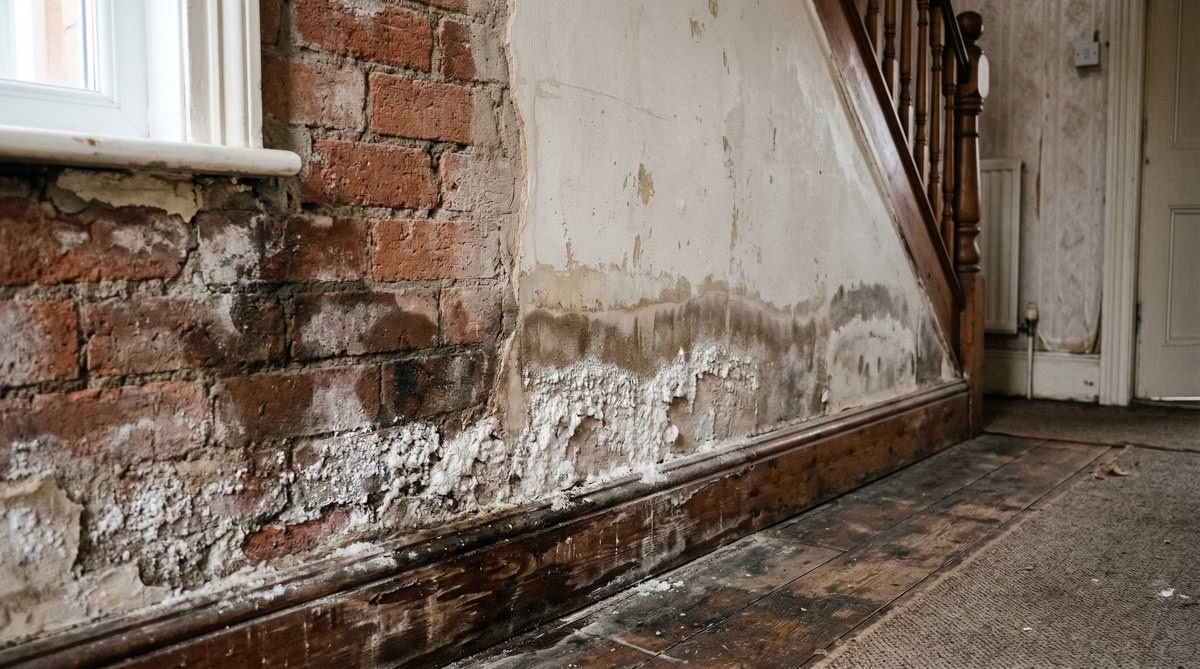
If you’ve spotted rising damp vs condensation solid wall patches creeping up your plasterwork and searched for answers, you’ve probably already encountered conflicting advice — and possibly a damp-proofing company telling you that you need a full chemical injection course without really explaining why. The truth is that diagnosing damp in a solid-wall property is genuinely tricky, and getting the diagnosis wrong is expensive. This guide will walk you through how to tell the difference yourself, what the tell-tale signs actually mean, and — just as importantly — how to spot when you’re being sold the wrong fix.
Why solid walls make damp diagnosis so difficult
Modern cavity-wall houses have a built-in defence against moisture: an air gap that stops ground water and wind-driven rain from crossing from the outer leaf to the inner one. Older solid-wall properties — typically pre-1920s brick or stone — have no such separation. The entire wall thickness is one continuous material, and moisture can migrate through it in multiple directions simultaneously.
That means the same damp patch in a solid-wall home could be caused by three or four different mechanisms at once. A north-facing bay, for example, might show surface mould from condensation, have a failed render joint letting in rain, and sit above a bridged damp-proof course — all contributing to the same discoloured patch. Treat only one cause and the problem returns. Treat the wrong cause entirely and you’ve wasted your money.
Understanding the most common causes — and their distinct signatures — is the starting point for any honest diagnosis.
The three main culprits in solid-wall homes
- Rising damp: groundwater drawn upward through porous masonry by capillary action. Rarely travels above 1–1.2 metres. Leaves a characteristic tide mark and salt deposits called efflorescence.
- Condensation: warm, moisture-laden air hitting a cold surface and releasing its water content. Tends to appear at corners, behind furniture, and around cold bridges. Produces black spot mould.
- Penetrating damp: rainwater getting in through defective render, failed pointing, cracked lintels, or leaking gutters. Can appear at any height and often worsens after rainfall.
Each has a distinct pattern, a distinct set of causes, and a distinct remedy. Let’s look at them in detail.
How to read the signs — rising damp vs condensation in a solid wall
The single most useful diagnostic tool you have is observation over time, combined with an understanding of where each type of damp typically appears and what it looks like up close.
Rising damp — the classic signs
Genuine rising damp in a solid wall tends to be relatively rare — the term is often over-applied by damp-proofing contractors. When it does occur, it shows a consistent pattern:
- Height limit: almost never rises above 1 metre. If patches are higher than this, rising damp is probably not the sole cause.
- Tide mark: a horizontal staining line at roughly the same height around the affected area, often with a wavy upper edge.
- Efflorescence: white, crystalline salt deposits on the plaster or masonry surface as ground salts are drawn up with the water and deposited as it evaporates. These can cause plaster to bubble and blow.
- Damp to touch year-round: unlike condensation, which largely disappears in summer, rising damp tends to remain persistent regardless of season.
- Skirting boards: damp, discoloured, or rotting timber at floor level is a significant indicator.
The classic cause is a failed or absent damp-proof course (DPC) — the horizontal layer of impermeable material built into a wall typically around 150mm above ground level. In very old properties there may be no DPC at all. A bridged DPC, where soil, concrete, or render has been built up over it, is equally common.
Tip: Before calling a contractor, check whether the external ground level has risen close to or above the DPC line. A simple adjustment — removing a flower bed, cutting back raised paving — can sometimes resolve the problem without any treatment to the wall itself.
Condensation — the modern epidemic
Despite rising damp getting most of the attention, condensation is by far the more common cause of damp problems in UK homes — and the problem has worsened as people insulate and draught-proof properties without improving ventilation.
- Black spot mould: the definitive sign. Rising damp does not produce black mould (Cladosporium or Aspergillus). If you have black spotting, condensation is almost certainly involved.
- Location: appears at cold bridges — external corners, around window reveals, behind large pieces of furniture against external walls, on ceilings of unheated rooms.
- Seasonal pattern: worse in autumn and winter. Often disappears or reduces significantly in summer.
- Surface-only initially: condensation starts at the surface and works inward. Rising damp starts within the structure and works outward.
- Correlation with occupancy: a house that was fine when it had fewer occupants, or before a loft conversion was added, is a strong condensation indicator.
The remedies for condensation — improved ventilation, better heating patterns, surface insulation to raise wall temperatures — are entirely different from rising damp treatments. Injecting a chemical DPC into a wall suffering from condensation will accomplish nothing except a lighter wallet.
Penetrating damp — don’t overlook the building fabric
In solid-wall homes, penetrating damp is extremely common and frequently confused with rising damp — particularly when it appears on lower sections of a wall near a defective plinth or failed render.
- Height and location variability: can appear anywhere on a wall, including above 1 metre. Look for patterns that correlate with architectural features — directly below a window, adjacent to a downpipe, beneath a parapet.
- Worse after rain: if you can observe patches appearing or worsening within 24–48 hours of rainfall, penetrating damp is the prime suspect.
- No salt deposits: penetrating damp rarely produces the white crystalline efflorescence associated with rising damp, because it doesn’t pull salts from the ground.
- Localised to one wall face: the most exposed elevation — typically south-west facing in the UK, into the prevailing wind — is most vulnerable.
Can you trust a damp meter reading — and what damp surveyors don’t always tell you
The handheld electrical resistance damp meter is the instrument you’ll see virtually every damp contractor use. It’s a useful screening tool, but it has significant limitations that are rarely explained to homeowners.
Resistance meters work by measuring the electrical resistance between two pins pressed into the surface. Wet materials conduct electricity more readily than dry ones, giving a moisture reading. The problem: so do soluble salts — the same salts left behind by previous episodes of rising damp. This means an old, dried-out wall with salt contamination will still register as “damp” on a pin meter, even though the active moisture problem was solved years ago.
- Salts give false readings: a meter showing high moisture in old plasterwork near floor level is often reading salt contamination, not active water ingress.
- Surface readings only: pin meters typically only penetrate a few millimetres. A truly independent damp survey should also involve core sampling or use of a carbide meter to test moisture at depth.
- The conflict of interest problem: a contractor who sells chemical DPC installation has a financial incentive to diagnose rising damp. An independent chartered surveyor (RICS) or a specialist independent damp surveyor has no such incentive.
Tip: If a contractor visits, uses a pin meter around your skirting boards, and quotes for a chemical DPC injection course without checking external drainage, examining the external ground level, or discussing ventilation, treat that diagnosis with caution. A thorough survey should last at least an hour and cover both the interior and exterior of the affected area.
We always recommend that clients commission an independent damp survey from a RICS-qualified surveyor before committing to any treatment programme. The cost — typically £200–£400 — is modest compared to the price of an unnecessary DPC injection (which can run to £2,000–£4,000).
The under-1-metre rule — and why location within the wall matters
One of the most reliable field rules for distinguishing rising damp from other causes in a solid wall is height. Rising damp, driven by capillary action against gravity, almost never travels above 1 to 1.2 metres in a standard brick wall. If you can measure the height of the damp patch and it’s consistently below 1 metre with a clear tide mark, you have a plausible rising damp signature.
However, height alone is not diagnostic. A leaking radiator pipe buried in the floor screed can look identical to rising damp at low level. A failed DPC membrane on a ground floor extension can produce patterns at any height up to 1 metre. The key is to use height as one data point among several, not a single conclusive test.
A simple checklist before calling anyone
- External ground level: is it at or above the DPC line (typically the first or second brick course from ground)? If so, is there a simple way to lower it?
- Gutters and downpipes: are they clear, intact, and draining properly? A blocked gutter can saturate a wall year after year without anyone noticing.
- Pointing and render: check mortar joints and render for cracks, particularly around window frames and at corners. Run a hosepipe test in dry weather to see if water reappears inside.
- Ventilation: are there working air bricks in the floor void? Do bathrooms and kitchens have functioning extract fans or openable windows? Is condensation forming on the inside of windows in winter?
- Seasonal pattern: photograph the patches over several months and note whether they worsen in winter or after rain.
How Fixiz approaches damp investigation
When clients come to us with a damp problem, our starting point is always the building fabric rather than the chemistry. We look at the external envelope first — drainage, render condition, pointing, ground levels, and any obvious moisture pathways — before we consider what’s happening inside the wall.
We work with independent RICS surveyors and specialist damp consultants who have no financial stake in recommending any particular treatment. That independence matters: it means the diagnosis is driven by evidence rather than by what a contractor has to sell.
Where rising damp is genuinely confirmed — through proper moisture profiling, core sampling, and external investigation — we can manage the full remediation process, from DPC installation to replastering with salt-resistant render. Where condensation is the primary issue, we address the root cause: ventilation, insulation, and heating, rather than treatments that make no difference to surface moisture levels.
Frequently asked questions
Can rising damp really reach above 1 metre?
In standard brick masonry, genuine rising damp very rarely travels above 1 to 1.2 metres. Above that height, the weight of water and the reducing capillary force mean it effectively stops. Higher patches are almost always penetrating damp, condensation, or a combination of both. Some extremely porous stone or rubble-fill walls can behave differently, but these are exceptions rather than the rule.
Why does my damp patch disappear in summer?
Seasonal variation is a strong indicator of condensation rather than rising damp. In summer, indoor air temperature rises, cold surfaces warm up, and the relative humidity inside homes typically falls. Condensation stops forming, existing moisture evaporates, and patches dry out. If your damp returns reliably in October and clears up in May, improve ventilation before spending money on any structural treatment.
Should I get a free survey from a damp-proofing company?
Be cautious. A free survey from a company that sells damp-proofing treatments creates an obvious conflict of interest. These surveys are often used to identify sales opportunities rather than to provide independent advice. They are not without value — a good damp-proofer can spot things a layperson would miss — but always get a second opinion from an independent RICS surveyor before committing to any treatment programme costing more than a few hundred pounds.
What does efflorescence (white staining) mean?
Efflorescence is the white, powdery or crystalline deposit left on masonry surfaces as water evaporates and deposits dissolved salts. It’s most commonly associated with rising damp (which brings ground salts up through the masonry) but can also result from penetrating damp and even from newly laid brickwork drying out. Its presence alone doesn’t prove rising damp — but combined with low-level staining, a tide mark, and persistent moisture readings, it’s a significant indicator.
Is chemical DPC injection always the right treatment for rising damp?
Chemical DPC injection — drilling holes into the mortar bed at DPC level and injecting a water-repellent silicone cream — is the standard modern treatment for genuine rising damp where no physical DPC exists or where the existing DPC has failed. It’s generally effective when properly carried out. However, it treats only the wall itself, not any associated issues such as bridging, drainage problems, or salt-contaminated plaster. A complete rising damp treatment also involves replastering with a sand-and-cement render or specialist salt-retardant plaster to prevent residual salts from causing ongoing staining.
Ready to move from confusion to construction? Get in touch with Fixiz today for a no-pressure chat about your project and the fastest route to full compliance.