Physical address:
128 City Road, EC1V 2NX, London,UK

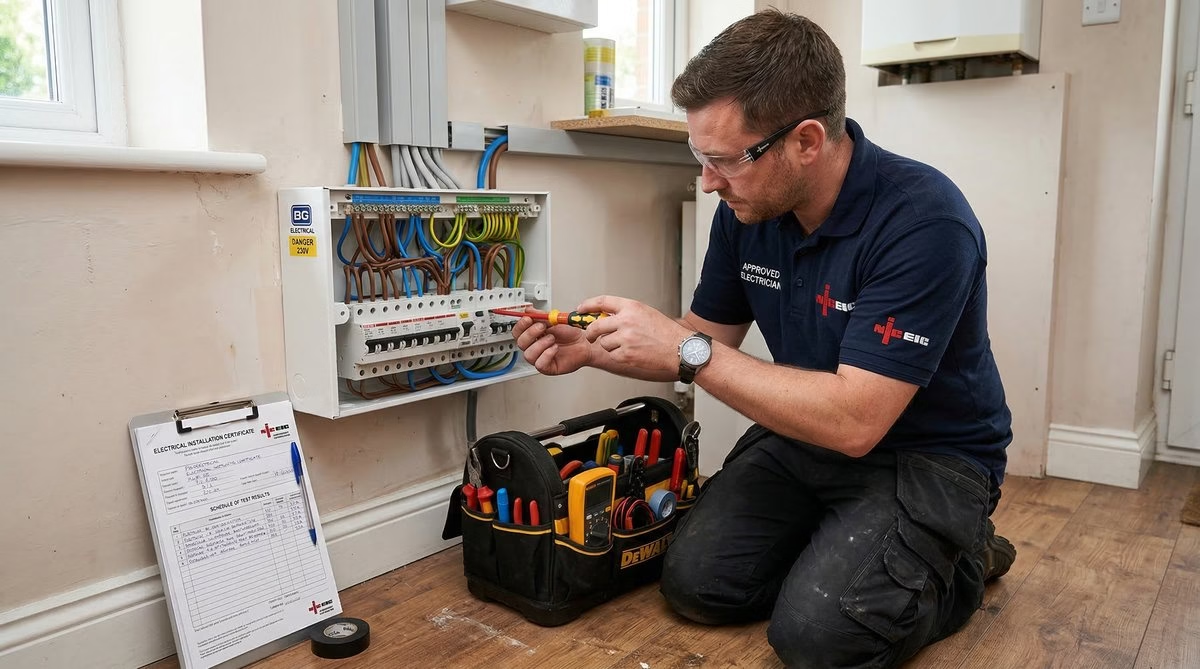
Few things concentrate a homeowner’s mind quite like the moment a solicitor asks for electrical certificates during a property sale — and the folder comes up empty. Understanding Part P rewire certificate electrical installation certificate who issues these documents is one of those areas where the rules are clear enough in theory but confusing in practice, partly because the terminology has evolved over the years and partly because the consequences of getting it wrong emerge painfully at the worst possible moment: exchange of contracts. This guide explains every certificate you need after a rewire, who has legal authority to issue each one, and the steps to take if you’re facing a gap in your paperwork.
Part P Building Regulations — what they actually require
Part P of the Building Regulations (England) came into force in January 2005. Its purpose is to ensure that electrical installation work in dwellings is designed and installed safely. It applies to notifiable electrical work — which includes a full or partial rewire, new circuits, and consumer unit replacement — as well as to certain non-notifiable minor works.
Part P does not require a named certificate with the words “Part P” on it. What it requires is that notifiable work is either:
- Self-certified: Carried out and certified by an electrician registered with a government-approved Competent Person Scheme (such as NICEIC, NAPIT, or Elecsa), who notifies the local authority on your behalf and issues the relevant certificate.
- Third-party certified: Carried out by any electrician (or a skilled person) and then inspected and certified by a Building Control body — either the local authority or an approved inspector — who issues a completion certificate after the work passes inspection.
The common misconception is that “a registered electrician” automatically means the work is certified. Registration with a trade body is not the same as registration with a Competent Person Scheme — and some electricians are registered with professional bodies but are not on a government-approved scheme. Always check before work starts.
The Electrical Installation Certificate (EIC) — the primary document
The Electrical Installation Certificate (EIC) is the document issued at the completion of new installation work, including a full or partial rewire. It is produced under BS 7671 (the IET Wiring Regulations, currently 18th Edition) and confirms that the installation has been designed, constructed, and inspected in accordance with the standard.
What an EIC contains
- Scope: A description of the installation covered — circuits, consumer unit location, and any limitations or exclusions.
- Declaration: Signatures from the designer, installer, and inspector/tester (which may all be the same person for a sole-trader electrician).
- Schedule of inspections: A checklist confirming that each required inspection point has been verified.
- Schedule of test results: Measured values for insulation resistance, earth fault loop impedance, prospective fault current, RCD operating times, and continuity tests for every circuit.
The EIC is issued by the electrician who carried out the work — or, in larger projects, by the person responsible for the installation. It cannot be issued by a different electrician after the fact without carrying out a full inspection and test of the completed installation (at which point it becomes an Electrical Installation Condition Report, not an EIC).
Tip: You are entitled to receive the original EIC, not a photocopy. Keep it with the property’s legal documents — your solicitor will ask for it. If you are buying a property and the seller cannot produce an EIC for recent electrical work, ask for a Minor Works Certificate or, for older work, an EICR as a minimum. The absence of any documentation for a recent rewire is a red flag.
Who can issue an EIC?
Any qualified electrician who carried out the work and holds the appropriate qualification (typically City & Guilds 2391 or equivalent inspection and testing qualification, in addition to their installation qualification) can issue an EIC. They do not need to be registered with a Competent Person Scheme to produce the certificate itself — the certificate is a technical document, not a regulatory notification.
What registration with a Competent Person Scheme adds is the ability to self-notify the local authority. If your electrician is not on a scheme, the work still needs to be notified — but the homeowner must arrange for Building Control to inspect the work and issue their own completion notice. This is the route many people don’t know exists, and it is important to understand for legacy work.
Building Regulations notification — the formal compliance route
For notifiable work, the loop must be closed with a Building Regulations completion certificate or equivalent. There are two routes:
Route 1 — Competent Person Scheme self-certification
This is the most common route for domestic rewires. The electrician is registered with a scheme (NICEIC, NAPIT, Elecsa, or one of the smaller government-approved schemes). They carry out and certify the work, then notify the local authority on your behalf — typically electronically, within 30 days of completion. You receive:
- The EIC: The technical installation certificate from the electrician.
- A Competent Person Scheme certificate: Sometimes called a “Building Regulations compliance certificate” or “self-certification certificate” — issued by the scheme (e.g., NICEIC) and sent directly to you (and sometimes also to the local authority).
Both documents together constitute your compliance paperwork. Note that the scheme certificate confirms notification has occurred — it is not a substitute for the EIC itself.
Route 2 — Building Control inspection and completion
If the electrician is not on a Competent Person Scheme — or if the work has already been done and notification was not made — the homeowner can apply to the local authority building control department to inspect the completed work. The BCO will inspect and test (or instruct a specialist inspector to test) the installation, and if it complies will issue a regularisation certificate or a completion notice. There is a fee, typically £200–£400 depending on the local authority and the scope of work.
Tip: If a rewire was carried out without notification and you are approaching a property sale, contact your local authority building control immediately rather than relying on indemnity insurance alone. Indemnity policies for electrical non-compliance are increasingly difficult to obtain and are rejected by some mortgage lenders. A regularisation route, while not free, provides a proper certificate.
Minor Works Certificate — the document for smaller jobs
A Minor Works Certificate (more formally, an Electrical Minor Works Certificate or MW certificate under BS 7671) is issued for additions or alterations to an existing circuit that do not constitute a new circuit or consumer unit work. Adding a spur, moving a socket, or adding a bathroom fan on an existing circuit are all examples of minor works.
A Minor Works Certificate is not a substitute for an EIC where an EIC is required — specifically, it is not appropriate for a new circuit, a consumer unit change, or a full or partial rewire. If your electrician issued a Minor Works Certificate for what was substantively a rewire, the paperwork is incorrect and will likely be challenged by a buyer’s solicitor.
Common paperwork problems at sale time — and how to resolve them
Rewire done without any notification
This is the most serious gap. Apply to the local authority for a regularisation inspection. If the work was done more than approximately 10 years ago and the installation is in good condition, some local authorities may accept an up-to-date EICR (Electrical Installation Condition Report) showing no Code 1 or Code 2 observations as reasonable evidence of compliance — but this varies by authority and you cannot rely on it. Get professional advice early.
EIC exists but no scheme notification certificate
If you have the EIC but not the Competent Person Scheme notification certificate, contact the scheme the electrician was registered with at the time of the work. Most schemes maintain records and can re-issue the notification certificate (sometimes for a small administrative fee). If the electrician’s scheme registration has lapsed or they are no longer trading, the local authority building control may accept the EIC together with a current EICR showing the installation is satisfactory.
Certificates were lost
Contact the Competent Person Scheme directly — NICEIC, NAPIT, and Elecsa all maintain searchable databases of certified work by property address. Many will provide a replacement certificate for a fee if the original registration is on their system.
How Fixiz manages electrical compliance on your project
We work exclusively with electricians who are registered with government-approved Competent Person Schemes — NICEIC approved contractors for all our projects. Every rewire we specify and manage results in a full EIC and scheme notification certificate, both of which we hand over as part of our project completion pack. We do not consider a project closed until every compliance document has been issued and filed.
Where we are engaged to carry out a property renovation that includes legacy electrical work, we conduct a thorough compliance review at the outset. If there are gaps in the paperwork, we advise on the most proportionate route to resolution before any sale is at risk — not after. That means working with the local authority where regularisation is needed, commissioning EICRs where they are appropriate, and advising clearly on where indemnity insurance is and is not a realistic option.
Frequently asked questions
Can a qualified electrician certify work done by someone else?
Not with an EIC. An EIC can only be issued by the person responsible for the design and installation of the work. If a different qualified electrician inspects and tests the completed installation, they can issue an Electrical Installation Condition Report (EICR) — but an EICR is a condition report, not a certificate of compliance for new work. It cannot substitute for an EIC in the context of Building Regulations notification for notifiable work.
How long is an Electrical Installation Certificate valid?
An EIC has no expiry date — it certifies that the installation complied with BS 7671 at the date of completion. However, the EICR (periodic inspection report) that assesses ongoing condition should be renewed every 10 years for owner-occupied properties and every 5 years for rented properties (or at change of tenancy). An old EIC does not replace a current EICR for a buyer’s solicitor — they serve different purposes.
What happens if I skip Part P notification and sell the house?
The buyer’s solicitor will raise a requisition in the property information form (TA6) if they identify electrical work without certification. At that point, you will either need to obtain a regularisation certificate, commission an EICR, or offer indemnity insurance — all of which take time, cost money, and can delay or jeopardise exchange. In the worst case, a buyer may withdraw if their lender refuses to accept the indemnity policy.
Do I need Part P certification for a like-for-like consumer unit replacement?
Yes. Consumer unit replacement is explicitly listed as notifiable work under Part P. Even a straight swap from one consumer unit to another must be notified — either through a Competent Person Scheme if the electrician is registered, or through Building Control if they are not. Failure to notify is one of the most common electrical compliance gaps we encounter at the point of property sale.
Ready to move from confusion to construction? Get in touch with Fixiz today for a no-pressure chat about your project and the fastest route to full compliance.