Physical address:
128 City Road, EC1V 2NX, London,UK

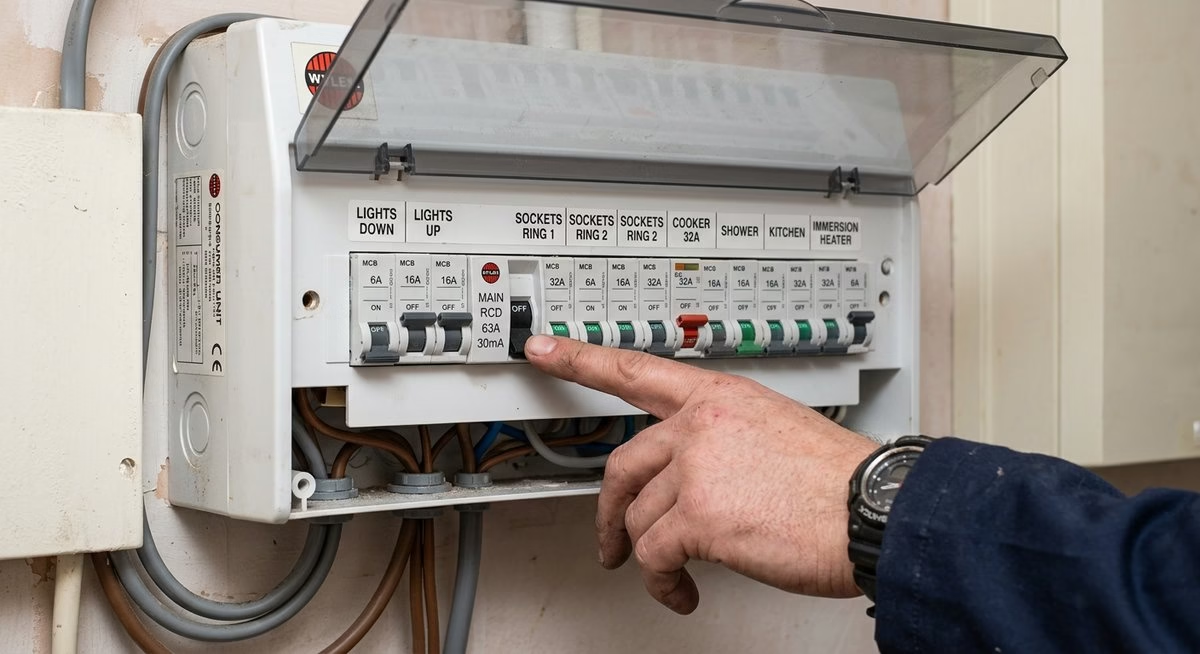
If your RCD keeps tripping UK homes experience this more than almost any other electrical problem, and it is one of the most misunderstood. An RCD — Residual Current Device — is not malfunctioning when it trips. It is doing exactly what it was designed to do: detecting a dangerous leak of electricity and cutting the power before that current can pass through a person. Understanding what the device is telling you — and how to investigate safely — is the difference between a quick fix and a dangerous mistake. This guide walks you through the practical, safety-first triage process that lets you narrow down the cause, identify whether the problem lies in an appliance or your fixed wiring, and know precisely when to stop and call a qualified electrician.
What an RCD Does — and Why It Trips
Your consumer unit contains two main layers of protection. The individual circuit breakers — MCBs — protect against overloads and short circuits. The RCD sits above those and monitors something more dangerous: earth leakage current. In a healthy circuit, the same amount of electricity that flows out through the live wire returns through the neutral. If those values drift apart — even by as little as 30 milliamps — current is finding another path to earth. That path is often through a person. An RCD detects that imbalance and cuts the power in under 40 milliseconds, fast enough to prevent electrocution in most cases.
When your RCD keeps tripping, it is detecting a genuine fault on the circuits it protects. In a modern split-load consumer unit, one RCD might protect upstairs circuits while another covers downstairs, or one covers sockets while a second covers lighting. Knowing which RCD is tripping and which MCBs sit beneath it is the foundation of any investigation.
The most common cause is a faulty appliance — a deteriorating element in a kettle, a worn seal on a washing machine motor, a damaged extension lead, or outdoor lights with cracked cable insulation. Less commonly, the fault lies in the fixed wiring — degraded insulation, a nail through a cable, or moisture ingress into an outdoor socket. The distinction matters because the investigation process differs in each case.
In our experience at Fixiz, the overwhelming majority of RCD trips we attend come down to one appliance — and it is usually one the homeowner has never suspected. Old immersion heaters and washing machines are repeat offenders, but we have also found the culprit to be a cheap extension lead forgotten behind a sofa for years.
What you must never do is bypass the RCD so it cannot trip. We have seen this — someone has wedged the rocker switch in the ON position with tape or a coin. An RCD held up by force cannot protect anyone. It is a warning that demands investigation, not a quirk to work around. The fault will not resolve itself, and in many cases it will worsen over time.
The Safe Step-by-Step Elimination Process
Before you open the consumer unit lid, check that your hands are dry, you are standing on a dry floor, and there is no smell of burning. A burning smell means stop and call an electrician. With those basics confirmed, work through the following steps in order.
Step one — turn off all MCBs beneath the tripped RCD
Open the consumer unit cover and switch all MCBs beneath the tripped RCD to the OFF position. Now attempt to reset the RCD. If it will not reset with all MCBs off, the fault may be in the RCD itself or the main supply — call an electrician rather than investigating further. If it resets cleanly, move on to step two.
Step two — switch MCBs back on one at a time
Flick each MCB back to ON individually, pausing a few seconds between each. When the RCD trips again, you have identified the problem circuit — labelled something like “sockets upstairs,” “kitchen ring,” or “outdoor.” Leave that MCB off, reset the RCD, and restore power to everything else.
Step three — unplug everything on the faulty circuit
Go to every socket on that circuit and physically unplug every appliance — not just switch off at the wall, but remove them entirely. Switch the faulty MCB back on. If the circuit holds without tripping, the fault is in an appliance rather than the wiring.
Step four — plug appliances back in one at a time
Reconnect each appliance individually and switch it on, waiting a few seconds each time. When the RCD trips, you have found the culprit. Remove that appliance permanently from use. A kettle that trips an RCD has a compromised heating element that poses a genuine electrocution risk — it needs replacing, not repairing.
Tip: If you cannot tell which sockets belong to the faulty circuit, plug a lamp into each socket in turn and see which ones the MCB controls — a safe way to map the circuit before you start unplugging appliances.
Step five — if the circuit trips with nothing plugged in
If the MCB still trips the RCD with absolutely nothing plugged into any socket on that circuit, the fault is in the fixed wiring rather than an appliance. Stop the investigation at this point and call a qualified electrician. Leave that MCB off — your other circuits remain safe — and arrange a proper insulation resistance test to locate the wiring fault accurately.
Common Culprits — What Is Usually to Blame
Having attended hundreds of RCD fault calls across London, we see the same appliances and situations time and again. Understanding the usual suspects allows you to investigate in the most efficient order rather than working through every appliance at random and taking far longer to reach the answer.
- Kettles and toasters: Heating elements degrade over time, and limescale build-up accelerates this process in hard-water areas. An old kettle — particularly one over five years old — is always worth unplugging first on a kitchen circuit. The failure mode is typically invisible: the element cracks internally, creating a path between the live component and water.
- Washing machines and dishwashers: Worn door seals allow moisture into the motor housing. Spin cycle vibration causes cable insulation to chafe against sharp metal edges over years of use. If the RCD trips when the machine reaches its wash or spin phase, the appliance is almost certainly at fault.
- Immersion heaters: The element is in constant contact with water and corrodes over time. A failing immersion element is one of the most reliable causes of RCD trips on a dedicated immersion circuit and is a straightforward like-for-like replacement job for an electrician.
- Outdoor sockets and garden lights: Outdoor fittings take a battering from rain, frost, and UV degradation over time. Cable glands work loose, IP ratings deteriorate, and cracked fittings allow moisture to track inside. Outdoor circuits are highly seasonal — circuits fine in summer will often trip in autumn as sustained rainfall increases.
- Extension leads: Old or overloaded extension leads develop insulation failures at the plug end or where individual socket outlets branch off internally. They are consumables, not permanent fixtures, and they degrade invisibly from the inside while appearing undamaged externally.
- Garage and workshop equipment: Power tools, compressors, and battery chargers develop earth leakage over time with regular use. A tool with a damaged cable wound tightly around a hook is a common RCD cause on garage circuits and easy to overlook in a visual inspection.
Tip: If your RCD trips at a particular time of day — mid-cycle on the washing machine, or shortly after the kettle boils — the timing itself tells you which appliance to investigate first and can save considerable time.
When to Stop and Call an Electrician Immediately
The elimination process above is safe under normal conditions. However, certain signs require a qualified electrician without delay. In these situations, no DIY investigation is appropriate — attempting one increases risk rather than reducing it. Recognising these conditions and responding correctly is as important as knowing the investigation steps themselves.
- Burning smell from the consumer unit or any socket: This is an emergency. Switch off at the main isolator if you can reach it safely and call an electrician — or the emergency services if the smell is strong or you can see scorch marks or heat discolouration on the unit or socket faceplates.
- Warm or discoloured sockets and switches: Heat and discolouration around a faceplate indicate a loose or arcing connection behind it — a direct fire risk. Stop using that socket immediately and have it inspected by a qualified electrician before it is used again under any circumstances.
- RCD trips with nothing plugged in: This confirms a fixed wiring fault that requires professional test equipment to locate safely. No socket-by-socket investigation will resolve or identify it.
- RCD trips immediately every time you reset it: A sustained, significant fault is present somewhere on the circuit. Do not keep resetting the device. Leave affected circuits isolated and call a qualified electrician the same day.
- Any sign of water near electrical fittings: A leaking pipe above a consumer unit, water pooling near an outdoor socket, or damp tracking behind a socket outlet all require immediate professional attention rather than a DIY investigation.
We were called to a property in South London where the homeowner had been resetting the RCD five or six times a day for three weeks, assuming it was a nuisance fault that would eventually settle. Testing revealed that the insulation on the ring main cable under the kitchen floor had been pierced by a screw during a flooring installation — a wiring fault no domestic triage process could locate, and a continuous fire risk. Persistent, unexplained tripping always warrants professional investigation rather than repeated resets and a wait-and-see approach.
What an Electrician Does — and Seasonal Factors to Know
When the elimination process points toward a wiring fault — or when you want professional confirmation of what the triage has found — a qualified electrician will carry out systematic dead testing using an insulation resistance tester. This device applies a high-voltage DC signal — typically 500V — to the circuit cables and measures how well the insulation resists it. Healthy cable shows an extremely high resistance value. Degraded cable, a nail through a wire, or moisture in a junction box all produce a significantly lower reading, directing the electrician toward the fault location. On a ring final circuit, testing from both ends and the midpoint allows the fault to be triangulated to a specific cable run, which reduces disruption considerably and avoids unnecessary floorboard removal or excavation.
The electrician will also verify the RCD’s own operating time — confirming it trips within 40 milliseconds at rated leakage current. An RCD tripping below its threshold explains persistent nuisance trips with no genuine fault present; one tripping too slowly is dangerous and must be replaced promptly.
At Fixiz, we see a consistent spike in RCD fault calls between October and February. Cold, wet weather accelerates the conditions that cause earth leakage on outdoor and semi-exposed circuits. Outdoor socket enclosures that are genuinely weatherproof when new become less so after years of frost and UV exposure. Rubber gaskets harden and crack, cable entry glands work loose with temperature cycling, and cracked fittings allow moisture to track inside. Garden lighting with poorly sealed cable joints is particularly vulnerable — the cable can look perfectly intact while the connection inside the fitting is saturated with rainwater.
Condensation also plays a role in garages and loft spaces, which experience large temperature swings on cold nights. A loft downlighter circuit running perfectly in summer can develop measurable earth leakage in January simply from moisture settling on aged connections. If your RCD trips seasonally and resolves by spring, an outdoor or exposed circuit is almost certainly involved. Replacing deteriorated fittings with properly rated IP66 weatherproof equivalents and ensuring all cable joints sit in appropriate IP-rated enclosures will resolve the problem for years rather than months.
When a homeowner contacts us about a repeatedly tripping RCD, our first conversation is always about the pattern — when it trips, which MCBs sit beneath the affected RCD, whether there has been recent building work, and whether the problem is seasonal. That context narrows the likely cause considerably before we arrive. We carry a calibrated insulation resistance tester, loop tester, and RCD tester to every fault call, and provide a written schedule of test values at the end.
Tip: Ask your electrician for the test results in writing after any fault investigation. This is standard practice and gives you a useful baseline for future reference or insurance purposes.
Frequently Asked Questions
Is it safe to keep resetting the RCD while I investigate?
Resetting the RCD as part of the structured elimination process above is safe provided conditions are normal — no burning smell, no visible damage, dry environment. Resetting it repeatedly without any investigation is not safe. If you cannot identify the cause, stop resetting and call a qualified electrician.
My RCD trips in the middle of the night with nothing running. What could cause that?
Appliances that cycle on automatically are the most common cause — a fridge compressor starting, a broadband router rebooting, or a smart plug timer. If genuinely nothing is running, the fault is likely in the fixed wiring, particularly on outdoor circuits where overnight temperature drops cause condensation on aged connections. An insulation resistance test will identify the source.
My RCD trips specifically when it rains. Is that always an outdoor circuit?
Almost always, yes. Rain-related tripping is the signature of moisture ingress into an outdoor socket, junction box, or fitting. Garden lighting, patio sockets, outside tap sockets, and garage supplies are the most common locations. Replacing the affected fitting with a properly rated IP66 weatherproof version typically resolves the fault permanently rather than requiring repeated intervention each winter season.
Can I replace my own RCD if I think the device itself is faulty?
No. Replacing an RCD involves working inside the consumer unit, and the incoming supply cables remain live even with the main isolator switched off. This work must be carried out by a qualified electrician and notified to building control under Part P of the Building Regulations. A faulty RCD is also genuinely rare — far more often it is working correctly and the fault lies elsewhere on the circuit it protects.
How much does it cost to have an electrician diagnose an RCD fault?
In London, expect to pay for a minimum call-out period — typically one to two hours — plus any parts required. Appliance faults are usually resolved in a single visit. Wiring faults requiring full circuit-by-circuit insulation resistance testing may take longer. We provide a clear estimate before any work begins.
Ready to move from confusion to construction? Get in touch with Fixiz today for a no-pressure chat about your project and the fastest route to full compliance.