Physical address:
128 City Road, EC1V 2NX, London,UK

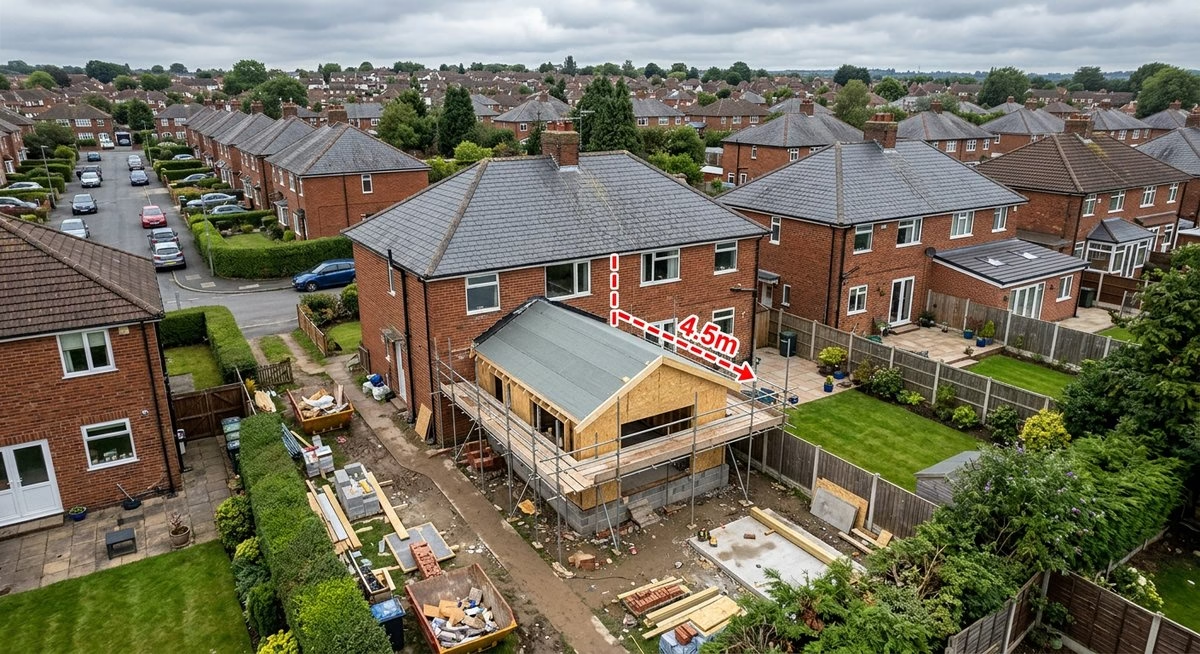
Rear extensions are the most popular home improvement in England. They transform how a family lives, adding usable floor space where it matters most. But the rules governing what you can build without a planning application are layered, and getting the measurements wrong can turn a lawful project into an enforcement headache. This guide is our practical walkthrough of permitted development rear extension rules UK homeowners need to understand before a spade goes in the ground — covering depth limits, height restrictions, the neighbour consultation process, and why a Lawful Development Certificate is the smartest paperwork you will ever commission.
What Permitted Development Means for Rear Extensions — and Why It Matters
Permitted development (PD) rights are national planning rules under the Town and Country Planning (General Permitted Development) (England) Order 2015 that allow homeowners to carry out certain works without a planning application. For rear extensions, the relevant rules sit within Part 1, Class A of the Order. These rights reduce the administrative burden for routine improvements — but they come with strict conditions on depth, height, materials, and location that are easy to misread.
What makes rear extensions confusing is that there are three possible routes. Depending on the size of your proposed extension and your property’s characteristics, you may need one of the following:
- Full PD — no application needed: Your extension falls within the standard depth and height limits, so you can proceed without notifying anyone. Building regulations approval is still required, but no planning application is needed.
- Prior approval (neighbour consultation scheme): Your extension exceeds the standard depth limits but stays within the larger allowance. You must apply to your council, who will consult your neighbours before deciding.
- Full planning permission: Your extension exceeds PD limits altogether, or your property is excluded from PD rights — for example, because it is a listed building, a flat, or PD rights have been removed by an Article 4 direction. This route involves a discretionary decision by your council.
The decision tree is straightforward once you know the numbers. We walk clients through this framework at the very first site visit because starting on the wrong route wastes time and money. Which category your extension falls into also determines the application cost, the timeline, and whether your neighbours have any formal say. Confusing one route for another is one of the most common mistakes we encounter, and it is entirely avoidable with a proper assessment.
Depth Limits — The Numbers You Need to Know
The depth limits depend on two things: whether the extension is single-storey or two-storey, and whether the house is detached. Every measurement is taken from the rear wall of the original dwellinghouse — meaning the house as first built, or as it stood on 1 July 1948, whichever is later. If a previous owner added a rear extension, that existing projection counts towards your allowance.
Single-storey rear extensions — standard PD limits
- Detached house: Up to 4 metres beyond the original rear wall.
- Semi-detached or terraced house: Up to 3 metres beyond the original rear wall.
Extensions within these standard limits are full PD — no application to the council is required, provided all other conditions (height, materials, coverage) are met.
Single-storey rear extensions — larger allowance (prior approval required)
- Detached house: Between 4 metres and 8 metres beyond the original rear wall.
- Semi-detached or terraced house: Between 3 metres and 6 metres beyond the original rear wall.
These larger limits are only available on properties not on Article 2(3) designated land and not on a Site of Special Scientific Interest. Extensions in this range must go through the prior approval process.
Two-storey rear extensions
- All house types: Up to 3 metres beyond the original rear wall.
- Minimum 7-metre gap: The rear wall of the two-storey extension must be at least 7 metres from any boundary directly opposite it.
- Roof pitch: Must match the pitch of the existing house roof as far as practicable.
Two-storey rear extensions are not permitted under PD on designated land — you would need full planning permission. One point we consistently flag for clients: if you are joining a new extension onto an existing one, the depth limit applies to the total enlargement, not just the new section. We have seen homeowners fall foul of this because they measured only the new build without accounting for the previous addition.
Height Rules, Boundary Restrictions, and Designated Land
Getting the depth right is only half the equation. Height limits are equally strict and are the rules that most commonly trip people up, particularly on sloping gardens or properties with unusually low eaves.
- Overall height: The enlarged part must not exceed the height of the highest part of the existing roof — measured to the ridge line, excluding chimneys and parapet walls.
- Eaves height: The eaves of the extension must not exceed the eaves height of the existing house — measured from ground level at the base of the external wall to where the wall meets the roof slope.
- Single-storey maximum: A single-storey rear extension must not exceed 4 metres in overall height.
- Within 2 metres of a boundary: If any part of the extension is within 2 metres of a boundary, the eaves height must not exceed 3 metres. This is one of the most common reasons we see projects needing redesign.
Tip: On sloping ground, height is measured from the elevation at the base of the extension, not from the level of the original house. This can reduce your effective allowance significantly — we always check levels with a laser at the initial survey rather than relying on estimated gradients.
If your property sits within Article 2(3) designated land — conservation areas, Areas of Outstanding Natural Beauty, National Parks, the Broads, or World Heritage Sites — the rules tighten considerably. You are limited to standard depths only (4 metres detached, 3 metres other). The larger allowances do not apply. Two-storey rear extensions beyond the original rear wall are not PD at all. You also cannot clad the exterior in stone, render, timber, plastic, or tiles, and the extension must not project beyond the original side elevation. We work across several conservation areas in South London and regularly help homeowners navigate these tighter rules — a well-designed single-storey extension at the standard depth still delivers an excellent result when planned from the outset.
Prior Approval — The Neighbour Consultation Scheme Step by Step
If your single-storey rear extension falls within the larger PD allowance — over 4 metres but up to 8 metres for a detached house, or over 3 metres but up to 6 metres for a semi or terrace — you must apply for prior approval before starting work. This is also called the neighbour consultation scheme, and it is distinct from a full planning application.
- Submit a prior approval application: You apply to your local planning authority with a written description of the proposed extension — including its depth, maximum height, and eaves height — along with scaled drawings and the addresses of all adjoining properties.
- Council notifies neighbours: The council writes to all adjoining owners and occupiers, giving them a minimum of 21 days to respond.
- If no objections are received: The council confirms that prior approval is not required, or grants prior approval. You can proceed.
- If objections are received: The council must assess the impact on the amenity of all adjoining premises — covering light, outlook, and privacy. Construction noise and disruption are not factors the council can consider under this route.
- Decision or deemed approval: The council has 42 days from the date of your application to issue a decision. If no decision is made within that period, the development is deemed to have prior approval.
Tip: Do not begin construction before receiving written confirmation — either a “prior approval granted” or “prior approval not required” notice. Prior approval under this scheme cannot be applied for retrospectively, so an unlawful start would force you into a full planning application instead.
From our experience managing these applications, the most common reason for neighbour objections is perceived loss of light. We find that including accurate shadow diagrams with the initial submission significantly reduces the chance of objections escalating into a refusal.
Materials, the 50% Rule, and Other Conditions That Catch People Out
The material matching requirement is a condition homeowners frequently underestimate. Materials used on the exterior must be of similar appearance to those on the existing house — not an exact match, but visually consistent in colour, texture, and style. This applies to brickwork, roof tiles, render, and windows. uPVC windows are acceptable even if the originals are timber, provided the visual appearance is similar. We have seen enforcement enquiries triggered simply because a homeowner chose a noticeably different brick to save a few hundred pounds. The cost difference for a close match is minimal compared to the risk, and getting this detail right at specification stage avoids problems later.
Beyond depth, height, and materials, several additional conditions under Class A must be satisfied:
- 50% curtilage coverage: The total area of ground covered by buildings (excluding the original house itself) must not exceed 50% of the total curtilage area. This includes sheds, garages, and any previous extensions. On smaller plots, this limit can be the binding constraint.
- No extension forward of the principal elevation: The extension must not project beyond the front wall of the original house, or any side elevation fronting a highway.
- No balconies, verandahs, or raised platforms: Permitted development does not cover balconies, verandahs, or raised platforms exceeding 0.3 metres above ground level.
- Upper-floor side windows: Any window on an upper floor of a side elevation must be obscure-glazed to a minimum of Level 3 and non-opening unless the opening part is more than 1.7 metres above the internal floor level.
We always run through a full Class A compliance checklist at the design stage. Missing even one condition means the extension is not PD, and you could end up needing to apply for planning permission after work has already started.
Why a Lawful Development Certificate Is Worth Getting
A Lawful Development Certificate (LDC) is a formal document issued by your local planning authority confirming that your proposed extension is lawful under permitted development rights. It is not legally required — you can build under PD without one — but we strongly recommend it, and here is why.
- Resale protection: When you sell, the buyer’s solicitor will check planning records. If your extension has no planning permission on file and no LDC, it raises questions that can delay a sale. Some buyers walk away; others insist on indemnity insurance. An LDC removes the doubt entirely.
- Mortgage lender confidence: Lenders and valuers are increasingly cautious about unverified extensions. An LDC provides the written confirmation they need.
- Protection against rule changes: Once granted, an LDC means your project must be presumed lawful unless there is a material change before work begins — such as an Article 4 direction removing your PD rights.
- Low cost: A proposed-use LDC costs half the planning application fee — around £129 in England. A retrospective LDC costs the same as a full planning fee. Getting it in advance is cheaper and simpler.
You submit the application to your local planning authority with plans and a description of the proposed works. There is no neighbour consultation — the council simply assesses whether the works comply with PD rules. In our experience, most LDC applications are determined within six to eight weeks. Unlike planning permission, the council cannot refuse on design merit — it is a purely factual assessment.
Tip: Apply for the LDC before construction starts. A proposed-use certificate under Section 192 is half the fee and avoids any ambiguity about the state of the property at the time of the application. We include LDC applications as a standard part of our project management service for exactly this reason.
How Fixiz Keeps Your Rear Extension Fully Compliant
At Fixiz, we treat the planning stage as the foundation of every rear extension project — not an afterthought to rush through once the architect has drawn something up. We have seen too many homeowners discover compliance gaps only after steelwork is in the ground. Our approach covers the full compliance picture so you can build with confidence:
- Measured site survey: We carry out a full measured survey with laser levels, confirming the original rear wall position, boundary distances, eaves and ridge heights, and ground levels — because the numbers on old deeds often differ from reality.
- PD compliance assessment: We run your proposal against every Class A condition — depth, height, boundary distances, curtilage coverage, materials, and designated-land status — and give you a clear answer on which route applies.
- Prior approval management: If your extension falls into the larger allowance, we prepare and submit the prior approval application, including shadow analysis where appropriate, and manage the neighbour consultation on your behalf.
- LDC application: We prepare and submit the Lawful Development Certificate as a standard step, giving you a documented record of compliance for your property file.
- Building regulations coordination: PD covers planning only — you still need building regulations approval for structural, thermal, drainage, and electrical requirements. We handle that submission alongside the planning paperwork so nothing falls through the gap between the two processes.
We have managed dozens of rear extension projects across South London, and the smoothest builds are always the ones where the compliance work is completed properly before anyone picks up a tool. If you are unsure whether your project qualifies for PD, prior approval, or full planning permission, a single site visit with our team can usually give you a clear answer and a defined route forward.
Frequently Asked Questions
Do I need planning permission for a 4-metre rear extension on a semi-detached house?
A 4-metre single-storey rear extension on a semi exceeds the standard 3-metre PD limit, so it falls into the larger allowance and requires a prior approval application — not full planning permission. The council will consult your neighbours before deciding. If your property is on designated land, the 3-metre limit applies and you would need full planning permission for anything deeper.
What is the maximum depth I can extend without any application at all?
For a single-storey rear extension with no application, the limit is 4 metres for a detached house and 3 metres for a semi or terrace — provided all other PD conditions are met. Two-storey extensions are limited to 3 metres for all house types but must also maintain at least 7 metres to the opposite boundary.
Can I build an 8-metre rear extension in a conservation area?
No. Properties on Article 2(3) designated land — including conservation areas, AONBs, National Parks, the Broads, and World Heritage Sites — are limited to the standard PD depths only. The larger allowances do not apply. You would need full planning permission for anything beyond the standard limits.
What happens if my neighbour objects to my prior approval application?
The council must assess the impact on the amenity of all adjoining premises — considering light, outlook, and privacy, but not construction noise. An objection does not automatically block the extension; it triggers a formal assessment. If the impact is acceptable, prior approval is granted.
How much does a Lawful Development Certificate cost?
For a proposed householder development in England, the LDC fee is around £129 — half the standard planning fee. A retrospective LDC costs the same as a full planning fee. Applying before you build is cheaper and provides stronger protection for resale.
Ready to move from confusion to construction? Get in touch with Fixiz today for a no-pressure chat about your project and the fastest route to full compliance.