Physical address:
128 City Road, EC1V 2NX, London,UK

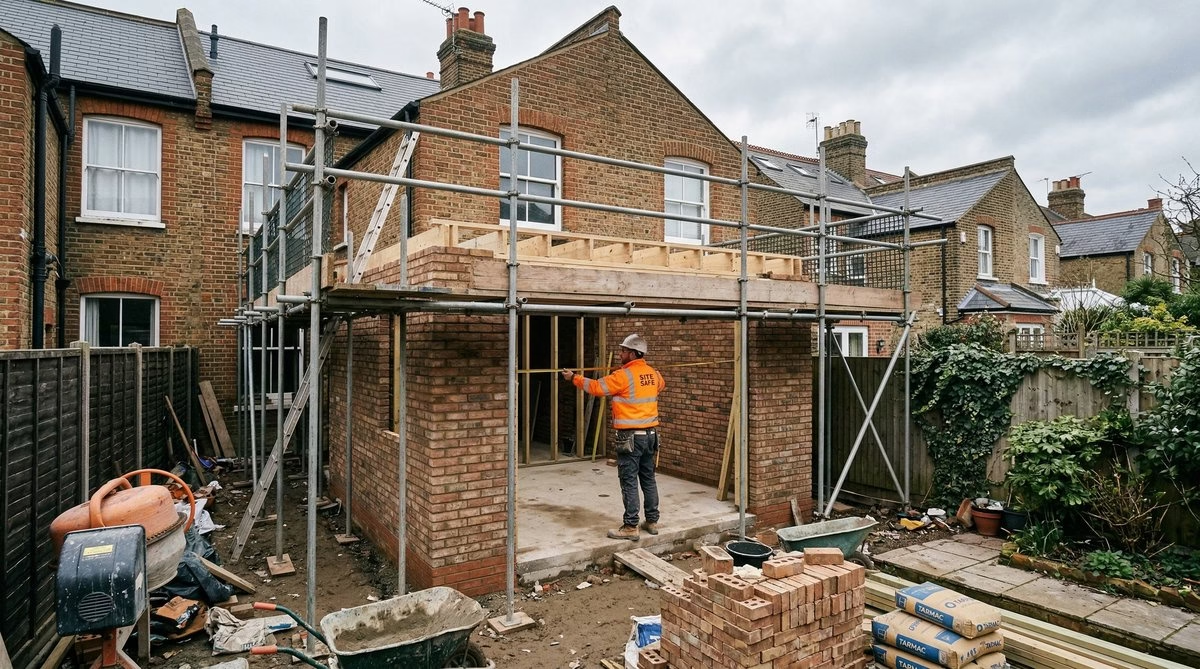
The rules around permitted development rear extension 6m 8m prior approval are among the most misunderstood in UK planning — and a misunderstanding at the planning stage can lead to enforcement notices, mandatory demolition, and considerable expense. Whether you’re extending a terraced house, a semi-detached, or a detached property, understanding exactly which limits apply to you, when prior approval is required, and what the most common refusal triggers are will save you a significant amount of time and money in 2026.
The two depth tiers for permitted development rear extensions — and why they exist
Permitted development rights for single-storey rear extensions in England exist in two tiers, and which tier you’re working within determines whether you need to notify your local authority before building.
The standard permitted development limits (no prior approval required)
Under Schedule 2, Part 1, Class A of the Town and Country Planning (General Permitted Development) (England) Order 2015, a single-storey rear extension is permitted development if it does not extend beyond the rear wall of the original house by more than:
- 3 metres — for a semi-detached or terraced house.
- 4 metres — for a detached house.
Within these limits, no prior approval application is required, and no notification is needed. You do, however, still need building regulations approval, and you must ensure the extension complies with all the other permitted development conditions (height, materials, proximity to boundaries, etc.).
The larger home extension scheme — prior approval required
The Larger Home Extension Scheme — introduced initially as a temporary measure in 2013 and made permanent in 2019 — allows single-storey rear extensions up to:
- 6 metres — for a semi-detached or terraced house.
- 8 metres — for a detached house.
This is the tier that causes most confusion. Extensions beyond the standard limits but within the larger scheme limits are still permitted development — but they require a prior approval application to be submitted to and determined by your local planning authority before works begin.
Tip: The prior approval process under the larger home extension scheme is a neighbour consultation process, not a full planning application. The local authority does not assess the extension’s design or appearance — only its impact on the amenity of adjoining neighbours. However, that impact test can result in the extension being refused, reduced in size, or modified.
What prior approval actually involves — and the timelines
Prior approval under the larger home extension scheme is a formal application process, and it must be completed before works begin. Here’s how it works in 2026:
- Submit the application: you provide the local planning authority with a written description of the proposed works, a plan indicating the site, and drawings or a written description showing the size and position of the extension. The fee in England is currently £120.
- Neighbour notification: the local authority notifies your adjoining neighbours (the properties immediately to each side, and potentially the property immediately behind) and gives them 21 days to comment. Only neighbours who adjoin the site can comment — not anyone else in the street.
- Assessment: if no objections are received, or if objections are received but the authority considers the extension does not have a negative impact on the amenity of adjoining occupiers, prior approval is granted. If objections are received and the authority agrees there is an impact, it can refuse or impose conditions.
- Decision deadline: the local authority has 42 days from receipt of a valid application to determine it. If it does not respond within 42 days, prior approval is deemed to be granted automatically.
- Works must begin within 3 years: the approved prior approval lapses if works do not begin within 3 years of the decision date.
The most important thing to understand about the prior approval test is that it is a binary neighbour amenity test — not a design review. The local authority cannot refuse because they think the extension is unattractive, doesn’t match the street scene, or fails to use matching materials. The only permitted grounds for refusal are the impact on adjoining neighbours’ daylight, privacy, and general amenity.
The other permitted development conditions you must not overlook
Even where depth limits are within the standard or larger scheme limits, there are a number of additional permitted development conditions that must all be satisfied. Failing any one of them means the extension is not permitted development, regardless of depth. These conditions are where most planning mistakes occur.
Height limits
- Maximum eaves height: 3 metres within 2 metres of the boundary. If your extension runs close to a side boundary, the eaves of the roof cannot exceed 3 metres at that point, even if the rest of the extension is taller.
- Maximum overall height: 4 metres for a single-storey extension (measured to the ridge of a pitched roof, or to the flat roof surface). The extension cannot be taller than the ridge line of the original roof of the house.
Proximity to boundaries
- No extension within 7 metres of rear boundary (for two-storey extensions): only relevant for two-storey rear extensions, but important to note if you’re combining a single-storey with any upper-floor works.
- Side extensions: a separate set of rules governs side extensions, which we’re not covering in this article but which interact with rear extension rules when you’re building in an L-shape.
Materials
The materials used in the extension must be of a similar appearance to those used in the construction of the original house. This is a source of significant enforcement action — particularly where rendered extensions are built onto brick houses, or where modern cladding materials are used on Victorian terraces. “Similar appearance” is interpreted by the local planning authority and can be subjective, but matching the dominant material of the existing house facade is a safe baseline.
Original house — what the baseline is
All depth measurements for permitted development are taken from the rear wall of the “original house” — defined as the building as it stood on 1 July 1948 (or as built, if constructed after that date). If a previous extension has already been built, it does not reset the baseline. You measure from where the house was before any extensions, not from the rear wall of the most recent addition.
Tip: Check your title deeds and any historic OS maps to establish what the original footprint of your house was. If a previous owner added an extension, your permitted development allowance for depth may already be partially or fully used up. We can help you establish this baseline before you commit to a design.
Common mistakes that trigger planning enforcement — and how to avoid them
Planning enforcement for unauthorised extensions is rare but real — and the consequences can include being required to demolish what you’ve built. These are the most common mistakes we see:
- Measuring from the wrong baseline: measuring from an existing extension rather than the original rear wall is one of the most frequent errors. Always confirm the original house footprint before submitting plans.
- Starting larger-scheme works without prior approval: beginning construction on a 6m or 8m extension without obtaining prior approval means the works are unlawful, not merely unpermitted. The local authority can require demolition to the permitted depth.
- Exceeding the 3m eaves height near the boundary: contractors sometimes build to the full 4m height right to the boundary line. This breaches the eaves height condition even if the overall height is within limits.
- Using non-matching materials: this is the condition most likely to produce an enforcement complaint from a neighbour. Even where the extension is otherwise within all depth and height limits, using materials that visually jar with the existing house can trigger enforcement action.
- Forgetting about Article 4 Directions: in some areas — particularly conservation areas and certain London boroughs — Article 4 Directions remove permitted development rights entirely or partially. Always check whether your property is subject to an Article 4 Direction before assuming PD rights apply.
- Confusing England and Wales rules: Wales has its own planning rules, and the 6m/8m larger scheme does not apply in Wales. If you’re building in Wales, consult the Technical Advice Notes and Welsh Government planning guidance.
Do you lose permitted development rights in an Article 4 area or listed building?
Yes — and this affects more properties than many people realise. Article 4 Directions are commonly applied in:
- Conservation areas (common in London, historic market towns, and seaside resorts)
- Areas of Outstanding Natural Beauty
- Some housing estates where the planning authority has chosen to protect the character of the streetscape
If your property is a listed building, permitted development rights for extensions are removed almost entirely — you will need listed building consent as well as planning permission for any external alterations, regardless of size.
Check your property’s status on your local planning authority’s interactive mapping system, or ask us to do it as part of our initial project assessment.
How Fixiz handles permitted development rear extensions in 2026
We manage the full process — from establishing whether your extension is within standard PD limits or requires prior approval, to submitting the application if it does, to co-ordinating building regulations approval and contractor appointment. We work with an in-house planning consultant who reviews every project before works begin to confirm compliance.
For extensions that fall outside permitted development entirely — because of Article 4 Directions, an unusual design, or the need for additional storeys — we manage the full planning application process. Our relationships with planning officers across London boroughs mean we know what each authority is likely to accept and can frame applications accordingly.
Frequently asked questions
Does the 6m/8m larger scheme apply to flats and maisonettes?
No. Permitted development rights for extensions — including the larger home extension scheme — apply only to houses (including terraced, semi-detached, and detached houses). Flats, maisonettes, and properties in purpose-built apartment blocks do not have permitted development rights for extensions and require a full planning application.
Can I build a two-storey rear extension under permitted development?
Yes, but the rules are considerably more restrictive. A two-storey rear extension can be permitted development, but it cannot extend beyond the rear wall by more than 3 metres, must not be within 7 metres of the rear boundary, must not exceed 4 metres in height, and has additional conditions around window positions and roof form. Two-storey extensions always require prior approval regardless of depth.
What happens if I’ve already started building and I realise I need prior approval?
Stop works immediately and seek specialist planning advice. You have a few potential routes: retrospective prior approval (possible in some circumstances), a full planning application for retrospective permission, or — as a last resort — modifying the works to bring them within the standard PD limits. Do not assume that completing the works quickly will make the problem go away — it won’t.
Do I need to tell my local authority if I’m building within the standard 3m/4m limits?
No prior approval application is needed within the standard limits, but you do need building regulations approval for any extension. You also need to ensure that all permitted development conditions are met — it is worth obtaining a Lawful Development Certificate from your local authority even for standard PD extensions, as this creates a legal record that the works were lawful that will be important when you come to sell.
How long does a prior approval application take?
The local authority has 42 days to determine a prior approval application. In practice, many authorities determine them more quickly — often within 3–4 weeks. However, allow at least 6–8 weeks from application submission to works commencement to give yourself a comfortable buffer, especially if you’re co-ordinating contractor availability at the same time.
Ready to move from confusion to construction? Get in touch with Fixiz today for a no-pressure chat about your project and the fastest route to full compliance.