Physical address:
128 City Road, EC1V 2NX, London,UK

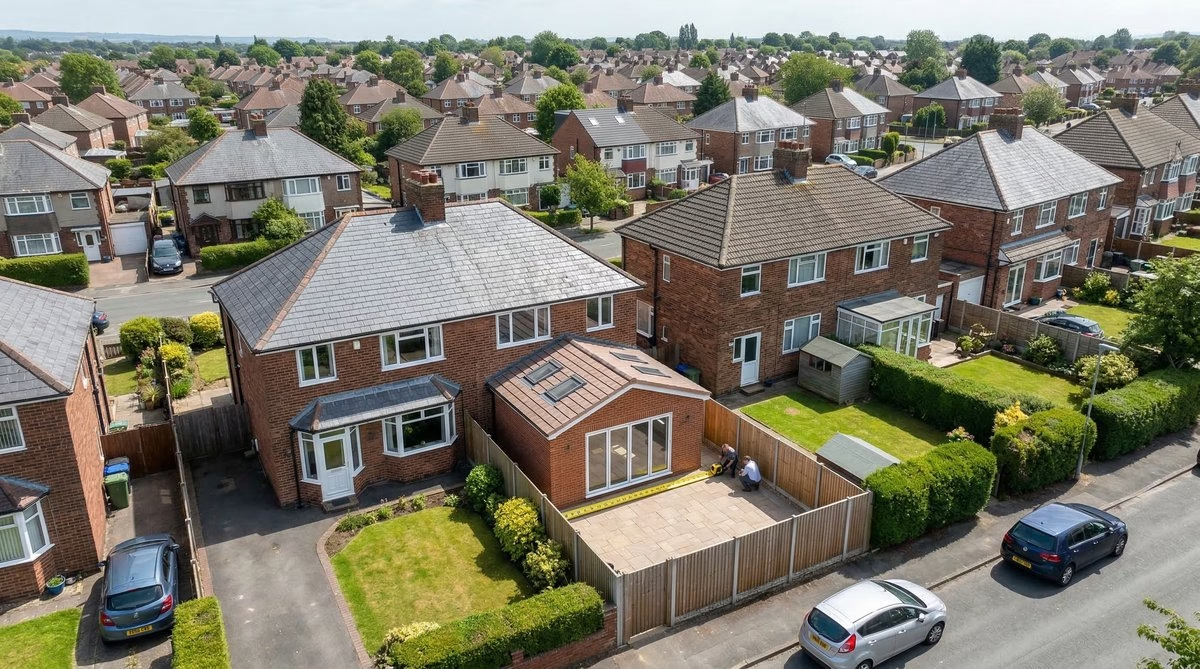
Every week we speak to homeowners who started a build believing they were fully covered by permitted development UK rules — only to discover, halfway through or after completion, that they were not. Permitted development (PD) is one of the most useful planning tools available to homeowners in England, but it comes with conditions, exclusions, and hidden triggers that catch people out regularly. This guide cuts through the jargon so you can approach your project with your eyes open.
What Is Permitted Development — and Why the Name Is Misleading
Permitted development rights are a set of national planning rules that allow homeowners to carry out certain works without submitting a full planning application. The idea is sound: reduce the administrative burden for routine home improvements and free up councils to focus on larger, more complex applications.
PD is better understood as a series of pre-approved permissions, each one tightly conditional. Stray outside any single condition — by a few centimetres on height, a square metre on coverage, or by virtue of where your house sits — and the permission evaporates. You are then either in the territory of needing full planning permission or, if work has already started, facing enforcement action.
In our experience across South and East London, homeowners who run into trouble are rarely reckless. They read the headline figures — “rear extension up to four metres for a detached house” — and stopped there. The headline is accurate; the conditions underneath it are what matters.
The Key Rules That Catch Homeowners Out
The Prior Approval Requirement for Larger Rear Extensions
Most homeowners know that single-storey rear extensions can be built under permitted development without a planning application. The standard limits are 4 metres deep for detached houses and 3 metres for semi-detached and terraced homes. What many do not realise is that there is a separate, larger-extension route that allows detached houses to extend up to 8 metres and all other houses up to 6 metres — but this route requires prior approval from the local planning authority before any work begins.
Prior approval is not the same as full planning permission, but it is not nothing either. You must submit a formal notification to the council — including a site plan, existing and proposed elevation drawings, and a description of the proposed materials. The council then writes to your adjoining neighbours and gives them a minimum of 21 days to raise any concerns.
If no valid objections are received, the council issues a decision (within 42 days of receipt of a valid notification) and work can proceed. If neighbours do object, the council must assess the impact on the amenity of all adjoining properties and decide whether to approve or refuse. Valid grounds for objection centre on overshadowing, loss of daylight, and overlooking — not general complaints about the noise of building work.
The critical point: you must not start work until prior approval has been granted. Unlike some other PD routes, the prior approval mechanism for larger home extensions cannot be sought retrospectively. If you build first and apply later, you will need a full retrospective planning application — with no guarantee of success and the real risk of being required to demolish what you have built.
We recently helped a homeowner in Lewisham who had started an 8-metre rear extension without triggering prior approval. He had read the 8-metre figure and assumed he was covered. His neighbour complained, an investigation followed, and he ultimately had to reduce the extension to 4 metres to avoid an enforcement notice. The cost of that partial demolition far exceeded what a straightforward notification process would have cost.
Height Limits Near Boundaries
One of the most commonly breached PD rules concerns the height of extensions or outbuildings near the boundary of your property. The rule is precise: where any part of a building or extension is within 2 metres of the curtilage boundary, the maximum eaves height permitted is 3 metres.
This applies to rear extensions, garden rooms, outbuildings, and any other structure within that 2-metre zone. The eaves — the point where the roof slope meets the external wall — must not exceed 3 metres if measured from ground level at the base of the external wall. Homeowners who want a taller garden office or a more imposing rear extension often overlook this rule when their design sits close to a fence line. A structure that would be perfectly acceptable at the bottom of a large garden becomes non-compliant the moment its edge crosses into that 2-metre boundary zone.
The 50% Garden Coverage Rule
Under permitted development, the total area of all buildings, extensions, and outbuildings within the curtilage of your property — excluding the footprint of the original house — must not exceed 50% of the total curtilage area. In plain English: all the additions to your property combined must cover no more than half the land around your original home.
This calculation catches people out for two reasons. First, it is cumulative: a rear extension built ten years ago counts towards your 50% limit just as much as the new garden studio you are planning today. Second, it is measured against the original curtilage — either when the house was built, or as at 1 July 1948 for older properties. Land acquired since then does not increase the baseline.
In our experience across South London, owners of smaller terraced or semi-detached houses with modest rear gardens reach this limit more quickly than they expect — particularly those who have already extended once or twice.
Flats and Maisonettes Are Excluded
Permitted development rights for householders apply specifically to dwelling houses. If your home is a flat or maisonette — whether purpose-built or converted — you do not benefit from the PD rights that allow rear extensions, loft conversions, or outbuildings. Any structural change of that nature will require a full planning application, regardless of its scale.
This surprises many owners of converted Victorian properties, particularly first-floor maisonettes with a rear garden. The garden may feel like theirs to use freely, but the planning status of the building determines what works are permissible. We always check the property’s planning classification before we discuss any structural project — it is the first question, not an afterthought.
Conservation Areas
If your property sits within a designated conservation area, your permitted development rights are substantially curtailed. Extensions to the side of the house require planning permission. Cladding the exterior in stone, render, or artificial materials requires planning permission. In some conservation areas, even replacing windows or doors — which would normally be PD elsewhere — requires prior approval or full permission.
There are over 10,000 conservation areas in England. Being in one is not as rare as many homeowners assume. If you are unsure whether your property is within one, your local council’s planning portal will confirm it in minutes.
Article 4 Directions
Even outside conservation areas, a local planning authority can issue an Article 4 direction that removes some or all permitted development rights from specific properties or streets. Article 4 directions are most common in conservation areas — where they are used to prevent the incremental erosion of architectural character through PD alterations — but they can be applied more broadly wherever the council considers that unrestricted PD activity would damage local amenity.
Crucially, an Article 4 direction does not ban the work outright. It simply means that you must apply for planning permission for development that would otherwise have been permitted without an application. The application can still succeed; you just cannot assume it will. Check whether your property is subject to an Article 4 direction before you start — your local planning authority can confirm this quickly.
Listed Buildings
If your property is a listed building — or sits within the curtilage of one — permitted development rights do not apply. Every alteration, extension, or addition, however minor, requires listed building consent and almost certainly a full planning application as well. This extends to internal works that would affect the character of the listed structure, not just external changes visible from the street. The planning framework for listed buildings is a separate regime entirely, governed by the Planning (Listed Buildings and Conservation Areas) Act 1990.
Prior Approval vs Full Planning Permission — What Is the Difference?
The distinction matters and is frequently misunderstood. Full planning permission requires the council to assess your proposal against the development plan and national policy — a broader, slower, more expensive process with a less predictable outcome.
Prior approval sits within the PD framework and is narrower in scope. Under the larger home extension route, the council can only consider the impact on the amenity of adjoining properties. It cannot refuse on grounds of design, materials, or general character. If you meet the technical conditions and no neighbour raises a valid amenity concern, the council must approve. Prior approval is faster, cheaper, and has a narrower range of possible outcomes — but it is still a formal process that must be completed before work starts, and it cannot be sought retrospectively.
What Happens If You Build Without Checking
The consequences of getting this wrong range from inconvenient to severe. The build is technically unauthorised. If a neighbour complains, or if the council picks it up through monitoring, the local planning authority can issue an enforcement notice requiring you to alter or demolish what you have built.
Ignoring an enforcement notice is a criminal offence under section 179 of the Town and Country Planning Act 1990. A person found guilty is liable to an unlimited fine, and where financial benefit has been derived from the unauthorised development, a confiscation order under the Proceeds of Crime Act 2002 may follow.
A retrospective planning application is possible in some cases, but you have only one opportunity to seek retrospective permission. If that application is refused, compliance with the enforcement notice becomes mandatory. For operational development completed on or after 25 April 2024, enforcement action can be taken within 10 years of substantial completion.
Tip: Unauthorised works must be disclosed when you sell the property. An unresolved enforcement notice can kill a sale or require costly indemnity insurance. Sorting compliance before you come to sell is always cheaper than dealing with it under conveyancing pressure.
Before You Assume PD Applies: A Checklist of 8 Things to Verify
- Property type: Is your home a house rather than a flat, maisonette, or converted multi-dwelling building? PD rights for extensions and outbuildings apply to dwelling houses only.
- Listed building status: Is your property listed, or within the curtilage of a listed building? PD rights do not apply and listed building consent is required.
- Conservation area: Is your property within a designated conservation area? Restrictions on cladding, side extensions, and sometimes windows and doors apply regardless of any Article 4 direction.
- Article 4 direction: Has your local planning authority issued an Article 4 direction affecting your property or street? Check directly with the council — it takes minutes.
- Designated land: Is your property in a National Park, AONB, World Heritage Site, or the Broads? Additional restrictions apply in all of these.
- Size and height limits: Does your proposal comply with all dimensions — depth, total height, and eaves height within 2 metres of a boundary (maximum 3 metres)?
- 50% coverage: When you add your proposed works to all existing additions and outbuildings, does the combined area remain below 50% of the original curtilage? Include previous extensions, sheds, and decking.
- Prior approval requirement: If you are proposing a larger rear extension (over 4 metres for a detached house, over 3 metres for any other house), have you submitted a prior approval notification and received a decision before starting work?
How Fixiz Keeps Your Project Compliant
Our approach at Fixiz is to front-load the due diligence so that the build itself is straightforward. Before we price any structural project, we review the planning classification of the property, check for conservation area and Article 4 status, and assess the proposed works against current PD conditions — including the cumulative coverage calculation and all boundary-related height constraints.
Where prior approval is required, we handle the notification process and liaise with the council on your behalf. Where full planning permission is needed — because the project falls outside PD or the property is exempt — we refer clients to our trusted network of architectural technologists and planning consultants who know how to prepare applications that stand up to scrutiny.
In our experience, the homeowners who avoid enforcement problems are not those who were lucky — they are those who asked the right questions before the first brick was laid. That is exactly the conversation we have at the start of every project.
Frequently Asked Questions
Does permitted development apply to new-build homes?
Not always. Developers sometimes include planning conditions that remove some or all PD rights from individual plots — to preserve the character of the development or protect neighbours’ amenity. Always check your original planning permission documents and title register if you own a new-build.
Can I get confirmation that my project is permitted development before I build?
Yes. You can apply to the local planning authority for a Lawful Development Certificate (LDC) for a proposed development. This is a formal written confirmation that the works are lawful under PD rules. It is not compulsory, but it protects you if questions arise from an enforcement team or a buyer’s solicitor, and it is strongly recommended where PD status is not entirely clear.
What if my neighbour objects to my prior approval application?
A neighbour objection does not automatically mean refusal. Under the prior approval route, the council can only consider the impact on the amenity of adjoining properties — primarily overshadowing, loss of light, and overlooking. Objections based on noise of construction or general aesthetic disapproval are not valid grounds. Many applications proceed successfully despite objections being received.
How long does a prior approval application take?
The council must issue a decision within 42 days of receiving a valid application. If no decision is issued within that period, prior approval is deemed to have been given — but always pursue a formal written decision rather than relying on deemed approval, as ambiguity can cause complications later.
What is the difference between building regulations and planning permission?
They are entirely separate regimes. Planning permission (or PD rights) controls whether a development is acceptable in land-use terms. Building regulations control the technical standards — structural safety, fire resistance, insulation, drainage, and electrics. A project can be permitted development and still require building regulations approval. Both must be satisfied for the build to be fully compliant.
Ready to move from confusion to construction? Get in touch with Fixiz today for a no-pressure chat about your project and the fastest route to full compliance.