Physical address:
128 City Road, EC1V 2NX, London,UK

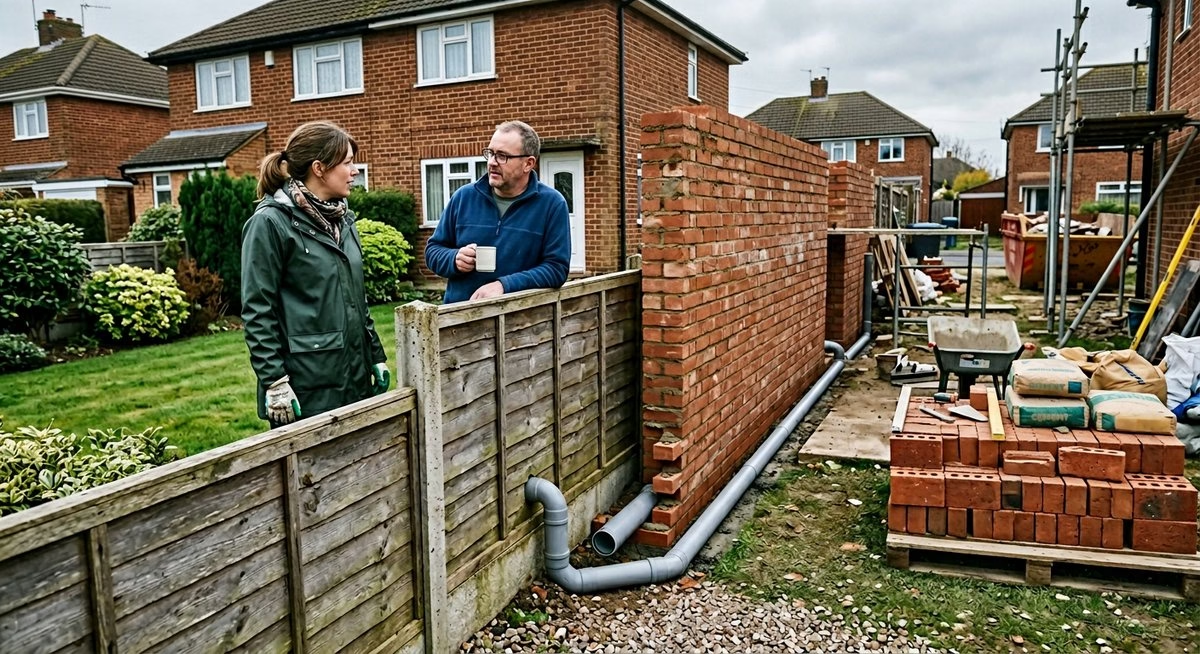
You have planning approval and foundations being dug — then your neighbour appears insisting you leave an 850 mm “maintenance gap” so they can reach their boiler pipes and flue. Suddenly you are caught between a lawful build and a neighbour who believes your extension must shrink to protect fittings they placed next to the boundary years ago. If you have been searching for guidance on a neighbour wants gap between extension and boundary UK situation, you are in the right place. At Fixiz we see this stand-off regularly on extension projects across London, and the law is far more straightforward than most people realise.
What is an “access gap” demand — and why does it keep happening?
An access gap demand is when your neighbour asks — or insists — you pull your new wall back from the boundary so they retain room to service their external pipes, boiler flues, or drainage runs. Typically the neighbour built their own extension first, positioned services close to the boundary, and now feels entitled to permanent clearance on your land.
The confusion arises because homeowners mix up four separate regulatory regimes:
- Planning permission (or Permitted Development rights): Controls the size, position, and appearance of your extension. Planning consent does not grant or restrict access rights over neighbouring land.
- Building Regulations: Sets the technical standards your extension must meet — fire separation, drainage, structural design. Building Control inspects compliance but will not adjudicate boundary disputes.
- The Party Wall etc. Act 1996: Covers work on or near shared boundaries. It requires you to serve notices and, if your neighbour dissents, to appoint surveyors. It does not require you to leave a gap for your neighbour’s pipes.
- Private property rights and common law: Your neighbour has no automatic right to an access corridor over your land simply because they have services near the boundary. Their remedy lies under the Access to Neighbouring Land Act 1992 — a court process, not something they can impose during your build.
When a neighbour conflates all four into a single emotional demand — “you can’t build there” — the result is delay, anxiety, and wasted money. Understanding which regime applies is the first step toward de-escalation.
Tip: Before any boundary conversation, ask: is this a planning matter, a Building Regs matter, a party wall matter, or a private access matter? The answer tells you who to call — planning officer, Building Control, party wall surveyor, or solicitor.
Building ON the boundary versus building NEAR it — the critical distinction
Much of the confusion comes from not understanding the difference between building on the boundary and building near it. The Party Wall etc. Act 1996 draws a bright line between the two.
Building on the boundary (the “line of junction”)
Under Section 1 of the Act, you have an absolute right to build a new wall up to your side of the boundary. You must serve a party wall notice at least one month before starting, but your neighbour cannot stop you building wholly on your own land. If you want to build astride the boundary you need written consent. If they refuse or do not respond within 14 days, you must build entirely on your own side.
We dealt with a project in south London last year where the architect drew the wall straddling the boundary. The neighbour refused, so we redesigned using an eccentric foundation — the wall sits on the outer edge of the footing, keeping everything on our client’s land. Eccentric foundations are one of the most commonly used designs for domestic extensions and are almost always feasible.
Building near the boundary (but set back on your land)
If you position your wall even a small distance inside the boundary — say 50 mm or 150 mm — you need not notify your neighbour under Section 1. However, if you are excavating and your neighbour’s building is within three metres, you may still need a Section 6 notice under the Party Wall Act. This catches many homeowners off guard.
Pulling back removes the Section 1 notice requirement, but it can also create the very gap your neighbour wants. The choice between on-boundary and near-boundary construction should be a deliberate design decision, not a concession forced by an anxious neighbour.
Tip: If your neighbour has existing services close to the boundary, building 100–150 mm inside the line avoids a shared wall, avoids a Section 1 notice for the wall, and gives you a thin buffer — without surrendering the 850 mm or one metre gap neighbours sometimes demand.
The Access to Neighbouring Land Act 1992 — what it actually allows
This is the statute your neighbour may cite — or, more likely, a version they half-remember from an internet forum. Here is what it actually says.
The Access to Neighbouring Land Act 1992 allows a landowner to apply to the county court for an “access order” to enter adjoining land to carry out basic preservation works on their own property. The Act defines basic preservation works as:
- Maintenance, repair, or renewal of any part of a building or structure on the applicant’s land.
- Clearance, repair, or renewal of any drain, sewer, pipe, or cable on the applicant’s land.
- Treatment, cutting back, or removal of hedges, trees, or shrubs that are damaged, diseased, or dangerous.
- Filling in or clearance of any ditch on the applicant’s land.
The court will only make an order if satisfied that the works are reasonably necessary and cannot be carried out, or would be substantially harder to carry out, without entry onto the neighbour’s land. Even then, it must refuse the order if it would cause unreasonable hardship.
In practice, your neighbour cannot simply demand a permanent gap. Their right is to apply to court for temporary access to repair their own pipes or structure — and the court has wide discretion to attach conditions, limit duration, and require the applicant to make good any damage. The Act has been used rarely — with just one reported county court decision in its first 30 years.
From our experience at Fixiz, the takeaway is clear: your neighbour’s right to maintain their pipes does not translate into a right to dictate wall position. It translates into a potential right — exercised through the courts — to access your land temporarily for specific preservation works, on fair terms.
When pipe rerouting is sensible versus when it is not your responsibility
Who pays to move the neighbour’s pipes is one of the biggest sources of friction in access gap disputes. The answer depends on where the pipes sit in relation to the boundary line and whether your build creates a Building Regulations conflict. There are three common scenarios worth understanding.
Pipes on your neighbour’s land
If the neighbour’s boiler flue, waste pipes, or soil stack are entirely on their side of the boundary, you are under no obligation to reroute them. Your extension making future maintenance harder is not your legal problem — any more than planting a hedge would be. They can maintain their services from their own land or apply for a court order under the 1992 Act.
Pipes crossing or encroaching on your land
If pipework overhangs or crosses your boundary without an easement or wayleave, you have stronger grounds to insist on rerouting at their cost. You are not obliged to design your extension around an unauthorised encroachment. Raise this with your solicitor before construction begins, and document the encroachment with photographs and measurements.
Flues that breach Building Regulations
If your neighbour’s flue was installed too close to the boundary and your extension creates a new wall within the clearance zone under Approved Document J, Building Control could flag the conflict during inspection. It is often more practical to negotiate a shared cost than wait for a protracted dispute. We have managed projects where the gas engineer rerouted a flue in a single morning, splitting the cost and keeping the build on programme.
Tip: Before breaking ground, photograph every pipe, flue, vent, and cable on and near the boundary. A dated record is invaluable if a dispute arises about what was there before your build started.
Practical de-escalation — keeping your project on track
Neighbour disputes rarely improve with silence. At Fixiz we have found that early, structured communication almost always produces a better outcome than legal letters.
Document existing conditions before you start
Take time-stamped photographs of the boundary area before excavation. Note the position of every neighbouring service — pipes, flues, cables, vents — and the condition of the neighbour’s wall and drainage. This removes the “you caused that crack” argument later.
Agree a method statement
Share a method statement with your neighbour outlining how the boundary wall will be constructed, what plant you need, and the expected programme. This is not a legal obligation, but it builds trust and pre-empts objections. We routinely prepare these for our clients and find they defuse tension before it escalates.
Consider a temporary access licence
If your neighbour has a genuine maintenance need — say a boiler service due during your build — consider granting a short, written licence allowing access at an agreed time. This costs nothing, keeps goodwill intact, and avoids escalation to a solicitor. A letter setting out dates, times, and permitted activities is usually sufficient.
Neighbour communication milestones
We advise clients to communicate at four key points:
- Before serving notices: An informal conversation explaining what you plan to build and when.
- After serving notices: Follow up in person to answer questions and offer a copy of plans.
- At foundation stage: Notify the neighbour when excavation starts and how long trenches will be open.
- At completion: Walk the boundary together and compare the finished state to pre-start photographs.
Escalation steps if communication breaks down
If your neighbour refuses to engage or makes threats, follow this escalation ladder:
- Step 1 — Written record: Confirm your position in writing and keep copies of everything.
- Step 2 — Professional advice: Appoint a party wall surveyor if a notice dispute exists, or a solicitor if the dispute is about access or property rights.
- Step 3 — Building Control liaison: If the concern involves a flue or drainage conflict, contact Building Control proactively rather than waiting for a stop-work flag at inspection.
- Step 4 — Mediation: Property mediation services can resolve access disputes faster and more cheaply than court.
Tip: Never agree verbally to move your wall position under pressure on site. Any change to the approved design should be documented, costed, and confirmed in writing before your builder alters a single block.
How Fixiz keeps your boundary build on programme
At Fixiz we manage the entire process so you never face your neighbour alone with a half-understood legal question. We have guided dozens of London homeowners through boundary-adjacent builds without a single project lost to a neighbour dispute, and we bring that hard-won experience to every new job. Here is what we do differently:
- Pre-start boundary audit: We survey the boundary line, identify every neighbouring service, and flag potential conflicts before design is finalised — not after your foundations are dug.
- Party wall coordination: We work alongside experienced party wall surveyors to ensure notices are served correctly and on time, whether you are building on the boundary under Section 1 or excavating near it under Section 6.
- Neighbour liaison: We prepare communication packs — plain-English letters, method statements, and programme summaries — so your neighbours understand what is happening and when.
- Flue and pipe resolution: Where a neighbouring flue or pipe creates a Building Regulations conflict, we coordinate directly with Gas Safe engineers and Building Control to find the fastest, lowest-cost resolution.
- Programme protection: We build realistic contingency into our programmes for boundary-related delays, so a two-week neighbour negotiation does not blow a hole in your completion date or your budget.
On a recent project in Lewisham, a neighbour’s incorrectly sited boiler flue was threatening to stall our client’s six-metre rear extension. We arranged a joint meeting with the neighbour, their Gas Safe engineer, and our Building Control officer. The flue was rerouted in under four hours, the cost was split, and the build continued without a single lost day on site. Whether your neighbour is anxious, obstructive, or simply confused about what they can and cannot demand, we know how to move the conversation forward and keep your build on programme.
Frequently asked questions
Can my neighbour force me to leave a gap between my extension and the boundary?
No. You have a legal right to build up to your boundary under the Party Wall etc. Act 1996. Your neighbour cannot compel you to set your wall back to create maintenance access. Their remedy is to seek a court order under the Access to Neighbouring Land Act 1992 — not to dictate wall position.
What is the Access to Neighbouring Land Act 1992?
A statute allowing a landowner to apply to the county court for a temporary access order to enter neighbouring land to carry out basic preservation works — such as repairing pipes, drains, or structures. The court grants the order only if works are reasonably necessary and cannot practically be done otherwise. It does not create a permanent right of access.
Do I need a party wall agreement to build near the boundary?
If you are building on or astride the boundary, you must serve a Section 1 notice. If you are set back but excavating within three metres of your neighbour’s foundations, you may need a Section 6 notice. If your foundations do not come within the relevant distances, no notice is required.
Who pays to move my neighbour’s pipes if they are in the way?
If the pipes are on your neighbour’s land, they are your neighbour’s responsibility. If pipes encroach onto your land without an easement, you may require your neighbour to move them at their cost. Where a Building Regulations conflict arises — for example, a flue clearance issue — a negotiated cost split is often the most practical solution.
What happens if my neighbour’s flue does not meet Building Regulations?
If a flue was installed more than about six years ago, enforcement becomes unlikely even if it was non-compliant. However, if your extension creates a new wall within the flue’s clearance zone, Building Control may flag this during inspection. Rerouting — often at shared cost — is usually the fastest resolution.
Can I build right up to the boundary without my neighbour’s permission?
Yes. Under the Party Wall etc. Act 1996, you have an absolute right to build a wall wholly on your own land up to the boundary line. You must serve a notice, but your neighbour cannot prevent you. The only scenario requiring written consent is building astride the boundary so the wall becomes a shared party wall.
Ready to move from confusion to construction? Get in touch with Fixiz today for a no-pressure chat about your project and the fastest route to full compliance.