Physical address:
128 City Road, EC1V 2NX, London,UK

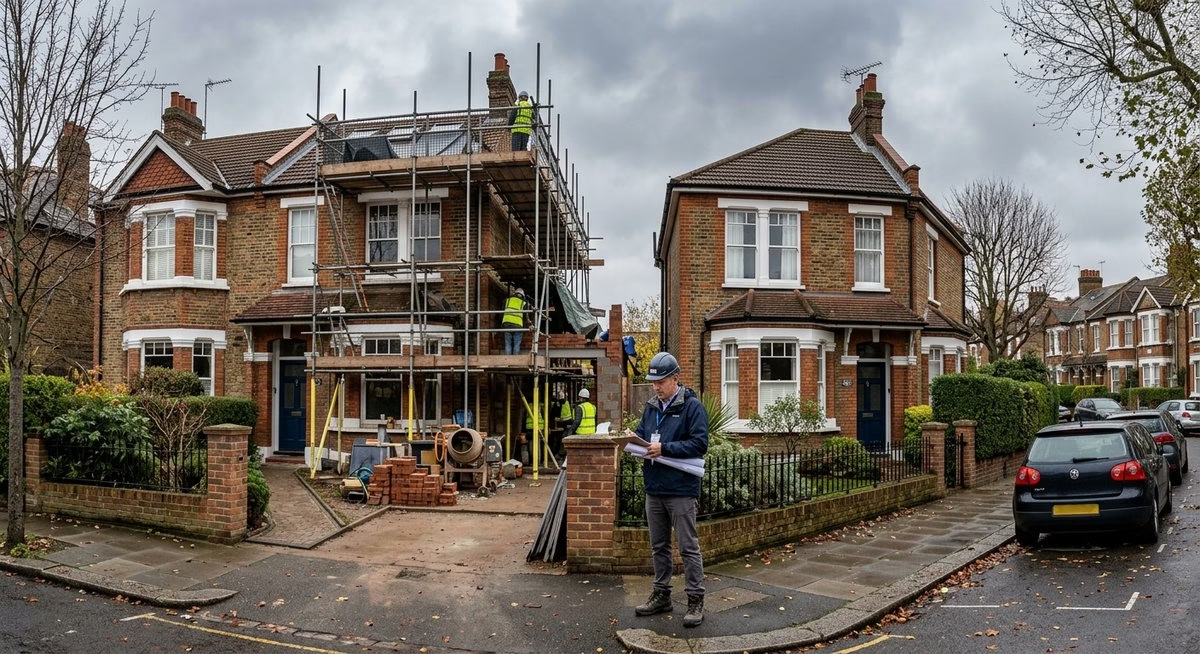
You served the notice. You waited. And then your neighbour said no — or said nothing at all. If you are dealing with a situation where your neighbour refuses party wall agreement, the good news is that this is far from a dead end. The Party Wall etc. Act 1996 has a clear, structured dispute resolution pathway designed for exactly this moment — and it does not give your neighbour the power to stop your project indefinitely. In our experience at Fixiz, the homeowners who feel most stuck at this stage are the ones who simply do not know what the rules say happens next. So let us walk you through every step.
What “Dissent” Actually Means Under the Party Wall etc. Act 1996
When your neighbour declines to sign a party wall agreement — or simply fails to respond — the law describes this as dissent. Dissent does not mean your neighbour has blocked your project. It means the informal route to consent has closed and the formal dispute resolution process has automatically opened.
The Act was designed precisely to prevent neighbourly disputes from holding up legitimate building work indefinitely. Once dissent is registered — whether explicitly or through silence — the process moves into a defined legal framework that runs on its own timeline, with or without your neighbour’s active cooperation. Dissent does not mean they object to the structural safety of your plans, it does not mean they can demand you abandon the project, and it does not mean you need to go to court. It simply means a surveyor must now step in to produce a legally binding Party Wall Award before you can break ground.
We have seen homeowners interpret a neighbour’s silence as hostility and give up on their project entirely. That is almost always the wrong call. Silence, under the Act, is simply a trigger for the next stage.
The 14-Day Deemed Dissent Rule — And What Happens When Your Neighbour Ignores You
Once you serve a valid party wall notice, your neighbour has 14 days to respond in writing: they can consent (ending the formal process), dissent explicitly (opening the dispute resolution route), or say nothing at all.
If 14 days pass with no response, you must serve a second notice giving your neighbour a further 10 days. If there is still no reply, you are automatically deemed to be in dispute under the Act. This is deemed dissent — silence carries the same legal weight as a formal refusal. At that point — roughly 24 days after your original notice — you have the right to appoint a party wall surveyor on your neighbour’s behalf if they continue to refuse to engage. Your neighbour cannot simply ignore the process into paralysis. The Act anticipates uncooperative adjoining owners and provides a route around them.
Tip: Always serve your party wall notice by a method that gives you proof of delivery — recorded post or hand-delivery with a photograph of the notice going through the letterbox. If your neighbour later claims never to have received it, you need that evidence to rely on.
Appointing Surveyors — The Agreed Route vs. Two Separate Surveyors
Once dissent is confirmed — whether explicit or deemed — both parties move to the surveyor stage. There are two distinct routes, and the one you end up on significantly affects cost and timeline.
- The agreed surveyor route: Both parties appoint a single, mutually acceptable surveyor to act impartially. This surveyor must be independent and should not be the same person already advising you on the build. This route is faster, typically cheaper, and less adversarial — it is the one we recommend wherever possible.
- Two surveyors: If your neighbour insists on appointing their own — which is their right — each party has a representative. Those two surveyors must produce a jointly agreed award. If they cannot agree, a third surveyor acts as adjudicator. This route adds cost and time but is a fully functional legal process.
If your neighbour refuses to appoint a surveyor or ignores the process at this stage, you have the right to appoint one on their behalf. The process will proceed regardless. In our work across London and the home counties, we have found that the majority of cases — even those starting with a flat refusal — end up with an agreed surveyor once both parties understand the cost implications of running two separate surveyors.
Tip: Even if relations are strained, suggest the agreed surveyor route in writing. Frame it around cost savings for both parties. If they decline, documenting the offer demonstrates goodwill and can help if there is later dispute about costs.
What a Party Wall Award Contains — and Why It Protects You As Much As Your Neighbour
A Party Wall Award is a legally binding document prepared by the appointed surveyor or surveyors. It contains considerably more than a simple permission to start work. A properly drafted award will set out:
- Scope of works: A precise description of what work is permitted — the type, location, and method of construction covered by the Act.
- Schedule of condition: A detailed photographic record of the current state of your neighbour’s property before work begins. This protects you as much as them — if your neighbour later claims your project caused a crack, the schedule is the baseline. Without it, you are exposed.
- Access arrangements: When and how you, your contractors, and the surveyor may access the adjoining property during works.
- Working hours and methods: Any conditions your neighbour has argued for — restricted hours, quieter construction methods, or specific protective measures.
- Timeframes: When work must begin and the period within which it must be completed.
The award is binding on both parties and can only be overturned by appealing to the county court within 14 days of receiving it. That appeal right cuts both ways, but think carefully before exercising it — if you appeal and lose, you risk paying your neighbour’s legal costs as well as your own. We have reviewed awards on behalf of clients where the schedule of condition alone proved invaluable — protecting the building owner from a claim of damage that predated the works entirely.
Who Pays the Surveyor’s Fees
As the building owner — the person carrying out the works — you pay. This covers your own surveyor’s fees and your neighbour’s reasonable surveyor costs, whether they appointed one independently or you did so on their behalf. The Act uses the word “reasonable” deliberately: if your neighbour’s surveyor charges excessive fees, the third surveyor can determine what is fair. This is another reason the agreed surveyor route is preferable — a single surveyor’s fee is almost always lower than two surveyors plus a potential adjudicator. For straightforward residential projects, expect an agreed surveyor to charge roughly £700–£1,200 for the award and schedule of condition, though this varies by location and complexity.
Tip: Get a written fee estimate from any surveyor before appointing them, and confirm it covers the schedule of condition inspection, the award drafting, and any follow-up correspondence. Hidden extras at this stage are not uncommon.
Can Your Neighbour Delay Your Project Indefinitely? No — Here Is Why
The short answer is no. The Act’s dispute resolution mechanism is designed to produce a binding outcome regardless of one party’s level of cooperation. Surveyors have the authority to proceed to make an award even if your neighbour is not engaging constructively — if their surveyor is obstructive, the matter escalates to a third surveyor. At each stage, there is a mechanism to break the deadlock.
What your neighbour can legitimately influence is the conditions of the award, not the award itself. They can argue for restricted working hours, a quieter construction method, or specific protective measures. These are reasonable and the Act accommodates them. But they cannot use the surveyor process to veto works that are otherwise lawful.
Once a valid award is in place, your neighbour must allow access to the party wall for the defined works. Blocking that access is a criminal offence prosecutable in the magistrates’ court. The law is not toothless at this point.
The Nuclear Option — Injunctions, and When They Actually Apply
There is one scenario where your neighbour can obtain an injunction to stop your works entirely: if you start party wall works without ever having served a valid notice. An injunction is not available simply because a neighbour dislikes your project or disagrees with the award. It is a remedy for a building owner who has bypassed the statutory process altogether and started notifiable works without notice. In that situation, the court can halt the works until proper procedure is followed — and judges are generally sympathetic to the adjoining owner in these cases.
We are firm with every client on this point: never start works within the Act’s scope before serving notice. We have helped clients who inherited half-completed projects where the previous owner failed to serve notice — unpicking those situations is significantly more expensive than getting it right from the start. If the dispute resolution process is running correctly — notice served, dissent recorded, surveyors appointed — an injunction is simply not on the table for your neighbour.
Typical Timescales — and How to Speed Things Up
Realistic timescales depend heavily on which surveyor route you end up on:
- Agreed surveyor: From the point surveyors are appointed, a Party Wall Award can typically be produced in 4 to 8 weeks. This assumes the surveyor can access both properties for the schedule of condition inspection without significant delay, and that your technical drawings are ready to share.
- Two separate surveyors: The process takes longer — typically 8 to 16 weeks — because the two surveyors must correspond, agree on the terms of the award, and potentially involve a third surveyor if they cannot agree. Each additional layer adds time.
The single biggest factor you control is document readiness. If your structural drawings, specification, and any relevant engineering information are ready to hand to the surveyor on day one, you remove the most common source of delay. Surveyors cannot finalise an award without understanding the full scope of the works.
Practical steps that accelerate the process:
- Respond promptly to surveyor correspondence: Any delay in your replies adds days to the timeline.
- Facilitate the schedule of condition inspection: If your neighbour is uncooperative about access, raise it with the surveyor immediately.
- Keep records of everything: Every letter, email, and notice should be dated and retained. Your paper trail is your protection if a later dispute arises about what was agreed and when.
- Appoint a surveyor promptly after deemed dissent: Every week you delay after the 14-day window closes is a week added to your project start date.
How Fixiz Helps You Get Through the Dispute Resolution Process Without Losing Time
We work with homeowners across London and the surrounding areas at every stage of the party wall process — from drafting the initial notice to navigating the aftermath of a neighbour’s refusal. The difference between a smooth award process and a drawn-out one almost always comes down to preparation and responsiveness, not the complexity of the dispute itself.
We ensure that when dissent occurs, everything the surveyor needs is already in order — drawings, specifications, schedules — so the clock starts running from a position of readiness. We have also seen neighbours who initially refused a party wall agreement come around once they understood that a properly drafted award protects their interests as much as the building owner’s. The schedule of condition gives many neighbours genuine peace of mind — they know there is a documented baseline if anything goes wrong. Sometimes what looks like hostility is simply anxiety, and the right conversation at the right time resolves it.
If your project is stalled at this stage, we can help you map the fastest compliant route forward — without cutting corners that could create larger problems later.
Frequently Asked Questions
My neighbour said no but won’t appoint a surveyor. What do I do?
You can appoint a party wall surveyor on your neighbour’s behalf if they dissent but fail to appoint their own. The Act gives you this right to prevent non-engagement from stalling the process. Notify your neighbour in writing that you intend to do so, giving them 10 days to act. After that, proceed with your appointment on their behalf.
Can my neighbour demand I change my building plans as a condition of agreeing?
Your neighbour can raise concerns about working hours, noise, and construction methods through the surveyor process, and those reasonable concerns can be reflected in the award. However, they cannot require you to fundamentally redesign your project or abandon works that are lawful under planning and building regulations. The surveyor determines what is reasonable — not your neighbour.
What is a schedule of condition and why does it matter?
A schedule of condition is a detailed photographic and written record of your neighbour’s property — particularly the walls, ceilings, and structures closest to the party wall — taken before works begin. It matters because it establishes a baseline. If your neighbour later claims your project caused a crack, the schedule shows whether that crack existed beforehand. Without it, you have no evidence to defend yourself. Insist on a thorough schedule of condition regardless of whether your neighbour requests one.
Can I appeal a Party Wall Award if I think it is unfair to me?
Yes. Either party can appeal a Party Wall Award to the county court within 14 days of receiving it. The court can uphold the award, amend it, or substitute a different decision. However, appeals are costly and uncertain — if you lose, you may be ordered to pay your neighbour’s legal costs. Take legal advice before appealing rather than acting on frustration alone.
What if I started work before serving notice — can I fix this now?
Yes, but it is more complicated than starting correctly. Stop works immediately, serve a retrospective notice, and go through the full award process. Your neighbour is in a stronger position to seek an injunction at this point. A party wall surveyor can advise on regularising the situation, but it will cost you time and goodwill. The lesson is always the same: serve the notice first.
Does the Party Wall Act apply to flats and leasehold properties?
Yes. Where a property has both a freeholder and leaseholders, each is considered an adjoining owner and must receive their own party wall notice. Each has the right to appoint their own surveyor if they dissent, which can multiply the surveyor costs involved. This is worth factoring into your planning if you are working on a property in a converted building.
Ready to move from confusion to construction? Get in touch with Fixiz today for a no-pressure chat about your project and the fastest route to full compliance.