Physical address:
128 City Road, EC1V 2NX, London,UK
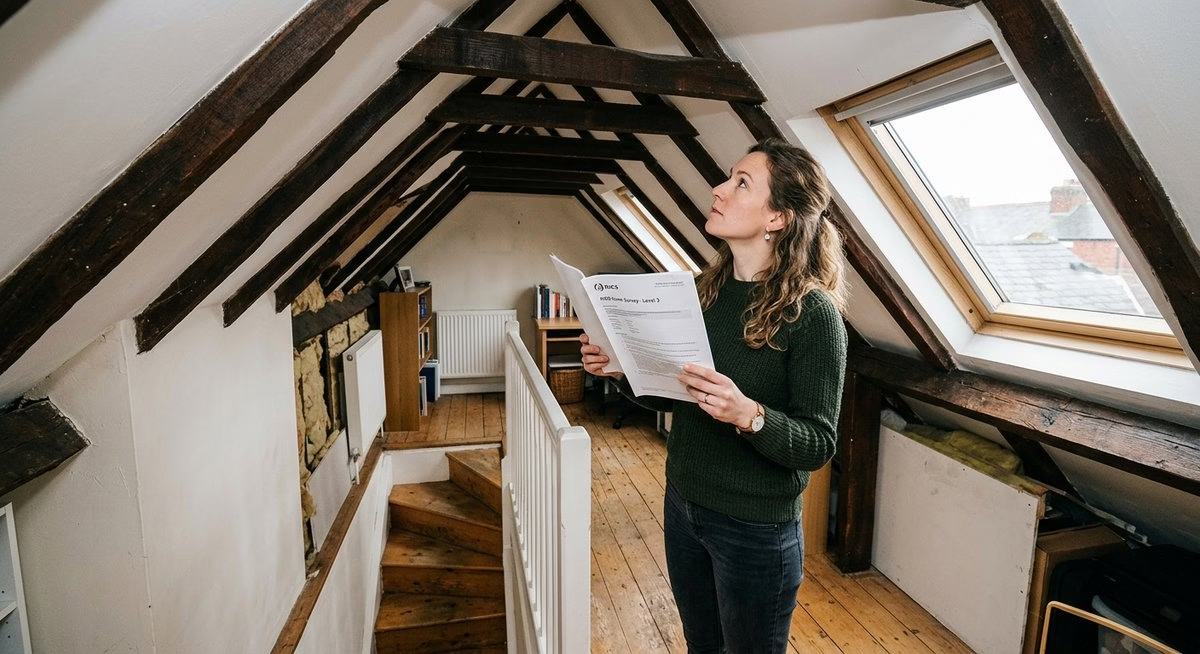
You have found the perfect home — and then your surveyor flags that the loft conversion has no completion certificate. Suddenly, phrases like “regularisation,” “indemnity insurance,” and “non-compliant staircase” are flying around and nobody is giving you a straight answer. If you are dealing with a loft conversion no building regs sign off, you are far from alone. This is one of the most common conveyancing headaches in the UK property market, and it is almost always resolvable — provided you understand what you are facing and what your options are before you commit.
What “No Building Regulations Sign-Off” Means — and How to Check
Every loft conversion in England and Wales requires Building Regulations approval — regardless of whether planning permission was needed. Many homeowners confuse the two, but they are entirely separate legal requirements. Building Regulations cover structural integrity, fire safety, insulation, staircase design, and ventilation. When the work is inspected and passes, the local authority (or an approved inspector) issues a completion certificate. This is the formal proof that the conversion met the required standard at the time of construction. Without it, there is simply no independent record that anyone qualified ever checked the work.
When there is no sign-off, it usually means the previous owner either never applied for Building Regulations or applied but never called the inspector back for the final visit. Either way, there is no official confirmation that the conversion is structurally sound, fire-safe, or compliant. Your mortgage lender will almost certainly raise it. Your buildings insurance may not fully cover the loft space — and if the insurer is not told about the conversion at all, a future claim could be rejected entirely. There is also a safety dimension: without inspection, nobody has verified that the floor can carry occupants, that the staircase is safe, or that adequate fire protection exists.
Your solicitor should be raising standard property enquiries, but be proactive. Ask the seller directly for a completion certificate. If they cannot produce one, check whether a building notice or full plans application was submitted — evidence that the process was at least started. Ask your solicitor to search the local authority’s building control records, which most councils provide for around £60–£70. If a private approved inspector was used, those records may not appear in a council search, so ask the seller which building control body was involved.
Tip: If the seller cannot produce any paperwork and the council has no record of an application, treat the loft as entirely unapproved. In our experience at Fixiz, this is one of the most common reasons conversions go unsigned — the homeowner assumed the builder handled it, the builder said planning was not needed, and everyone confused that with Building Regulations not being needed either.
Non-Compliant Staircases, Headroom, and Fire Safety — the Real Risks
The staircase is often where building regulations non-compliance becomes most visible. Under Approved Document K, a loft staircase needs a minimum of 2 metres of clear headroom, though this can reduce to 1.8 metres at the lowest point where stairs pass under a sloping ceiling. The pitch should not exceed 42 degrees. Risers must be between 150 mm and 220 mm, goings between 220 mm and 300 mm, and handrails are required at 900–1000 mm height with landings at both top and bottom.
In practice, a non-compliant staircase usually means one or more of the following:
- Headroom below 1.8 m: The most common issue — you physically have to duck, which is uncomfortable and potentially dangerous in an emergency.
- Excessive pitch: Stairs steeper than 42 degrees feel more like a ladder, increasing fall risk.
- No proper landing: The staircase opens directly into the loft room without adequate transition space.
- Retained loft ladder: Some conversions skip a permanent staircase entirely, which cannot meet Building Regulations for a habitable room.
Fire safety is arguably the most serious concern, because loft occupants have the longest escape route to the front door. Under Approved Document B, a loft conversion in a house that becomes effectively three-storey requires:
- Protected escape route: The staircase from the loft to the final exit must be enclosed with 30-minute fire-rated walls and ceilings.
- FD30 fire doors: Required on every habitable room opening onto the staircase — typically the loft room, all first-floor bedrooms, and ground-floor living areas.
- Mains-powered interlinked smoke alarms: Fitted on every storey so that when one triggers, they all sound.
- Fire-resistant ceilings and floors: The first-floor ceiling should provide 30 minutes of fire resistance.
- Fire-rated glazing: Any glass within the escape route must resist fire for 30 minutes.
In unapproved conversions, we frequently find hollow-core doors, no interlinked alarm system, stairwells separated by thin timber panelling, and ordinary glass in the escape route. Each is a genuine safety gap — not just a paperwork issue.
At Fixiz, we always measure headroom and pitch during our initial assessment, because the staircase often determines the entire scope and cost of remediation. A 50 mm shortfall is a very different problem from a 300 mm one.
When Indemnity Insurance Helps — and When It Does Not
If you are buying a property with a loft conversion and no building regs sign off, your solicitor will almost certainly mention indemnity insurance. It is important to understand exactly what this covers, because there is a widespread misconception that it “solves” the problem.
Indemnity insurance for lack of Building Regulations covers one specific risk: enforcement action by the local authority. If the council discovered the unauthorised work and required you to remove it or bring it up to standard, the policy would cover those costs. These policies are inexpensive — often £80–£500 for a one-off premium — and they transfer to future owners.
However, indemnity insurance does not do any of the following:
- Fix physical defects: If the staircase headroom is dangerously low, the policy will not pay to rebuild it. If floor joists are undersized, it will not cover structural remediation.
- Confirm the work is safe: An indemnity policy is not a substitute for a building control inspection — it provides financial protection against enforcement, not a certificate of safety.
- Guarantee mortgage approval: Some lenders will still downvalue or refuse to lend if the conversion is clearly substandard.
- Protect you if you contact the council first: Most policies require that you have not notified the local authority. If you or the seller have already contacted building control, the policy may be void.
Tip: Think of indemnity insurance as a legal safety net, not a physical one. It protects your wallet from enforcement costs but does nothing to protect your family from a non-compliant staircase or missing fire provisions. If there are genuine safety concerns, remediation — not insurance — is the answer.
At Fixiz, we often see buyers who were told indemnity insurance was “all they needed” and later discovered the loft still had real problems — no fire doors, no interlinked alarms, headroom that made daily use uncomfortable. The paperwork sat in a drawer while the defects remained overhead.
Corrective Works, Budget, and Impact on Your Mortgage
If you decide to proceed, quantify the cost of bringing the loft into compliance before you exchange contracts. This gives you leverage to negotiate on price and ensures you are not walking into an unknown financial commitment. A typical corrective works scope might include:
- Regularisation application: A retrospective Building Regulations application — expect £500–£750 or more depending on the council. The officer will inspect and identify what needs to change.
- Fire door installation: FD30 fire doors with intumescent strips and smoke seals, roughly £150–£300 per door. A typical house may need five to eight.
- Interlinked smoke alarms: A mains-powered system fitted on every floor — usually £300–£600 including installation.
- Staircase modifications: From minor adjustments (£1,000–£3,000) to a full rebuild (£5,000–£10,000 or more).
- Fire-resistant construction: Upgrading plasterboard for 30-minute fire resistance — from £500 for localised boarding to several thousand for a full overhaul.
- Structural verification: A structural engineer’s report (£300–£600) if there is doubt about floor joists, steel beams, or roof structure.
In total, bringing a moderately non-compliant loft up to standard typically costs between £3,000 and £10,000, though complex cases involving staircase repositioning or major structural work can push this higher. At Fixiz, we provide itemised corrective works assessments so buyers can present those figures to the seller during negotiations.
Tip: Use the corrective works estimate as a negotiation tool. Many sellers will accept a price reduction equivalent to the remediation cost rather than risk the sale falling through. Alternatively, you can request the seller applies for a regularisation certificate before completion — though this takes time and may delay your purchase.
On the mortgage side, most mainstream lenders will accept an unapproved conversion if indemnity insurance is in place — but the valuer is likely to treat the loft as a “room” rather than a bedroom, potentially reducing the loan amount offered. Some lenders are stricter and may decline to lend or impose conditions requiring remediation before completion. Speak to your mortgage broker early.
When it comes to resale, the same issue will resurface with every future buyer’s solicitor. If you obtain a regularisation certificate during your ownership, you eliminate this problem entirely — and the property can be legitimately marketed with the loft as a bedroom, potentially adding tens of thousands of pounds to the asking price.
We have worked with several homeowners at Fixiz who bought properties with unapproved loft conversions, invested in corrective works and regularisation, and sold at a meaningful premium because the loft was now fully certified. It is one of the few scenarios where compliance work directly and measurably increases marketable value.
Frequently Asked Questions
Can the council force me to remove a loft conversion with no Building Regulations sign-off?
Technically, yes — the local authority can take enforcement action against unauthorised building work. In practice, councils rarely pursue this on domestic loft conversions unless there is a formal complaint or an obvious safety hazard. The risk — however small — is why indemnity insurance exists. It covers the financial consequences if enforcement action is taken.
Is a regularisation certificate the same as a completion certificate?
Not exactly. A completion certificate is issued when work is inspected during construction. A regularisation certificate is the retrospective equivalent — it confirms that unauthorised work has been assessed and meets the Building Regulations in force when the work was carried out. For conveyancing purposes, it serves the same function and satisfies mortgage lenders.
Should I get a structural survey before buying?
Yes — we strongly recommend it. A standard homebuyer’s survey will flag the absence of documentation but will not open up floors or ceilings to check structural adequacy. A structural engineer can confirm whether floor joists have been upgraded, steel beams correctly specified, and the roof structure remains sound. This typically costs £300–£600 and is money well spent.
Does the 10-year rule mean I do not need to worry about Building Regulations?
No. The 10-year rule applies to planning enforcement, not Building Regulations. Even if a conversion is immune from planning enforcement because it has existed for over 10 years, Building Regulations compliance is a separate requirement with no time limit. You may still need regularisation and remedial works regardless of age.
What if I cannot afford the corrective works right now?
If the conversion is structurally sound but lacks fire safety provisions, prioritise the safety-critical items first: interlinked smoke alarms, fire doors on the loft room and escape route, and ensuring the staircase is safe to use. These can often be addressed for under £2,000. You can pursue full regularisation later when budget allows — just be aware that until you have a regularisation certificate, the same conveyancing issue will remain for any future sale of the property.
Ready to move from confusion to construction? Get in touch with Fixiz today for a no-pressure chat about your project and the fastest route to full compliance.