Physical address:
128 City Road, EC1V 2NX, London,UK
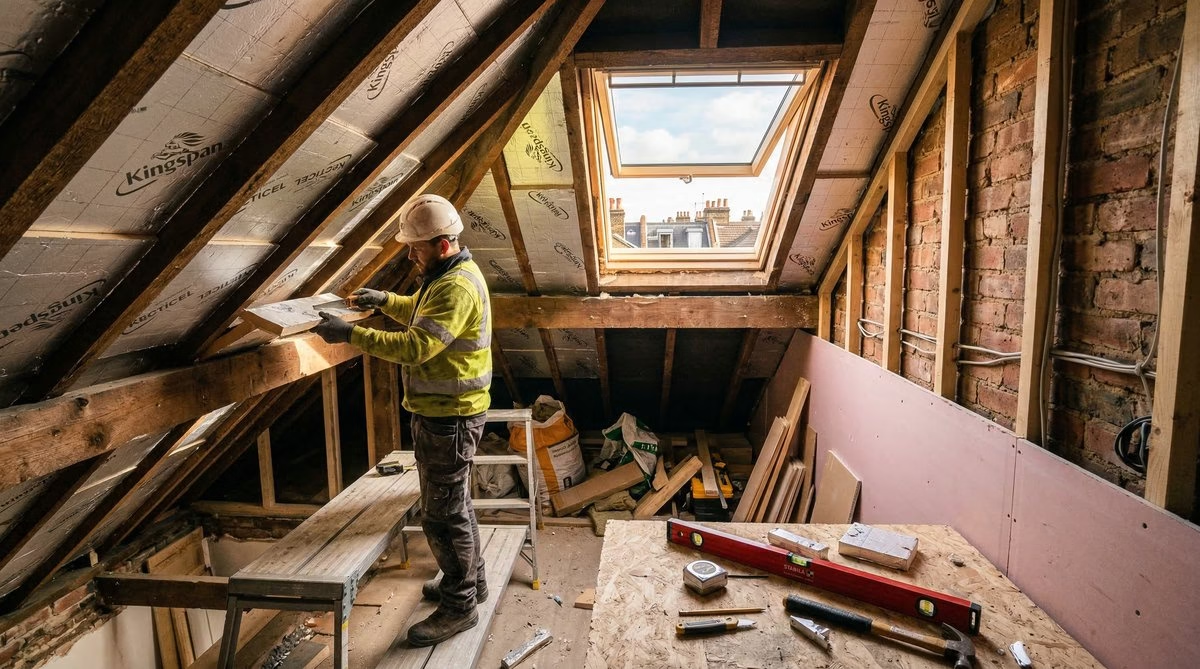
If you’ve just discovered that the insulation fitted in your loft conversion doesn’t match what the architect specified, you’re not alone — and the good news is that loft conversion insulation not as specified building control UK is a problem we deal with regularly at Fixiz. The bad news is that leaving it unchallenged can mean failed sign-off, wasted money ripping back plasterboard, and a property that underperforms thermally for decades. This guide explains exactly what Building Control inspectors focus on, how to push back effectively against a builder who deviated from spec, and what realistic remediation looks like even after the walls are closed.
Why insulation specification matters — and what Building Control actually measures
Loft conversions are notoriously difficult to insulate correctly. The geometry is awkward, the rafter depths vary, and there is constant pressure to keep ceiling heights compliant with Part K (headroom) while still achieving the thermal performance required under Part L of the Building Regulations. When a builder substitutes one insulation product for another — swapping PIR (polyisocyanurate rigid board) for mineral wool, or fitting a multifoil in place of a specified hybrid system — the thermal calculation changes fundamentally.
Building Control in England and Wales does not police brand names. What they care about is U-value compliance. The maximum permitted U-value for a pitched roof in a new thermal element (or an existing roof being upgraded as part of a conversion) is 0.18 W/m²K under Part L1B of the Building Regulations (England). If the substituted product achieves or betters that figure within the available rafter depth, Building Control may accept it. If it doesn’t, they won’t — and they are within their rights to require opening up to verify.
How U-values are assessed
U-value calculations are performed by a qualified energy assessor or by the contractor, using the actual thermal conductivity (lambda value) of the installed product, the depth of the insulation layer, any air gaps, and the effect of repeating thermal bridges such as rafters. A PIR board at 100 mm might achieve a lambda of 0.022 W/mK, whereas a standard mineral wool quilt at the same depth might have a lambda of 0.038 W/mK — a significant difference that will almost certainly fail to meet the 0.18 W/m²K target without additional compensation elsewhere.
Tip: Always ask your builder or energy assessor to produce a written U-value calculation for the as-built insulation, not just the specified insulation. If they cannot produce one, that is itself a red flag for Building Control.
What inspectors look for on site
A Building Control officer (BCO) will typically inspect the loft conversion at several stages: at structural frame completion, before insulation is covered, and at final completion. If the inspection at the pre-plasterboard stage was missed or the BCO was not called, Building Control may issue a notice to open up under Section 33 of the Building Act 1984 to verify the work. This is their legal right, and refusing to comply creates serious problems at sale time.
- Thermal performance: The BCO will want evidence — usually a U-value calculation and the product technical data sheet — that the installed insulation achieves the required standard.
- Continuity: Inspectors look for gaps, cold bridges, and areas where insulation has been compressed or cut short around rafters, ridge boards, or trimmer joists.
- Condensation risk: Different insulation systems have different requirements for vapour control layers and ventilation gaps. If the builder changed the product type, the vapour management strategy may also need to change.
- Fire performance: Some PIR products require additional fire protection (typically 12.5 mm plasterboard) when installed in certain configurations. Substituting a product without checking fire performance requirements can create a separate compliance failure.
How to challenge a builder who deviated from spec
The architect’s or structural engineer’s drawings form part of the building contract — and if the builder deviated from them without your written consent, they are in breach. The key is to act systematically rather than emotionally, and to build a paper trail before any confrontation.
Step 1 — Gather the evidence
Pull together the original specification drawings (usually the architect’s package), any variation orders or emails where you approved changes, and the builder’s invoices or delivery notes that show what product was actually purchased. Delivery notes and packaging on-site photographs are particularly valuable because they are contemporaneous — a builder cannot argue they used a different product if you have photos of the mineral wool packaging from the day of installation.
Step 2 — Get an independent assessment
Commission a thermal performance survey from an independent energy assessor or a specialist building pathologist. They can inspect any accessible areas (eaves, loft hatch, exposed rafter sections at the edges of rooms) and produce a professional report. Some surveyors use thermal imaging to identify areas of missing or inadequate insulation without opening up walls. This report is your leverage — it quantifies the shortfall in objective, measurable terms.
Tip: Do not open up plasterboard yourself before getting professional advice. Unauthorised opening-up can complicate an insurance or legal claim and may void the builder’s own insurance position.
Step 3 — Formal written notice to the builder
Write to the builder formally — by recorded post and email — setting out the specific departure from specification, the thermal shortfall as quantified by your independent assessor, and a reasonable time frame (typically 14 to 28 days) within which you require them to rectify the defect. Reference the contract documents and the relevant Building Regulations clauses. If you paid a deposit or staged payments, note that you are withholding the final payment pending satisfactory resolution.
Step 4 — Notify Building Control
Contact the Building Control body that issued the building notice or full plans approval — either the local authority (LABC) or an approved inspector. Inform them of the discrepancy and provide a copy of your independent assessment. Building Control cannot take sides in a contract dispute, but they can confirm whether the as-built work meets Part L or whether remediation will be required for sign-off. Getting that confirmation in writing protects you entirely — the builder cannot later claim the BCO was happy with the work.
Realistic fixes — even after the plasterboard is up
If the builder is unresponsive or the remediation options are limited, you still have practical routes to compliance. Fixiz has resolved several cases where insulation was sub-spec behind finished plasterboard, and the solutions ranged from non-invasive to partial strip-back.
Blown or injected insulation
For certain rafter configurations, loose-fill insulation (such as blown cellulose or mineral wool fibre) can be injected through small holes drilled in the plasterboard, significantly improving the thermal performance without a full strip-out. This approach works best in warm roof configurations where there is sufficient depth between the rafter and the plasterboard — it is less effective where the insulation sits tight against the underlay.
Secondary internal layer
Where rafter depth is insufficient and the existing insulation is below spec, a secondary layer of rigid insulation (typically PIR boards at 25–50 mm) can sometimes be fixed directly over the existing plasterboard and re-lined. This does reduce ceiling height — typically by 40–70 mm — but it avoids a full strip-back and can bring the overall U-value into compliance. The calculation must be re-run to confirm.
Partial strip-back and reinstatement
In some cases — particularly where the thermal bridge at eaves level is severe, or where the vapour control layer is missing — a partial or full strip-back is unavoidable. At Fixiz we always pursue non-invasive options first, but where strip-back is necessary we carry out the work in a controlled, sequenced programme that minimises disruption and protects the structural integrity of the conversion.
Tip: Always obtain a new U-value calculation after any remediation and keep it on file. This is the document your solicitor will need if you sell the property, and it demonstrates ongoing compliance to any future Building Control inspection.
How Fixiz approaches insulation compliance
When we take on a loft conversion — whether as the principal contractor or as a remediation specialist — we start from the thermal calculations, not from habit or convenience. We work with energy assessors from the specification stage, so the product choice is driven by the actual rafter geometry and the headroom constraints of your specific roof, not by what the merchant has in stock. If a product substitution is genuinely equivalent, we document it formally, obtain client approval, and notify Building Control proactively — so there are no surprises at sign-off.
Where we’re brought in to fix someone else’s work, we follow a structured diagnostic process: review the original specification, assess the as-built condition as thoroughly as access allows, obtain an independent thermal assessment, and then present a hierarchy of remediation options from least invasive to most invasive — with clear cost and compliance implications for each. You make the decision based on full information, not on what’s quickest for us.
We also handle all communication with Building Control on your behalf. If there is a dispute with the original builder, we can provide a technical witness statement to support your case and, where appropriate, refer you to a specialist construction solicitor who understands building regulation compliance issues.
Frequently asked questions
Can Building Control refuse to sign off my loft conversion if the insulation is wrong?
Yes. If the as-built U-value does not meet Part L requirements, Building Control can refuse to issue a completion certificate and can require you to open up and remediate. They may also issue a formal notice if they believe the work was covered up without inspection. A property without a completion certificate is significantly harder to sell and may affect your mortgage.
Is multifoil insulation accepted by Building Control in the UK?
Multifoil insulation (reflective foil products) is a contentious area. The British Board of Agrément (BBA) has certified some multifoil products, but most mainstream Building Control bodies do not accept multifoil as a standalone solution for pitched roofs — the BRE and NHBC have published guidance questioning whether multifoil products achieve their claimed U-values in real-world conditions. If your builder substituted a multifoil product for a specified PIR or mineral wool system, you have reasonable grounds to challenge this with both the builder and Building Control.
What if my builder has now gone out of business?
If the builder is a limited company that has been dissolved, your first port of call is your household insurance and any new-build or structural warranty that was arranged at the time (for example, a LABC Warranty or NHBC Buildmark warranty). If no warranty exists, the cost of remediation typically falls to the homeowner, but you may have recourse through the builder’s former professional liability insurance or through the small claims court if the amounts are within the relevant thresholds. We can advise on options during an initial consultation.
Will this show up when I try to sell the property?
Yes — a surveyor acting for a buyer’s mortgage lender will check for a Building Regulations completion certificate. If one was never issued, or if Building Control have noted a non-compliance on their records, this will emerge during conveyancing. Indemnity insurance can sometimes bridge the gap for minor issues, but persistent thermal non-compliance is harder to insure around and may require remediation before the sale can proceed.
Ready to move from confusion to construction? Get in touch with Fixiz today for a no-pressure chat about your project and the fastest route to full compliance.