Physical address:
128 City Road, EC1V 2NX, London,UK

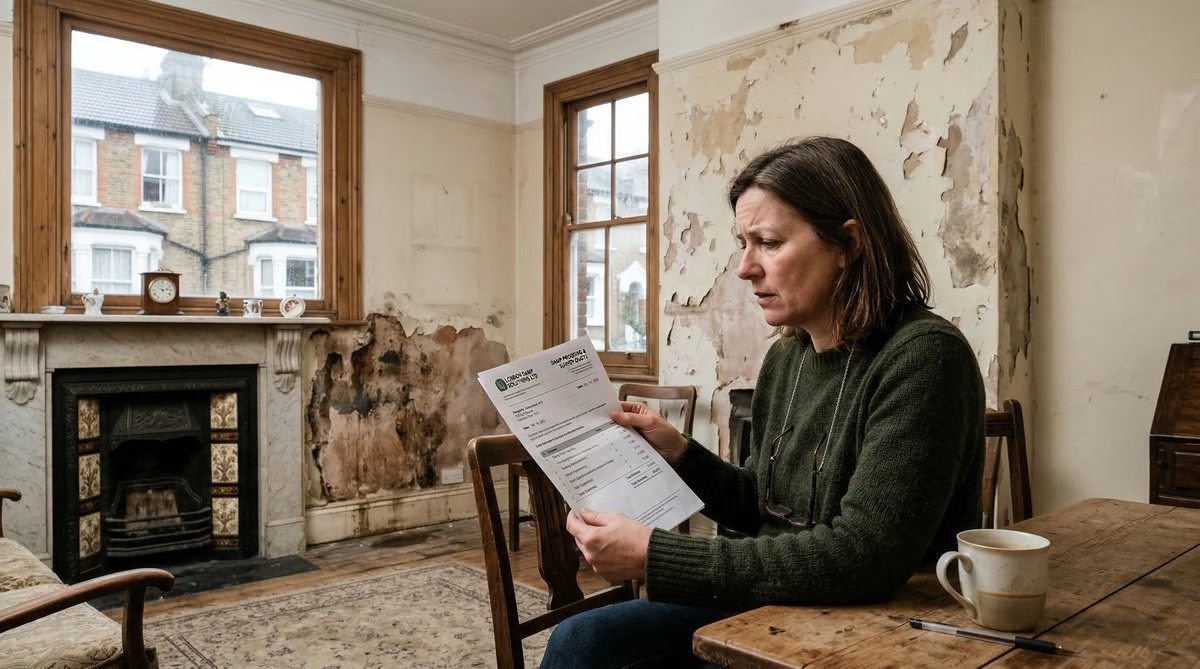
If you have received a damp proofing quote London surveyors or damp specialists have produced — and the figure sits somewhere between £10,000 and £18,000 — you are probably asking yourself whether that number reflects genuine necessity or whether someone has drawn a very wide scope around what is actually a modest problem. We see this regularly at Fixiz, and the honest answer is: sometimes the quote is legitimate, sometimes it is significantly over-specified, and telling the difference requires knowing what to look for. This article walks you through the key questions, red flags, and practical steps to evaluate any damp proofing quote before you commit a penny.
Why London Victorian and Edwardian Properties Attract High Damp Quotes
London’s housing stock is dominated by Victorian and Edwardian terraces — precisely the type of building that specialist damp companies target most aggressively. There are legitimate reasons why older properties can require more involved treatment: solid brick walls without cavity construction, original lime mortar degraded over a century, and external ground levels that have risen above the original damp-proof course. In some cases a meaningful scope of work is genuinely warranted.
However, the same characteristics that make these properties susceptible to damp also make them the ideal ground for over-specified treatments. A damp specialist who arrives at a 1900s terrace with peeling paint around a front door and a damp meter in hand can justify tanking the entire front wall, hacking off and replacing plaster with a waterproof render, cutting in a chemical DPC, and adding a waterproof screed to the floor — all packaged as a comprehensive waterproofing system. The resulting quote of £12,000 to £18,000 sounds authoritative. Whether the property needs any of it is an entirely different question.
We recently helped a homeowner in Hackney whose surveyor flagged damp around the front entrance and a ground-floor storage area. A specialist quoted £16,500 for full internal tanking, a chemical DPC, and a waterproof screed. When we attended independently, the root cause was failed external pointing and a bridged airbrick blocked during landscaping work. Addressing both defects cost under £900. The remaining damp readings were consistent with hygroscopic salts in old plaster — not active ingress requiring tanking.
This pattern repeats across South, East, and North London: a buyer’s surveyor flags moisture readings, a damp company quotes, and a specification suited to a below-ground basement is applied to a ground-floor wall with minor ingress and degraded plaster. Understanding why this happens — and what the legitimate alternative looks like — is essential before you proceed.
What a Legitimate Scope Looks Like Versus an Over-Specified One
A properly scoped damp proofing project begins with a thorough diagnosis, not a treatment plan. Any specialist who arrives, takes a few readings, and hands you a quote within the same visit has skipped the most important step. Diagnosis requires understanding your wall’s construction, the age and condition of existing plaster, external drainage conditions, and internal humidity relative to ventilation. A written survey report should precede any quote.
A legitimate scope of works for a single affected ground-floor wall in a Victorian terrace is specific and proportionate. It will typically include:
- Identification and repair of the external defect: Failed pointing, cracked render, blocked DPC, or raised external ground level — whichever is actually causing moisture to enter the structure.
- Localised plaster removal only where necessary: Targeted hack-off in areas where plaster has become saturated or contaminated with hygroscopic salts, not wholesale stripping of entire rooms.
- Breathable replastering: A lime-based or salt-resistant breathable system rather than hard cement render or a fully tanked system — allowing residual moisture to dissipate rather than trapping it behind an impermeable skin.
- Ventilation improvements where appropriate: Clearing or installing airbricks, adding positive input ventilation, or improving through-flow where condensation contributes to the problem.
- A chemical DPC only if genuinely indicated: Where there is clear evidence of active rising damp with a failed DPC and no bridging cause, a targeted injection may be appropriate — but this is the conclusion of a diagnosis, not a default first step.
An over-specified scope looks very different. It tanks entire walls and floors in above-ground spaces where the issue is minor penetrating damp or hygroscopic plaster. It recommends chemical DPC injections with no evidence of true rising damp. It specifies hard cement waterproof renders on pre-1919 solid brick walls — a combination that can actively harm the building by trapping moisture. It covers large areas rather than targeting the actual defect. And it is typically delivered with no written diagnostic report, relying instead on damp meter readings presented as proof of a serious structural problem.
Tip: Ask any specialist to provide their survey report and their quote as two separate documents. If they cannot separate diagnosis from treatment proposal, that is a meaningful red flag — the inspection was a sales visit rather than an independent assessment.
Tanking Versus a Breathable System — The Question That Can Save You Thousands
One of the most important questions to ask any damp company is whether tanking is actually required, or whether replastering with a breathable system would achieve the same outcome. The answer matters enormously — not just for cost, but for the long-term health of the building.
Tanking — applying a fully waterproof membrane or cementitious slurry — is appropriate for below-ground spaces subject to significant hydrostatic pressure: basements and cellars with active water ingress. It is not the standard solution for above-ground walls in Victorian terraces with minor penetrating damp or hygroscopic salt contamination.
For above-ground solid walls in pre-1919 properties, breathable systems are generally more appropriate. A lime-based or salt-resistant breathable plaster system allows the wall to manage residual moisture through vapour diffusion rather than sealing it in. In our experience across South and East London, Victorian terraces with apparent damp at low-level walls are regularly quoted for full tanking when the correct answer is a breathable replaster combined with an external repair. The cost difference on the same job can be £8,000 to £14,000.
Tip: Ask the quoting company specifically: “Is this a below-ground waterproofing scenario requiring tanking, or an above-ground wall where a breathable replaster would be appropriate?” A specialist who cannot give you a clear, reasoned answer has not carried out an adequate diagnosis.
Getting an Independent Survey Before Committing to Any Works
The single most effective step before accepting any damp proofing quote is to commission an independent survey from a specialist who has no financial interest in selling you treatment — not the company that produced the quote. Ideally this is a RICS-regulated building surveyor or a PCA-accredited specialist who will attend, diagnose, and report in writing, with their survey and any subsequent quote delivered as clearly separate documents. An independent survey typically costs between £300 and £600 for a standard London terrace — a straightforward investment against a quote of £10,000 to £18,000.
We recently advised a buyer in Lewisham whose conveyancing surveyor flagged high moisture readings in a front ground-floor room, and a specialist contractor had quoted £18,000 for tanking, a chemical DPC, and complete replastering. The seller disputed the problem, noting only peeling paint around the front door and a small storage area — nothing that had caused internal problems during their ownership. An independent PCA-accredited survey confirmed the moisture readings were almost entirely attributable to hygroscopic old gypsum plaster retaining atmospheric moisture — a cosmetic issue requiring breathable replastering, not tanking. The properly assessed cost was £1,800. The original quote was over-specified by a factor of ten.
When you receive an independent report, compare its findings directly with the contractor’s proposed scope. If the surveyor identifies hygroscopic salts and the contractor is proposing tanking and a chemical DPC, you have a clear mismatch to challenge.
Damp Quotes in Property Negotiations — What Buyers and Sellers Should Know
Damp proofing quotes have become a significant tool in property price negotiations. A buyer who receives a surveyor’s report noting high moisture readings typically invites a damp contractor to quote. That contractor has a commercial interest in maximising the scope. The resulting document then becomes a negotiating tool — used to justify a price reduction far in excess of what properly scoped remediation would actually cost.
For sellers: if a buyer presents a quote of £12,000 to £18,000 to support a price reduction, you are within your rights to challenge it. Commission your own independent survey. If it shows the issue is cosmetic, or that appropriate works cost £2,000 rather than £18,000, that report is a legitimate counter. Sellers who accept a buyer’s contractor quote without scrutiny regularly concede far more than the actual issue warrants.
For buyers: an independent survey confirming a genuine problem and providing a realistic scope is far more credible in negotiation than a contractor quote with a commercial interest in a large job. Lenders and their valuers are also more comfortable with independently surveyed evidence.
Tip: In a property transaction, neither party should treat a damp contractor’s quote as an objective assessment of the problem or its cost. Both parties benefit from independent, diagnosis-led evidence.
Red Flags in Damp Proofing Quotes
After reviewing a large number of damp proofing quotes across London properties, we have identified a consistent set of warning signs that suggest a quote is over-specified, under-diagnosed, or both:
- No written survey report preceding the quote: If the specialist did not provide a written diagnostic report before quoting, the visit was a sales inspection rather than a technical assessment. Any quote produced on the same day as a “free inspection” should be treated with caution.
- Jumping straight to chemical DPC: A chemical DPC injection is a specific treatment for a specific problem. If it is being proposed without moisture profiling, salt analysis, or evidence that the existing DPC has failed with no bridging cause, it is likely unnecessary.
- Tanking above-ground walls in a Victorian terrace: Full internal tanking is appropriate for below-ground spaces under hydrostatic pressure. Applying it to above-ground ground-floor walls as the default response to moisture readings is almost always over-specification.
- No mention of external defects: The overwhelming majority of damp problems in Victorian and Edwardian properties originate from external defects — failed pointing, cracked render, blocked or bridged DPC, raised ground levels, defective rainwater goods. A quote proposing extensive internal works with no mention of the external cause is treating the symptom rather than the disease.
- Vague scope descriptions: Phrases like “hack off and replaster as necessary” or “treat affected areas” give you no ability to compare quotes or hold a contractor accountable. A properly scoped quote names each wall, gives dimensions, specifies the system by layer and product, and describes reinstatement.
- Hard cement render on solid brick walls: Victorian solid brick walls were built to breathe through lime mortar and lime plaster. Sealing them with hard cement or waterproof sand-and-cement systems can trap moisture within the structure, causing spalling and accelerated deterioration — the opposite of the intended outcome.
How Fixiz Approaches Damp Concerns
At Fixiz, we do not sell damp proofing treatments. We are a London-based building and renovation contractor, and when clients come to us with damp concerns or with a quote they want reviewed, our starting point is always diagnosis rather than prescription. We work with independent damp surveyors to establish what is happening before any works are specified or priced.
In our experience across North and East London, the majority of cases where a client has been quoted £10,000 or more for damp proofing to a Victorian terrace turn out to require a fraction of that scope when properly investigated. The genuine issues — failed external pointing, bridged DPCs, blocked airbricks, or hygroscopic salt contamination in old plaster — are real, but are typically addressable with targeted works rather than comprehensive tanking systems.
We recently worked with a client in Islington quoted £14,000 by a damp specialist following a buyer’s survey. After an independent PCA-accredited survey and a scope review, we established that the correct works were repointing a section of external brickwork, installing a replacement airbrick, and replastering a single wall with a breathable salt-resistant system. The project was completed for £1,650, and the buyer received works that actually addressed the diagnosed cause.
Frequently Asked Questions
Is a £10,000 to £18,000 damp proofing quote ever justified for a Victorian terrace in London?
Yes, in some cases — where there is widespread timber damage, significant structural water ingress through multiple elevations, or a failed below-ground structure requiring full tanking. But for the majority of Victorian terraces where the issue is localised moisture ingress, degraded plaster, or condensation, a quote at this level is likely over-specified. Always commission an independent diagnostic survey before accepting any quote above £3,000 to £4,000.
What is the difference between tanking and a breathable replaster?
Tanking applies a waterproof barrier to resist hydrostatic pressure and suits below-ground structures with active water ingress. A breathable replaster — using a lime-based or salt-resistant system — allows the wall to manage residual moisture through vapour diffusion. For above-ground walls in Victorian terraces, breathable systems are generally more appropriate and significantly less expensive.
How do I find an independent damp surveyor in London?
Look for a RICS-registered or PCA-accredited surveyor who is not also selling damp treatment works. Confirm they will provide a written diagnostic report separate from any quote. Expect to pay £300 to £600 for a standard London terrace.
How should I handle a high damp proofing quote in a property purchase negotiation?
Do not present a contractor’s quote as your negotiation basis without independent verification. A contractor who inspects speculatively has a commercial interest in maximising scope. Commission an independent survey, establish the properly diagnosed cost of appropriate works, and use that figure — supported by a written report — as the basis for your negotiation. This is more credible to the seller and more likely to survive scrutiny from your lender’s valuer.
What questions should I ask a damp specialist before accepting their quote?
Ask for the written diagnostic survey as a separate document. Ask what moisture mechanism they have identified and what evidence supports it. Ask whether tanking is genuinely required or whether a breathable replaster would suffice. Ask what external defects have been identified and how the quote addresses them. If they cannot answer clearly, the quote lacks an adequate diagnostic basis.
Why do damp meter readings in old plaster not necessarily indicate active ingress?
Old and previously damp-affected plaster contains hygroscopic salts that absorb atmospheric moisture, causing a damp meter to read elevated levels with no active water ingress. This is a common source of misdiagnosis. The correct solution is to remove the salt-contaminated plaster and replaster with a breathable salt-resistant system — at a fraction of the cost of a full tanking specification.
Ready to move from confusion to construction? Get in touch with Fixiz today for a no-pressure chat about your project and the fastest route to full compliance.