Physical address:
128 City Road, EC1V 2NX, London,UK

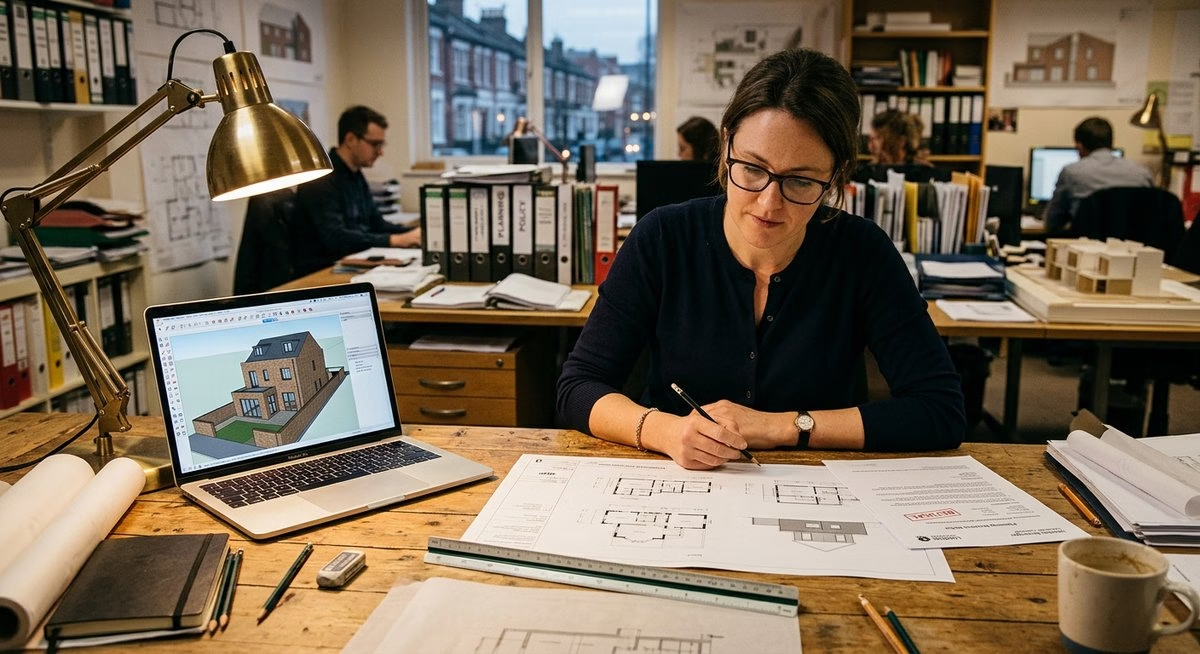
A planning refusal does not have to be the end of your project — but only if you respond to it correctly. Every week we speak with homeowners who have received a decision notice, felt deflated, and then made the situation worse by rushing into a resubmission that repeats the same mistakes, or by assuming that a stack of neighbour support letters will somehow persuade officers to change their minds. If you are looking to resubmit a planning application after refusal UK, this guide gives you the structured approach that actually moves projects forward.
Understanding Your Decision Notice — The Most Important Document You Have
The decision notice is not a rejection letter in any ordinary sense. It is a legal document that sets out, in numbered paragraphs, the precise policy reasons why your application failed. Each reason corresponds to a specific clause in your council’s local plan or to national planning policy. This distinction matters enormously: the refusal is not a general expression of displeasure — it is a mapped list of the exact problems you need to solve.
When we sit down with a client who has just received a refusal, the first thing we do is read every numbered reason in full and map it to the relevant policy. Reason 1 might say something like: “The proposed rear extension, by reason of its depth and siting, would cause a material loss of daylight to the habitable rooms of the adjoining property at No. 14, contrary to Policy DM10 of the Local Plan.” That single sentence tells you three things — what the harm is, which property is affected, and which policy was applied. Your resubmission must specifically address all three.
A common mistake is treating the decision notice as a vague signal to “make the extension a bit smaller.” That approach rarely works. Officers are not marking you down on a sliding scale — they are applying a binary policy test. You either comply or you do not. If there are four numbered reasons, your revised application needs to resolve all four. Fixing three out of four simply produces a shorter decision notice at the next refusal.
It is also worth reading the officer’s delegated report, published on the council’s planning portal alongside the decision notice. The report contains the full reasoning behind each refusal point and sometimes flags concerns that did not make it into the formal reasons — valuable context when redesigning the scheme. Some officers note in their reports that a minor amendment would have resolved their concern, which is effectively a roadmap for your resubmission.
The Myth That Neighbour Support Overrides Planning Policy
This is possibly the most persistent misconception we encounter, and it originates from a reasonable but incorrect intuition: if the neighbours are happy, who is harmed? The answer, in planning law, is that the question is not primarily about who is happy. It is about whether the proposal complies with the development plan.
Planning officers are required to assess applications against the local plan and the National Planning Policy Framework. Public representations — whether in favour or against — are a material consideration, but they are not the decision-making framework. A letter of support from the occupier of No. 14 does not change the policy on daylight. A petition signed by every household on the street does not alter the requirement on bulk and massing in a Conservation Area. The council is administering a statutory process, not conducting a referendum.
What support letters can do is carry some weight where a planning judgement is genuinely finely balanced and where the harm is to the amenity of a specific neighbour who actively supports the revised scheme. But officers must still satisfy themselves that granting permission would not set a problematic precedent for the wider area. We have seen applications refused despite unanimous neighbour support because the design failed a policy test unrelated to any individual neighbour’s preferences.
The Reddit discussions on this subject are instructive. Time and again, applicants cannot understand why they were refused when every surrounding neighbour wrote in to support them. The council is not conducting a popularity vote. It is applying a legal framework, and understanding that distinction will save you time, money, and frustration when planning your resubmission.
Tip: If a neighbour who previously objected is now supportive, that is worth documenting — but only because it may remove an active objection from the case, not because it changes the policy position the officer must apply.
What to Change in a Resubmission — and What It Will Cost
The redesign must be driven by the refusal reasons, not by guesswork. There are consistent themes across householder refusals in England that point to the changes most likely to unlock an approval.
- Reduce height or depth: Oversized rear extensions are the most common refusal reason. Bringing depth within the 3m–4m range for semi-detached properties, or reducing the ridge height on a hip-to-gable loft, often resolves the bulk and massing objection in one move.
- Change external materials: Officers frequently cite incongruous materials in Conservation Areas or Article 4 zones. Switching from render to brick, or matching the existing roof tile specification, can transform a refusal into an approval with minimal change to the scheme.
- Improve daylight and sunlight assessment: If the refusal cites loss of light to a neighbour’s habitable room, commission a formal BRE 209 assessment. A professional report demonstrating compliance with the 25-degree test gives the officer a technical basis to approve.
- Add privacy screening: Raised terraces, flat-roof extensions with roof lights, and side-facing windows are frequently refused on overlooking grounds. An obscure-glazed screen or relocated window can resolve this entirely.
- Redesign the roof form: A flat-roof extension can sometimes be approved with a pitched or mono-pitch roof that sits more sympathetically in the streetscape. Roof form is one of the quickest design levers to pull.
On costs: the “free go” resubmission concession was abolished in England on 6 December 2023. The standard householder application fee as of April 2025 is approximately £528 — a full fee is payable on every resubmission. Factor this into your budget from the outset. What remains free is the option to withdraw before a decision is issued if you become aware refusal is likely; withdrawal avoids a formal refusal on your planning history and allows resubmission of a revised scheme without that refused application sitting on the public record.
Tip: Monitor the officer’s decision timeline closely. If a negative recommendation is issued, speak to your architect immediately about withdrawing before the decision date — this is a legitimate and commonly used tactic that has saved several of our clients the cost and delay of a formal refusal.
Pre-Application Advice and Building Your Evidence Pack
Pre-application advice — known as pre-app — is a paid service offered by virtually every local planning authority in England. For householder extensions, fees typically range from around £180 to £600 depending on the council. After a refusal, pre-app is almost always worth the investment: it gives you a direct channel to a planning officer to present your revised scheme before committing to a full application fee. An officer who indicates informally that the revised design resolves their concerns is not making a binding commitment, but it removes much of the guesswork from the resubmission.
We particularly recommend pre-app advice where the refusal reasons are complex, where the site is in a Conservation Area, AONB, or Green Belt, where multiple reasons were cited, or where the original application was refused at committee rather than under delegated powers. Committee refusals often signal heightened political sensitivity — pre-app dialogue helps you understand what it will take to secure officer support.
Strong resubmissions also require a targeted evidence pack. Each document should be framed as a direct response to a numbered refusal reason:
- Daylight and sunlight assessment: A BRE 209-compliant report from an accredited consultant gives the officer technical authority to approve where loss of light was cited. Costs typically run £500–£1,500 for a householder application.
- Precedent photographs: Search the council’s planning portal for approved extensions of similar depth and massing in the same street. Document these with planning reference numbers. Officers cannot easily refuse on consistency grounds if comparable schemes have been approved nearby.
- Arboricultural reports: Where trees are mentioned in the refusal, an arboricultural impact assessment compliant with BS 5837:2012 is essential. Without it, officers default to a precautionary refusal.
- Revised design and access statement: Rewrite this document to map each section directly to a numbered refusal reason. A well-structured statement that speaks the officer’s language significantly reduces the chance of a further refusal.
Resubmit vs Appeal — Understanding the Trade-Offs
When a planning application is refused, applicants have two formal routes: resubmit a revised application, or appeal to the Planning Inspectorate under Section 78 of the Town and Country Planning Act 1990. The appeal route sounds attractive — it bypasses the local council and goes to an independent inspector — but the statistics should give pause.
According to Planning Inspectorate data for 2024/25, the overall success rate for householder planning appeals across England is approximately 34%, meaning roughly two in three householder appeals are dismissed. The process takes six to twelve months from submission to decision for written representation appeals — the procedure used in the vast majority of householder cases. During that period your project is on hold, costs are accumulating, and there is no certainty of outcome.
An appeal is, in effect, an argument that the council misapplied policy. If the design genuinely conflicts with the local plan, an appeal is unlikely to succeed regardless of how strongly you feel about the refusal. The inspector’s role is to determine whether the policy assessment was lawfully made — not to substitute their judgement for the officer’s on matters of design preference. Appeal is most appropriate when the council has clearly departed from its own precedents, when a condition goes beyond what policy permits, or when the refusal rests on a single, discrete point of policy interpretation.
For the vast majority of householder refusals — where the issue is scale, design, or amenity — a well-targeted resubmission is faster, cheaper, and carries a materially higher chance of success. The appeal route also carries a risk that resubmission does not: a dismissed appeal becomes part of the permanent planning history of the site and can weigh against future applications on the same property. We have rarely advised a client to appeal a straightforward householder refusal without first attempting a redesigned resubmission.
How Professional Support Changes Outcomes
We are candid with clients about this: the involvement of a qualified architect or planning consultant on a resubmission materially improves the chances of approval. This is borne out by the pattern of outcomes we observe across the projects we manage in London and across England — and by the frequency with which clients come to us after a self-managed resubmission has also been refused.
An experienced architect will redesign the scheme specifically to address each numbered refusal reason, selecting materials, dimensions, and roof forms that have demonstrably worked on comparable sites in the same area. A planning consultant will handle pre-app dialogue, interpret officer feedback accurately, and draft a supporting statement that maps directly onto the council’s policy framework. Together, they ensure that the resubmission is a properly considered response to a specific legal objection — not a repeat of the original application with minor tweaks.
Planning consultants also understand the political geography of local planning committees — which officers take a pragmatic reading of policy, which design review panels a council uses, and what those panels look for. That local knowledge is genuinely difficult to replicate without professional experience in the area.
Professional advice on a resubmission typically costs between £1,500 and £5,000 for a householder extension — a fraction of the cost of a failed appeal. We have seen clients spend more on appeal costs than the extension itself would have cost to build, simply because they bypassed professional guidance at the resubmission stage. The upfront investment in the right expertise consistently delivers better value than a second or third attempt without it. If you are unsure whether your project needs an architect, a planning consultant, or both, a brief initial conversation with us will clarify the right approach for your specific situation.
Frequently Asked Questions
Can I resubmit a planning application for free after a refusal in England?
No. The “free go” resubmission concession was abolished in England on 6 December 2023. All resubmissions now require the full application fee — approximately £528 for a householder extension as of April 2025. Wales may retain different provisions, so check with your local authority if you are outside England.
How long do I have to appeal a planning refusal?
You have 12 weeks from the date of the decision notice to lodge a householder appeal with the Planning Inspectorate. For other application types, the window is six months. Missing this deadline means the appeal right is lost, though you remain free to resubmit a revised application at any time without a time limit.
Will neighbour support letters help my resubmission?
They carry some weight as a material consideration, particularly if a neighbour who previously objected now supports the revised scheme. But they do not override policy. If the refusal cited a design or amenity policy, letters of support — however numerous — cannot substitute for addressing the specific policy failure in your revised drawings and supporting documents.
How many times can I resubmit a planning application?
There is no legal limit on the number of resubmissions. However, each submission now costs the full application fee, and a series of refused applications on the same site can make future submissions more difficult. It is far more effective to invest the time in one well-considered resubmission than to iterate through multiple quick attempts.
Is pre-application advice binding on the council?
No. Pre-application advice is officer opinion and does not bind the local planning authority. A committee could still refuse an application that received positive pre-app feedback. However, a formal pre-app response indicating support is a strong indicator of likely outcome and will carry weight in any subsequent appeal if the council then refuses without material new evidence.
What is the difference between an appeal and a resubmission?
A resubmission is a revised application submitted to the local planning authority for fresh consideration. An appeal bypasses the council and goes to an independent Planning Inspector, takes six to twelve months, and succeeds in only around 34% of householder cases. Resubmissions are faster and — with proper professional support — generally more likely to succeed where the original refusal was a design or amenity issue rather than a fundamental policy conflict.
Ready to move from confusion to construction? Get in touch with Fixiz today for a no-pressure chat about your project and the fastest route to full compliance.