Physical address:
128 City Road, EC1V 2NX, London,UK

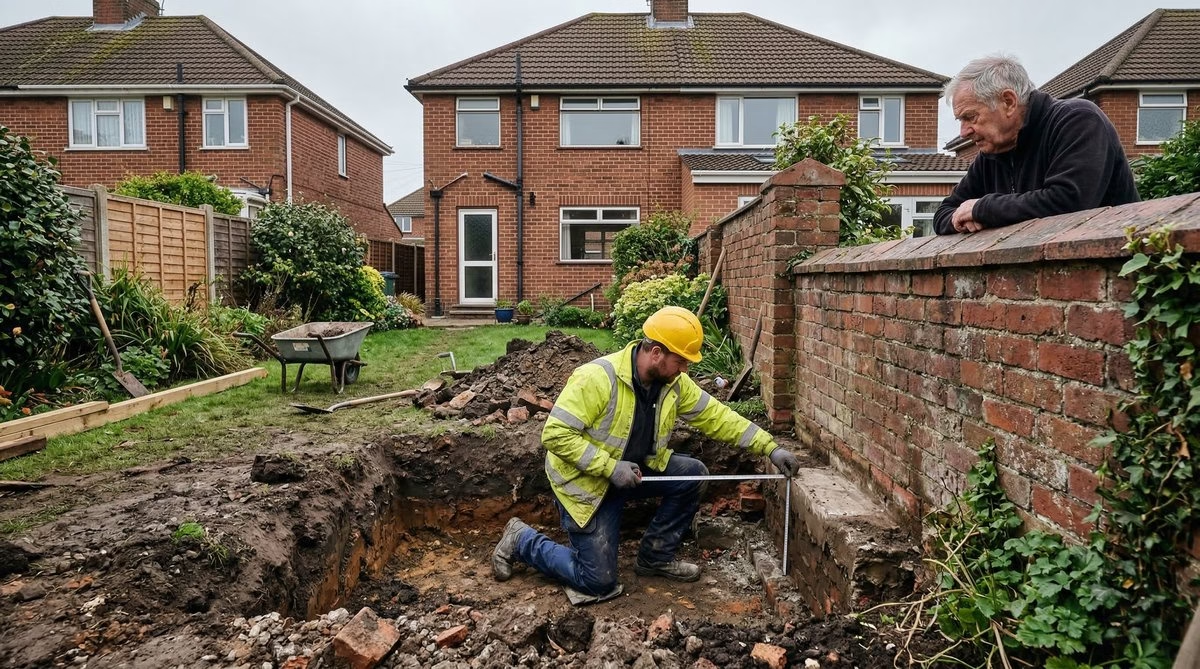
Most homeowners planning a rear extension think the Party Wall Act only applies when you knock through a shared wall. That assumption can bring a project to a full stop. Party wall notice excavation requirements under Section 6 of the Party Wall etc. Act 1996 mean that digging foundations in your own back garden can be a notifiable event. If you are planning a 3-metre rear extension with 1-metre-deep foundations on a 1930s property, there is a real chance you are legally required to serve notice before a single spade breaks ground — regardless of what your builder tells you.
What Is Section 6 — and Why Does It Cover Your Foundations?
Most people associate party wall legislation with shared walls between terraced or semi-detached houses. The Party Wall etc. Act 1996 goes further. Section 6 deals specifically with excavation near a neighbouring structure, and it applies even where there is no shared wall. A detached house next door, a neighbour’s garage, an outbuilding — all of these can trigger notice obligations once you dig close enough and deep enough.
The logic is straightforward: soil provides lateral support to foundations. When you excavate nearby, you remove some of that support, potentially causing the neighbour’s structure to settle or crack. The Act pre-empts disputes by requiring advance notice, giving the adjoining owner a chance to assess risk and, if necessary, have a surveyor oversee the work. It also protects you — follow the process correctly and you gain statutory protection from damage claims.
We recently helped a homeowner in Tooting who was planning a modest 3-metre rear extension to a 1930s detached house. Her structural engineer had said no party wall notice was needed for excavation because her foundations were only going 1 metre deep. Her builder agreed. When we considered the likely foundation depth of the 1930s detached next door, it became clear that Section 6 almost certainly applied — and that proceeding without notice would have been a costly mistake.
Section 6 does not care about the overall scale of your project. It cares about geometry — how close you are digging to a neighbouring structure, and how deep you are going relative to the base of that neighbour’s foundations.
The 3-Metre Rule: Close and Deeper Equals Notifiable
The first trigger under Section 6 is the 3-metre rule. The test has two parts, and both must be satisfied before notice is required:
- Distance: Your proposed excavation must be within 3 metres horizontally of any part of the adjoining owner’s building or structure.
- Depth: Any part of your excavation must extend below the level of the bottom of the adjoining owner’s foundations.
If either element is absent, the 3-metre rule does not apply. If your new foundations are shallower than your neighbour’s, you fall outside this trigger — assuming you are also outside the 6-metre trigger. But if both conditions are met, you must serve a Section 6 notice at least one month before excavation begins.
The difficulty lies in the depth check. To know whether your 1-metre foundations go below your neighbour’s foundation level, you need to know how deep their foundations actually are. For a 1930s detached house, that is rarely straightforward. Original construction records almost never survive, and building control drawings for pre-war properties are rarely available from the council. 1930s properties were typically built on shallow strip foundations — often 450 mm to 600 mm deep, sometimes less. In the absence of records, the professional guidance is to err on the side of caution and assume a shallow foundation depth. If your excavation reaches 1 metre and the neighbour’s foundations sit at 600 mm, you are clearly going below their foundation level, and Section 6 applies.
Tip: Do not rely on your builder’s estimate of your neighbour’s foundation depth. Builders work from experience and educated guesses, not measurements. Only a trial pit or original drawings can give you certainty.
The 6-Metre Rule: The 45-Degree Geometry Test
The second trigger under Section 6 catches excavations that are not as close as 3 metres but still fall within a zone of influence. Section 6(1)(b) applies where you propose to excavate within 6 metres of a neighbouring structure and any part of your excavation meets a plane drawn downwards at 45 degrees from the bottom of their foundations, in the direction of your excavation.
This is a geometry test. To apply it, you need to know the neighbour’s foundation depth, the horizontal distance between your excavation and their wall face, and your own excavation depth. Picture a diagonal line at 45 degrees from the base of their foundations, sloping downward and outward toward your dig. If any part of your excavation sits within that diagonal zone, the 6-metre rule is triggered.
In our experience across South London, the 6-metre rule catches out homeowners on larger plots more often than people expect. Someone building a new outbuilding 4 or 5 metres from the boundary may assume they are clear of any party wall obligations, only to find that the geometry tells a different story once foundation depths are factored in.
A practical note: the 6-metre distance is measured from the neighbour’s structure, not from the boundary. If their building is set back from the shared boundary, the notifiable zone extends further into your plot than you might expect.
What “Below the Foundations” Means — and When to Dig a Trial Pit
Both the 3-metre and 6-metre rules hinge on a comparison between your excavation depth and the base of your neighbour’s foundations. There are three ways to establish that depth:
- Original drawings: Rare for pre-war properties, but occasionally held by local authority archives or a solicitor’s file from the original purchase.
- Trial pits: A small excavation, typically hand-dug or by mini-digger, adjacent to the neighbour’s wall at the boundary. This is the most reliable method where drawings are unavailable.
- Informed assumption: In the absence of evidence, surveyors and the courts expect the building owner to err on the side of caution. For a 1930s structure, an assumption of 600 mm or less is widely used by party wall surveyors.
Trial pits are a modest investment — typically a few hundred pounds including a structural engineer’s inspection — but they can save thousands. If the pit reveals that your neighbour’s foundations are at 900 mm and your proposed excavation is at 1 metre, you know precisely where you stand. If they are at 500 mm, you know you need to serve notice. The cost of certainty is far lower than the cost of getting it wrong.
Tip: If your neighbour agrees and access can be arranged, a trial pit on their side of the boundary gives the most direct measurement. Agree the access in writing before any digging takes place, and have the results logged by a structural engineer.
What Happens If You Skip the Notice
The Party Wall etc. Act 1996 contains no criminal penalties for failing to serve notice. This leads some homeowners and builders to treat Section 6 as optional. That is a serious misjudgement, and the consequences can be far more disruptive than simply serving the notice in the first place.
If you excavate without notice and your neighbour becomes aware, their immediate remedy is an application to the court for an injunction. Injunctions can be granted quickly — in some circumstances on the same day. Work stops. Your contractor is stood down. The project collapses. You then face legal costs and a damages claim for any loss or inconvenience suffered by the adjoining owner, including their legal fees and surveyor costs incurred as a result of your non-compliance.
In the case of Nutt v Podger, a building owner who proceeded without notice was ordered to pay damages covering physical damage to the neighbouring property, the loss of the adjoining owner’s statutory protections, and compensation for noise and disruption. The court also raised the prospect of a mandatory injunction requiring the completed works to be demolished and the wall restored. That outcome — demolishing a finished extension — is the nuclear option, but courts have the power to order it.
In our experience across South East London, the homeowners who most regret skipping the notice are those whose neighbours discovered the works mid-project and used the absence of notice as leverage to halt construction entirely. A retrospective award is sometimes possible, but it requires the neighbour’s cooperation and will not undo injunction proceedings already under way.
How the Surveyor Process Works — Costs and Timescales
Once a Section 6 notice is served, the neighbour has 14 days to respond. Written consent within those 14 days means works can proceed when the month’s notice period expires. Silence for 14 days, or an explicit dissent, triggers the Act’s dispute resolution process and surveyor appointment becomes mandatory.
There are two routes at this stage:
- Agreed surveyor: Both parties appoint a single impartial surveyor. This is the simpler and cheaper route. The agreed surveyor prepares a Party Wall Award setting out the method of working, any protective measures, and a schedule of condition of the adjoining property before works begin.
- Two surveyors plus a third: Each party appoints their own surveyor. They work together to produce the Award. If they cannot agree, a previously named third surveyor makes the final determination. The building owner typically pays both surveyors’ reasonable costs, plus the third surveyor’s fees if that stage is reached.
On timescales: the statutory minimum notice period is one month. If the neighbour consents promptly, that is the only delay. If they dissent, add four to eight weeks for surveyor appointment and Award preparation on a straightforward Section 6 matter. Build at least six to ten weeks of party wall lead time into your programme from the outset.
On costs: a single agreed surveyor for a rear extension Section 6 matter typically runs to £1,200 to £1,500. Two surveyors can reach £2,400 to £3,000 or more, since the building owner generally pays both sets of reasonable fees. A trial pit to confirm foundation depths costs roughly £200 to £500 — modest relative to the risk of a wrong assumption.
We recently helped a client in Penge facing exactly the scenario described here: a 1930s detached house, a 3-metre rear extension, 1-metre foundations, and conflicting advice from an engineer and a builder. We arranged a trial pit at the boundary, confirmed the neighbour’s foundation depth was under 600 mm, and served the Section 6 notice that same week. The neighbour consented, an agreed surveyor prepared the Award, and the extension broke ground on schedule — with full legal protection in place for both sides.
Frequently Asked Questions
Does a rear extension always need a party wall notice for excavation?
Not automatically. It depends on distance and depth. If your excavation is within 3 metres of your neighbour’s structure and goes below their foundation level, Section 6 applies. If you are within 6 metres and your excavation crosses the 45-degree plane from the base of their foundations, Section 6 also applies. Many rear extensions on 1930s properties do trigger one of these tests, but the neighbour’s foundation depth must be confirmed before you can be certain either way.
My structural engineer says no notice is needed. Can I rely on that?
Only if they have confirmed the neighbour’s foundation depth through a trial pit or original drawings — not through assumption. If the advice is based on an assumed standard depth without physical investigation, treat it with caution. Structural engineers are not always party wall specialists, and the legal test under Section 6 is precise. An incorrect assumption that no notice is required creates real legal exposure.
Is the 3 metres measured from the boundary or from the neighbour’s wall?
From the nearest part of the neighbour’s building or structure — not from the boundary. If the neighbour’s house is set back 2 metres from the shared boundary, the 3-metre notifiable zone extends 3 metres from their wall face, which may be 5 metres from your fence line. Always measure to the structure itself.
What is a trial pit and when should I get one?
A trial pit is a small hand- or machine-dug excavation adjacent to the neighbour’s wall that exposes the base of their foundations. For a 1930s property where no records exist, it is the only way to replace assumption with evidence. The cost is modest — a few hundred pounds — and it is the first step we recommend where foundation depths are uncertain and a Section 6 trigger is possible.
Can I save money by using one agreed surveyor rather than two?
Yes, and we recommend it where the neighbour is cooperative but wants professional oversight. A single agreed surveyor acting impartially for both parties typically costs half to a third of the two-surveyor route, and the process tends to be faster and less adversarial. The agreed surveyor’s Award carries the same legal weight as one produced by two separately appointed surveyors.
Ready to move from confusion to construction? Get in touch with Fixiz today for a no-pressure chat about your project and the fastest route to full compliance.