Physical address:
128 City Road, EC1V 2NX, London,UK

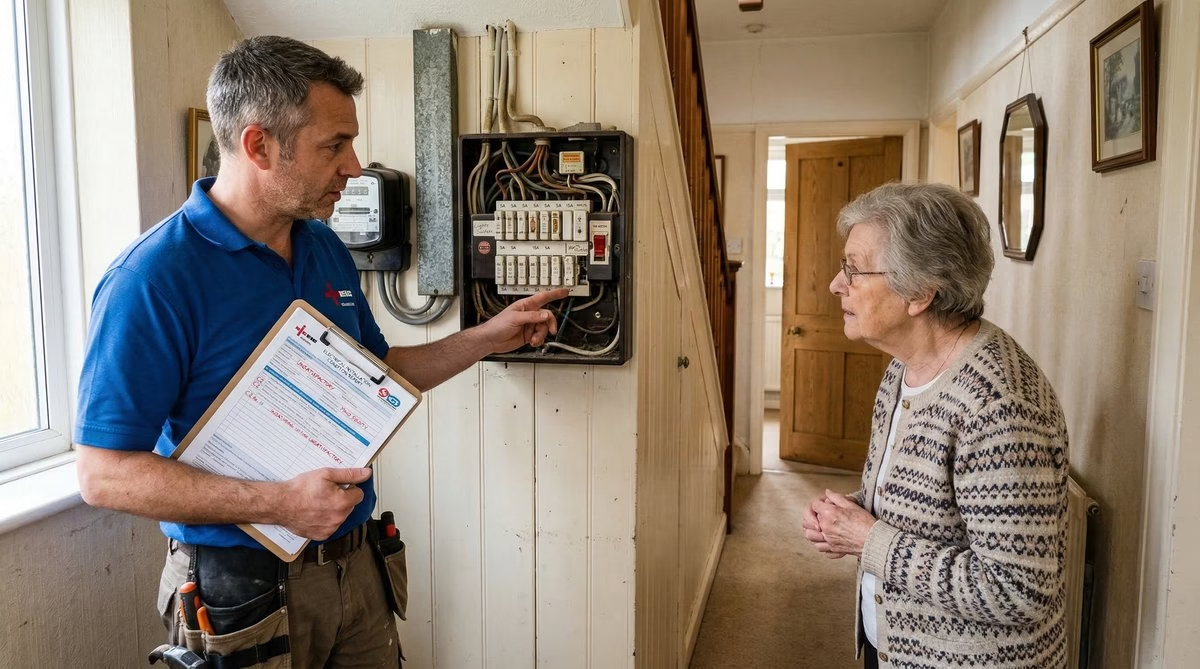
One of the most common questions we hear after a client receives their report is: “Do I need a full rewire, or just a new board?” The answer lies squarely in the detail of your EICR rewire or consumer unit upgrade decision — a choice that can mean the difference between a few hundred pounds and several thousand. An Electrical Installation Condition Report is not a simple pass-or-fail certificate; it is a diagnostic document, and reading it correctly tells you precisely which path to take.
What an EICR Actually Is — and Why the Codes Matter
An Electrical Installation Condition Report is a formal inspection of all fixed electrical wiring, accessories, earthing, and bonding in a property. A qualified electrician registered with NICEIC, NAPIT, or ELECSA tests every circuit and records observations against BS 7671, the IET Wiring Regulations. The report assigns one of four codes to each observation, and those codes are the key to your decision.
- C1 — Danger present: The installation poses an immediate risk of injury or fire. The electrician may make it safe on the spot before leaving. No negotiation, no delay — this must be rectified immediately.
- C2 — Potentially dangerous: Not an immediate threat, but a fault that could become one. Examples include no RCD protection on socket circuits, damaged insulation that has not yet exposed live conductors, or absent supplementary bonding in a bathroom. C2 codes make the overall report Unsatisfactory.
- C3 — Improvement recommended: Safe to use as-is, but the installation does not meet current best practice. An old consumer unit made of combustible material with all fuses intact and cables in good condition might attract a C3. Critically, a C3 alone does not make the report Unsatisfactory — it is advisory.
- FI — Further investigation required: Something was found or suspected that could not be fully assessed during the inspection — perhaps an inaccessible section of wiring, a high insulation resistance reading on a circuit that may indicate a buried joint, or inconclusive earthing continuity. An FI must be investigated before a full condition can be confirmed, and it too makes the report Unsatisfactory.
A report is Satisfactory only if it contains no C1, C2, or FI codes — C3 observations may appear on a Satisfactory report. The moment a C1, C2, or FI appears, the report is Unsatisfactory and remedial work is required. Understanding this distinction is step one in any rewire-versus-board-upgrade conversation.
In our experience, homeowners often arrive with an Unsatisfactory report and assume the worst. We routinely find that the unsatisfactory codes relate entirely to the consumer unit — no RCD protection, rewireable fuses, no surge protection device — while the underlying cables are in perfectly serviceable condition. That is a very different picture from an installation riddled with degraded rubber wiring and absent earth conductors throughout.
When the EICR Points Toward a Full Rewire
Certain patterns in an EICR report are strong indicators that a full house rewire is the proportionate and correct response. A consumer unit swap will not address these; it would merely put a new front door on a structurally compromised building.
- Multiple C1 and C2 codes spread across circuits: If virtually every circuit on the test schedule carries a C2, the problem is systemic rather than localised. Replacing the board cannot fix insulation that has failed across the ring final, the lighting, and the cooker circuit simultaneously.
- Rubber or fabric-insulated cables: Wiring insulated with vulcanised rubber or woven fabric braiding dates from before the 1960s. Rubber becomes brittle and crumbles with age, sometimes releasing green copper oxide (‘green goo’) at terminals. A new consumer unit cannot rehabilitate cables whose insulation will fragment the next time a floorboard is lifted.
- Absent or inadequate earthing throughout: Virtually all pre-1966 wiring lacks an earth conductor on lighting circuits. If the report records missing CPCs on multiple circuits and the earthing arrangement is itself deficient, a board upgrade simply relocates the problem.
- Inadequate circuit protection throughout: Where circuits are undersized, incorrectly rated, or share protection in ways that new breaker assignments cannot rectify, only a redesign and physical rewire produces a correct outcome.
- Age and known installation type: A property with original wiring from the 1950s or earlier, or one that has never been rewired despite decades of use, is a candidate for full replacement on practical grounds even if individual test readings do not all fail outright. At a certain point, repeated partial interventions cost more than doing the job once correctly.
We have seen reports on pre-war properties where the test schedule was a catalogue of C2 codes across every circuit. In those cases, telling the homeowner they only needed a new consumer unit would have been irresponsible — the wiring needed to go.
When a Consumer Unit Upgrade Alone Is Sufficient
Equally, there is a large category of properties where the cables are sound and a consumer unit upgrade is precisely the right and proportionate response. The classic scenario is a 1980s or 1990s property that still has its original rewireable fuse board — a bank of ceramic fuse holders with replaceable fuse wire — or an early MCB board that predates modern RCD requirements.
- Good cables, poor protection: If insulation resistance readings are healthy, earthing continuity is confirmed on all circuits, and the Ze is within limits, the cables are fit for purpose. The deficiency is at the board level alone — no RCD protection, no RCBO capability, possibly a combustible enclosure.
- No RCD protection as a standalone C2: The absence of RCD protection on socket circuits is one of the most common C2 codes in the country. It appears routinely on properties wired in the 1980s and 1990s. A modern split-load consumer unit, or an all-RCBO board, resolves this entirely without touching a single cable.
- Need for SPD — surge protection device: The 18th Edition of the Wiring Regulations requires surge protective devices in most replacement consumer unit installations. A new board fitted to current standards automatically incorporates an SPD, improving protection against voltage transients without rewiring a single cable.
- Rewireable fuses only: A board fitted entirely with rewireable fuses carries no automatic disconnection capability in the event of overload, short circuit at the correct level, or earth fault — and certainly no RCD protection. Replacing it with a modern consumer unit addresses all of these in a single operation.
- C3 observations only on the board itself: Where the only board-related code is a C3 — perhaps a combustible enclosure that hasn’t yet caused a problem — and cable test results are all healthy, a board upgrade remains the sensible choice, though it may not be urgently required.
Tip: A board upgrade typically takes one to two days and causes far less disruption than a rewire. If your EICR results point clearly to the board as the sole deficiency, there is no justification for the larger project.
The Grey Area — Partial Rewires and How to Scope Them
Many properties sit between these two poles, and this is where clear professional advice is most valuable. The EICR may show that the ring finals serving sockets are in excellent condition — modern PVC twin-and-earth, good insulation readings, confirmed CPCs — while the older lighting circuits still carry the original 1960s rubber-insulated cable. In that situation, neither a full rewire nor a pure board upgrade is the right answer. The correct scope is a partial rewire: replace the deficient circuits, leave the healthy ones, and fit a new consumer unit as part of the package.
Common partial rewire scenarios include:
- Lighting circuits only: Where socket circuits pass all tests but lighting wiring is aged, unsheathed at accessories, or lacks earth conductors, rewiring the lighting alone and upgrading the board is a cost-effective and targeted solution.
- Kitchen and bathroom circuits: High-demand and high-risk zones that were added or modified at various points often have mixed quality wiring. Rewiring these specific circuits while leaving the main ring finals intact is common practice.
- Specific C2 circuits: Where an FI code on two circuits leads to investigation and confirmed cable degradation on those circuits only, replacing those runs and upgrading the board addresses every observed deficiency without a full strip-out.
We always recommend that homeowners request a written scope from their electrician that maps each EICR observation to the specific remedial action proposed. This makes it straightforward to compare quotes and to confirm that all codes are addressed — not just the most visible ones. A partial rewire carried out correctly and certified with an EIC is entirely satisfactory from a mortgage and insurance perspective; it does not need to be a full rewire to be bankable evidence of a safe installation.
EICR Timing — Before or After Exchange?
For anyone in the process of buying a property, the timing of an EICR is a genuinely consequential decision. Our strong advice — and that of most conveyancing solicitors — is to commission the EICR before exchange of contracts if at all possible.
Here is why timing matters:
- Negotiating position: An EICR completed before exchange gives you concrete, costed evidence to renegotiate the purchase price or request that the vendor undertakes remedial work. Once contracts are exchanged, you have no leverage — you own whatever problems the property contains.
- Mortgage implications: Some mortgage lenders, particularly on older properties, will require confirmation of satisfactory electrical condition before releasing funds. An Unsatisfactory EICR at a late stage can delay or jeopardise a mortgage offer. Discovering this before exchange allows time to resolve it.
- Insurance implications: Home insurers may require a current Satisfactory EICR, particularly on properties over a certain age. An Unsatisfactory result, or the absence of any EICR, can result in higher premiums, additional policy exclusions for electrical faults, or — in some cases — refusal to insure until remedial work is completed and confirmed. Insurers may increase premiums significantly where there is no current electrical safety record, and some impose conditions requiring a satisfactory inspection within a fixed period of the policy start date.
- Walk-away option: If the EICR reveals a full rewire is necessary on a property priced as if in good order, you retain the option to withdraw before exchange. After exchange, that option has gone.
Tip: If a seller provides an existing EICR, check the date and who issued it. An EICR carried out by a non-registered electrician, or one that is more than five years old on a rental property (or more than ten on an owner-occupied property), should be treated with caution and may need to be repeated independently.
The Practical Sequence From EICR to Completion
Understanding the correct order of operations saves time and money. We follow a consistent process with every client facing a rewire-or-board decision:
- Commission a thorough EICR from a registered electrician with no financial interest in the outcome — ideally separate from the firm that will carry out any remedial work, to give you a genuinely independent starting point.
- Interpret the codes carefully — do not rely solely on the summary judgement. Review the circuit-by-circuit test schedule. Where are the C2 codes? Are they board-related or cable-related? Where are the FI codes, and what investigation do they require?
- Resolve any FI observations before finalising scope. An FI on a circuit could clear entirely on investigation, or could reveal degraded cable that tips the balance toward a partial rewire. Do not scope or price remedial work until FIs are resolved.
- Agree scope in writing — board upgrade only, partial rewire, or full rewire — with a clear map of which EICR observations are addressed by which elements of the work.
- Obtain and compare quotes on the agreed scope. Three quotes on identical scope allows genuine comparison — beware quotes that expand scope without explanation.
- Carry out the agreed works with a registered electrician who will notify the work under Part P of the Building Regulations (or arrange third-party certification). All new and replacement work must comply with BS 7671 18th Edition.
- Receive the Electrical Installation Certificate (EIC) upon completion. This is your documentary evidence that the work has been carried out to the current standard. Keep it safe — you will need it when you sell, let, or insure the property. The EIC supersedes the previous Unsatisfactory EICR for the circuits to which it relates.
We have carried out this sequence many times for clients who believed they faced a full rewire, only to find that a board upgrade and a few hours of remedial work was all that was required. Honest interpretation of the report is the foundation of everything that follows.
Frequently Asked Questions
Can I get a new consumer unit fitted without an EICR first?
Technically yes — a registered electrician can fit a new consumer unit and issue an EIC without a prior EICR. However, fitting a new board without testing the existing installation gives you no confirmed picture of what it is connected to. We always recommend basic circuit testing alongside any board replacement.
Does a C3 code mean I have to do the work?
No. A C3 is advisory — it does not render the report Unsatisfactory, and there is no legal obligation to act on it immediately. That said, C3 observations can deteriorate to C2 over time, so they are worth addressing when other work is already under way.
Will my insurer pay out if I have an Unsatisfactory EICR and suffer an electrical fire?
This is a genuine risk. Insurers may decline or reduce a claim if the policyholder was aware of a known defect and failed to remedy it. An Unsatisfactory EICR sitting unaddressed for months is exactly the document a loss adjuster will ask to see. Remedying deficiencies promptly and retaining the EIC as proof protects your position.
How long does a full rewire take on a typical three-bedroom house?
A full rewire on a three-bedroom semi-detached property typically takes five to ten working days, depending on construction type and access. There will be a period without power and a significant amount of making-good before redecoration. A board upgrade is typically a one-to-two-day job with a much shorter period off supply.
What is the difference between an EIC and an EICR?
An Electrical Installation Certificate (EIC) is issued when new work is carried out, certifying compliance with BS 7671 at the time of completion. An Electrical Installation Condition Report (EICR) is a periodic inspection of an existing installation. After remedial works, you receive an EIC for the new work; a future EICR will inspect the whole installation including the newly certified elements.
Can I use the EICR results to negotiate on a house purchase?
Yes. An Unsatisfactory EICR before exchange gives you grounds to request a price reduction, ask the vendor to undertake remedial work before completion, or withdraw entirely. Getting the report before exchange is what makes negotiation possible — after exchange, the leverage has gone.
Ready to move from confusion to construction? Get in touch with Fixiz today for a no-pressure chat about your project and the fastest route to full compliance.