Physical address:
128 City Road, EC1V 2NX, London,UK

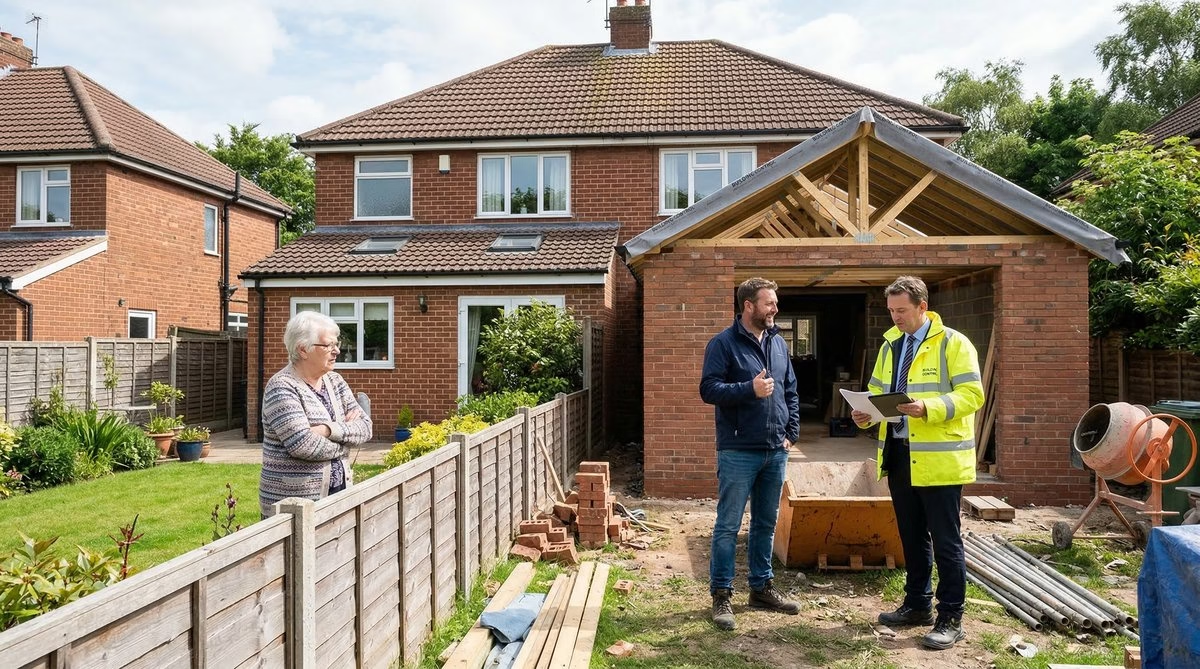
If you have deliberately reduced your rear extension to stay within permitted development limits and your neighbour is still insisting you need planning permission — or threatening to have work stopped — you are not alone. The question of whether a neighbour can stop a permitted development extension is one we encounter regularly on projects across South London, and the short answer, in the overwhelming majority of cases, is no. But understanding exactly why that is, and what your neighbour can legitimately do, is what gives you the confidence to carry on building lawfully. This article sets out the legal reality in plain terms.
Planning Permission and Building Regulations — Two Completely Different Things
One of the most common sources of confusion in extension projects is treating planning permission and building regulations as the same process. They are not. They operate under separate legislation, are administered by different departments, and serve entirely different purposes.
Planning permission is concerned with whether a development is acceptable in land-use terms — its size, appearance, impact on the street scene, and effect on neighbouring properties. It is granted or refused by your Local Planning Authority (LPA). Neighbours have a formal consultation right within the planning process: when a full planning application is submitted, neighbours are notified and given 21 days to comment. Their objections become a material consideration, though even then the council can only refuse on valid planning grounds such as loss of daylight, overbearing impact, or harm to the character of the area. Personal grievances, property value concerns, or simple dislike are not valid grounds for refusal.
Building regulations — sometimes called building control — cover an entirely different question: how the building is constructed. This means structural integrity, fire safety, thermal insulation, ventilation, drainage, and electrical safety. Building regulations approval is required for almost all extension work regardless of whether planning permission is needed. Crucially, the building regulations process has no neighbour consultation mechanism at all. A neighbour has no right to object to, delay, or veto a building regulations application. The council’s building control department cannot refuse to approve compliant work because a neighbour has written to complain. These are simply not grounds that building control can act upon.
We regularly explain this distinction to homeowners in Lewisham and across the wider South London boroughs who have received letters or visits from neighbours claiming that the council will be “informed” and work will be stopped. The reality is that building control and planning enforcement are separate teams with separate powers, and neither can act against you for carrying out work that is lawful.
What Permitted Development Actually Means — and Why 3 Metres is Lawful
Permitted development rights are granted by Parliament through the Town and Country Planning (General Permitted Development) (England) Order 2015. Under Class A of Schedule 2, Part 1, a single-storey rear extension on a terraced or semi-detached house may extend up to 3 metres beyond the original rear wall without any planning application, providing the other conditions are met — including restrictions on height, eaves, materials, and proximity to boundaries. For a detached house the standard limit is 4 metres.
Extensions beyond these standard limits — up to 6 metres for terraced and semi-detached or 8 metres for detached — require prior approval under the Neighbour Consultation Scheme. But for an extension within the standard limits, no planning application, no prior approval, and no neighbour consultation is legally required at the planning stage.
This matters enormously. If a neighbour tells you that you “need permission” for a 3-metre rear extension that meets all the other PD conditions, they are factually incorrect. You have a statutory right to build it. That right does not disappear because a neighbour disagrees with it.
Tip: If you want ironclad documentary evidence that your extension is lawful, you can apply to your LPA for a Lawful Development Certificate (LDC). This is not a requirement to build, but it is a formal legal document confirming your PD rights, which is invaluable if a dispute arises or when you come to sell the property.
In our experience working on projects across South East London, homeowners who obtain an LDC before starting work are significantly better placed if a neighbour later attempts to raise spurious planning concerns. The LDC effectively closes down that avenue of dispute at the outset.
What Happens When You Submit a Building Regulations Application
Once you submit a building regulations application — whether a Full Plans application or a Building Notice — you enter a technical compliance process between you and the council’s building control body. The purpose is to ensure your extension is structurally sound, thermally efficient, properly drained, and safe. It has nothing to do with planning policy or neighbour amenity.
There is no statutory mechanism for a neighbour to object to a building regulations application. There is no consultation period and no right of appeal for neighbours against building control approval. If a neighbour contacts building control to complain, the officer’s response is to assess whether the work is technically compliant — not whether the neighbour approves. A complaint will not delay your project unless it reveals a genuine safety issue that would need addressing regardless.
The same applies if the planning enforcement team is contacted. Planning enforcement investigates breaches of planning control — work that required permission but did not obtain it. A single-storey rear extension within permitted development limits is not a breach. An enforcement officer called out will confirm the work is lawful and take no further action.
We recently worked with a homeowner in Bromley who reduced their extension to 3 metres to stay within PD limits for their semi-detached house. Their neighbour still claimed planning permission was needed and telephoned the council repeatedly. The planning enforcement team confirmed in writing that no permission was required and no action would be taken. Work proceeded without interruption. The key was having the building notice acknowledgement and site plan confirming the 3-metre projection readily to hand.
What Neighbours Can Legitimately Do — and What They Cannot
There are a small number of areas where a neighbour genuinely has rights that must be respected. Conflating those with the many areas where they have no power only creates unnecessary anxiety.
- Party wall rights: If your extension involves building on or at the boundary, cutting into a party wall, or excavating within 3 metres of your neighbour’s foundations, the Party Wall etc. Act 1996 applies and you must serve the appropriate notices. Your neighbour can dissent from those notices, which triggers the appointment of surveyors and the drawing up of a Party Wall Award. This is a legitimate legal right. It does not, however, give the neighbour any power over the planning or building regulations aspects of your project — it simply governs the way the boundary or shared structure is dealt with.
- Reporting genuine building code violations: If a neighbour has reasonable grounds to believe work is structurally dangerous or that materials are blocking the pavement, they can report this to building control. If the concern is legitimate, it may result in an inspection. If the work is compliant, no action will follow.
- Raising a boundary dispute: If there is a genuine disagreement about where the boundary lies, this is a civil matter under land law — separate from planning and building control. A neighbour cannot use a boundary dispute to stop an otherwise lawful extension, but it may need to be resolved independently using a land registry title plan and a surveyor.
- Making a noise nuisance complaint: A neighbour can complain to environmental health if work is carried out outside permitted hours. Most councils require work only between 8am and 6pm on weekdays and 8am to 1pm on Saturdays, with no noisy work on Sundays or bank holidays.
What a neighbour cannot do is any of the following:
- Veto a lawful PD extension: There is no legal mechanism by which a neighbour can veto development that falls within permitted development rights. Their approval is not required, their objection has no formal standing, and they cannot obtain a court order to stop lawful building work.
- Demand you obtain planning permission you do not legally need: A neighbour telling you that you need planning permission is an expression of opinion, not a legal notice. Only the council can determine whether permission is required, and their determination (or an LDC) is what counts.
- Instruct your builder to stop: A neighbour has no authority over your builder. Your builder takes instructions from you and is accountable to building control. A neighbour approaching your builder and demanding they stop work has no legal standing to make that demand.
- Block access to your own property: If a neighbour physically blocks access to your property or attempts to obstruct work on your land, this is potentially a civil trespass and possibly a criminal offence depending on the circumstances.
When Neighbour Pressure Becomes Harassment — and How to Respond
Most neighbour disputes around extensions are frustrating but manageable. However, some homeowners face something more serious: a sustained pressure campaign involving repeated calls to the council, letters to the builder, or direct confrontations with workmen. When this behaviour creates a pattern causing alarm or distress, it may cross the threshold into harassment under the Protection from Harassment Act 1997 — a course of conduct on at least two occasions that a reasonable person would recognise as harassment. It is both a civil wrong and a criminal offence, and the police can issue a warning or bring charges. Civil courts can grant injunctions.
We recently helped a client in Catford in exactly this situation: a 3-metre extension unambiguously within permitted development, but a neighbour making near-daily contact with the council, sending threatening letters to the builder, and confronting workmen on the pavement. Our advice was consistent: document everything, continue lawfully, and let the paperwork speak for itself. Here is how to do that:
- Keep a written log: Record every incident — date, time, what was said or done, and who was present. This is essential if you need to report to the police or take civil action.
- Retain all correspondence: Keep every letter, email, and text message. Do not delete voicemails. These form your evidence base.
- Respond in writing where possible: A calm written response stating that the extension is within permitted development and building control has been notified creates a clear record of your position.
- Inform your builder: Make sure they know not to take instructions from the neighbour and to document any approaches or threats made on site.
- Contact the police via 101 if behaviour escalates: If your neighbour makes threats or physically obstructs access, report it on 101 and obtain a crime reference number. The police will assess whether a harassment warning is appropriate.
- Seek legal advice if necessary: A solicitor’s letter to a neighbour making baseless demands can resolve matters quickly and signals that you are prepared to enforce your rights.
Tip: Obtaining a Lawful Development Certificate early, and keeping a printed copy on site, often defuses neighbour pressure very quickly. Many neighbours who make confident claims about planning requirements will back down the moment they see a formal document from the council confirming the work is lawful.
How Fixiz Keeps Your Extension Project on Solid Legal Ground
Our approach at Fixiz has always been that the best defence against neighbour disputes is meticulous compliance from day one: confirming PD dimensions before work begins, serving party wall notices on the correct timeline, submitting a building regulations application promptly, and keeping the acknowledgement on file.
In our experience across South London — from Lewisham to Croydon, Bromley to Lambeth — the homeowners who face the most protracted disputes are those who proceeded informally with no paper trail. Those who move confidently are the ones with their LDC or building notice acknowledgement ready to produce the moment anyone challenges them. We also advise on managing the site practically — keeping noise within permitted hours, ensuring materials do not block the pavement, and maintaining a tidy boundary. That removes ammunition for legitimate grievances alongside spurious ones.
Frequently Asked Questions
My neighbour says I need planning permission for my 3-metre extension. Do I?
For a standard single-storey rear extension on a terraced or semi-detached house, up to 3 metres from the original rear wall is permitted development provided all other conditions are met. You do not need planning permission. Your neighbour’s assertion, however strongly held, carries no legal weight. If you want certainty in document form, apply to your LPA for a Lawful Development Certificate.
Can a neighbour object to my building regulations application?
No. There is no statutory right for a neighbour to object to a building regulations application. Building control approval is a compliance process between the applicant and the building control body. Neighbours are not consulted, and a complaint from a neighbour to building control will not cause an application to be refused if the work is technically compliant.
Can the council stop my extension because my neighbour keeps complaining?
The council can only take planning enforcement action if there is a genuine breach of planning control — meaning work that required planning permission but did not obtain it. If your extension is within permitted development limits, there is no breach and no basis for enforcement. The council may send an officer to inspect following a complaint, but if the work is lawful, no action will be taken. Persistent unfounded complaints to the council do not change the legal status of your development.
My neighbour has threatened to get an injunction to stop my work. Is that realistic?
For a court to grant an injunction stopping lawful building work, there must be a cause of action — typically a trespass, a private nuisance, or a breach of a restrictive covenant. Building a compliant extension within your own boundary does not of itself give rise to any of these. An injunction application based purely on dislike of a neighbour’s lawful PD extension would not succeed, and the applicant would likely face a costs order. If specific legal threats have been made, take advice from a property solicitor.
My neighbour is approaching my builder and telling them to stop. What should I do?
Inform your builder in writing that the extension is within permitted development, that building control has been notified, and that they should not take instructions from any third party regarding a stop to work. Keep a record of every incident where the neighbour approaches the site or workmen. If the behaviour continues or escalates, consider reporting it to the police on 101 and seek advice from a solicitor about whether it amounts to harassment. The builder’s contract is with you, not your neighbour, and your neighbour has no authority to vary or terminate it.
Ready to move from confusion to construction? Get in touch with Fixiz today for a no-pressure chat about your project and the fastest route to full compliance.