Physical address:
128 City Road, EC1V 2NX, London,UK

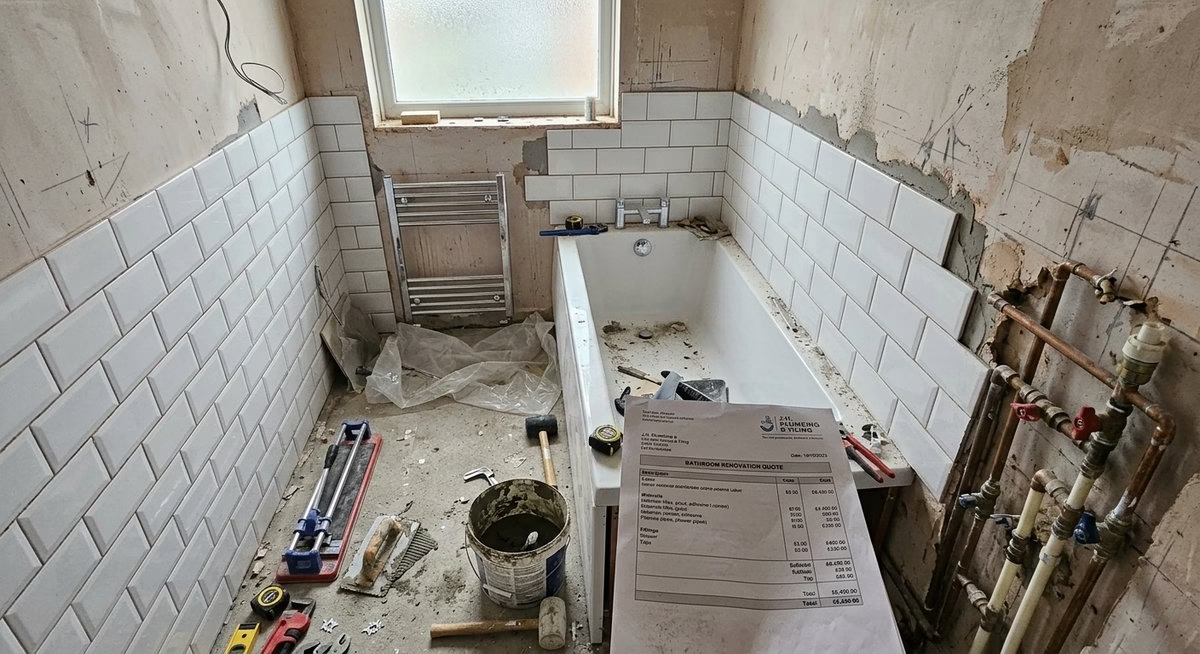
You agreed a price, shook hands on the scope — and now the invoices keep climbing. If you are dealing with a bathroom fitter charging extra UK homeowners are increasingly reporting, you are not alone, and you are almost certainly not legally obliged to pay. This article explains what should be in a standard bathroom refit quote, what counts as a legitimate extra, how to protect yourself before the job starts, and what steps to take if you find yourself mid-dispute with a fitter billing for items already priced in.
Why Bathroom Quote Disputes Happen — and Why They Matter
A bathroom refurbishment involves multiple trades working in sequence — strip-out, first-fix plumbing, tiling, and second-fix sanitaryware installation — and that complexity creates fertile ground for billing disputes. The most common scenario we see at Fixiz: a homeowner receives a detailed, itemised quote for a full bathroom refit, the fitter begins work, then presents a revised invoice with line items for fitting the bath panel, silicone sealing, and connecting the basin and toilet — all clearly listed in the original quote.
The justification offered is almost always the same: “It took longer than expected.” This reasoning has no legal weight when the scope of work has not changed. A bathroom fitter’s inability to anticipate how long a standard installation takes is the fitter’s commercial risk — not yours.
In our experience, disputes almost always trace back to one of two root causes: either the quote was never properly itemised, or the fitter issued an estimate rather than a fixed quote without making the distinction clear. Understanding the difference between a quote and an estimate is, quite literally, worth hundreds of pounds.
Tip: Check the document you receive carefully. If it says “quote” or “quotation,” the price is fixed. If it says “estimate,” push for a fixed quote before agreeing to proceed.
A widely cited thread on MyBuilder from a homeowner whose fitter charged extra for the bath panel, basin fitting, toilet connection, and silicone work — all itemised in the original quote — drew responses from over a dozen experienced fitters. The unanimous verdict: none of those charges were legitimate. As one contributor put it, if a fitter prices a job wrong, that is their problem — complications are the fitter’s risk to absorb, not the homeowner’s bill to carry.
What a Standard Bathroom Refit Quote Should Cover
Before you can identify an illegitimate extra, you need to know what a properly scoped bathroom refit quote should include. In our experience, every itemised quote for a full bathroom refurbishment should cover the following phases — without ambiguity.
- Strip-out: Removal of the existing bath, basin, toilet, tiles, and flooring, including disconnecting and capping off existing plumbing connections.
- Waste removal: Collection and disposal of all stripped-out materials. Some fitters attempt to charge this separately post-completion; it should be agreed and costed upfront.
- First-fix plumbing: Running supply and waste pipework to the positions required for the new sanitaryware. Where pipes are being repositioned, that should be flagged and costed in the original quote.
- Tiling: Preparation of walls and floors, laying tiles, and grouting — all included as a matter of course.
- Second-fix sanitaryware installation: Fitting and connecting the bath, basin, toilet, and any shower enclosure. Fitting the bath panel, making the toilet waste connection, and connecting the basin are all standard second-fix tasks. They should never appear as extras.
- Sealing and finishing: Silicone sealing around the bath, basin, and shower tray. This is a non-negotiable part of a finished installation — a fitter who leaves silicone unfinished has not completed the job.
- Snagging: A final walkthrough to address any cosmetic or functional deficiencies before sign-off.
We always recommend requesting an itemised quote with an explicit “included / not included” column for each phase. If a fitter will only give you a lump-sum figure, treat that as a warning sign.
Tip: Ask your fitter to confirm in writing that all labour and materials required to complete the installation — including sealing, panel fitting, and waste disposal — are included in the quoted price. A professional fitter will have no objection to this.
What Are Legitimate Extras — and How to Handle Them
Not every additional charge is illegitimate. There are genuine scenarios where a bathroom refit uncovers conditions that no fitter could have reasonably anticipated. Understanding where the line sits protects you from being overcharged while ensuring you are fair to a fitter who has encountered a genuine problem.
- Rotten floorboards discovered during strip-out: If the subfloor beneath the bath or toilet has suffered water damage concealed by existing flooring, replacing rotten boards is a legitimate extra — but the fitter must stop, show you the damage, provide a written cost, and get your written approval before proceeding.
- Asbestos identification: If asbestos is identified during strip-out, work must stop and licensed removal is required. This is a genuine extra no quote could have anticipated.
- Unexpected pipework rerouting: If a structural element prevents the new pipework from following the planned route, the additional labour and materials to find an alternative can legitimately be charged — but must be agreed in writing before the work is done.
- Customer-initiated changes: If you change the position of the basin, upgrade to a larger bath, or request additional features mid-project, those changes carry additional cost and should be documented on a written change order.
The key distinction: a legitimate extra was genuinely unforeseeable, is evidenced — you can see the problem with your own eyes — and is agreed in writing before any additional work begins. A fitter who simply took longer than planned to complete items already in the quote cannot characterise that overrun as an extra.
In our years of managing bathroom projects, we have seen fitters charge for complications any experienced tradesperson would have anticipated — pipes not exactly where expected in a 1970s semi, tiles requiring more adhesive on an uneven wall. These are ordinary variables of bathroom fitting. A fair day rate for unforeseen work, agreed before the job starts, is the right mechanism — not a post-completion invoice for tasks already in the quote.
How to Structure Your Bathroom Quote to Prevent Disputes
The best protection against a billing dispute is a quote document that leaves no room for misinterpretation. Here is the structure we recommend — and the one we use ourselves at Fixiz.
- Itemised scope with an “included” column: Every task — strip-out, first-fix, tiling, second-fix, sealing, waste removal — should appear as a separate line item, clearly marked as in-scope. Any items explicitly excluded should be listed too.
- Agreed day rate for unforeseen work: Rather than leaving the cost of genuine unknowns open, agree a day rate for any additional labour upfront. State it in the quote document so that when a genuine unforeseen event occurs, there is no negotiation required in the heat of the job.
- Written change orders before any extra work starts: Any variation to scope — whether requested by you or caused by a genuine unforeseen condition — should be documented on a change order before a single additional task is carried out. The change order should describe the work, state the cost, and require your signature. A fitter who carries out additional work without written agreement has no contractual right to charge for it.
- Payment schedule tied to milestones: Structure payments around verifiable stages — typically a deposit on commencement, a payment on completion of first-fix, and a final payment on practical completion. Avoid paying in full before the job is signed off.
- Confirm quote versus estimate in writing: Before work begins, confirm by email that the figure provided is a fixed quote and not an estimate. A one-line reply from the fitter confirming this is valuable evidence if a dispute arises later.
Tip: Keep a project folder with the original quote, all written communications, any change orders, and photographs taken at each stage. If a dispute arises, this evidence is invaluable.
Your Rights Under the Consumer Rights Act 2015
If your fitter is charging for items that were clearly included in a fixed quote, the law is straightforwardly on your side. Under the Consumer Rights Act 2015, a trader who provides a quote is bound by that price. They cannot charge more than the quoted amount unless you have agreed to additional work — and that agreement must be genuine, not a unilateral decision on their part.
As Citizens Advice confirms, a trader cannot charge more than the quoted price because their costs have risen or the job took longer than expected. If the fitter made a pricing error, that is their commercial risk — provided the error was not obvious to you at the time you accepted the quote.
The Act also requires that any service is carried out with reasonable care and skill. A fitter cannot cite their own poor workmanship, inefficiency, or inadequate planning as justification for additional charges. Complications that arise from the fitter’s own preparation failures are not legitimate extras.
Practically, your position under the Act is clear: if the work was quoted at a fixed price and the scope has not changed, you are legally entitled to pay only the quoted amount. Put that position in writing, state that you understand your rights under the Consumer Rights Act 2015, and document everything. If the job took longer because the fitter was inexperienced or poorly organised, that is not a legitimate basis for a surcharge — and no court would award it.
Practical Steps If You Are Mid-Dispute
If your fitter has presented an inflated final invoice, here is the step-by-step approach we recommend.
- Withhold only the disputed amount: Pay everything you genuinely owe. Withholding the entire final payment when only part of it is in dispute can give the fitter grounds to claim breach of contract. Pay the undisputed amount and state in writing that you are withholding the remainder pending resolution.
- Put your concerns in writing immediately: Email each disputed charge, referencing the specific line item in the quote document. Keep the tone professional and state that you require a written response.
- Reference the Consumer Rights Act 2015: State clearly that the trader is bound by the quoted price and that you will only pay the original agreed amount unless shown evidence of a change you agreed to in writing.
- Get an independent assessment if necessary: If the fitter claims an additional charge relates to genuinely unforeseeable work and you are unsure, instruct an independent tradesperson or surveyor for a written opinion. This provides objective evidence if the dispute escalates to a small claims court.
- Use alternative dispute resolution: Many trade bodies, including the Federation of Master Builders, offer dispute resolution for members. If your fitter belongs to a trade association, contact them about their complaints process.
- Small claims court as a last resort: If the fitter refuses to engage and the disputed amount is within the small claims limit (currently £10,000 in England and Wales), you can issue a claim through the county court without a solicitor. Your project documentation will be central to your case.
The most important thing is to act quickly, document everything, and not be pressured into paying amounts you do not owe.
How Fixiz Handles Bathroom Quotes Transparently
At Fixiz, we built our quoting process around the principle that a homeowner should never be surprised by their final invoice. Every bathroom project we manage starts with a fully itemised written quote specifying what is included at each phase — strip-out, first-fix plumbing, tiling, second-fix sanitaryware fitting, sealing, and waste removal. Each line item carries an explicit inclusion marker so there is no ambiguity about scope.
Before any project begins, we agree a day rate for unforeseen labour and build in a written change order process for any variations. If we encounter a genuine unforeseen condition — rotten floorboards, concealed pipework — we stop, document it with photographs, provide a written cost estimate, and obtain your written approval before proceeding. We do not present surprises at the end of a job.
We know that the fear of unexpected extras is one of the biggest anxieties homeowners face when choosing a bathroom fitter. Our fitters are selected on trade experience, references, and a track record of completing jobs to the original quoted scope. We carry out post-completion reviews with every homeowner so any concerns about billing or workmanship are resolved promptly rather than escalating into formal disputes. In short, we take responsibility for managing the commercial risk of a bathroom project, so our customers do not have to.
Frequently Asked Questions
Can a bathroom fitter charge extra if the job took longer than they expected?
No. If the fitter provided a fixed quote and the scope of work has not changed, they cannot charge more because the job took longer than planned. As confirmed by MyBuilder trade professionals, an experienced fitter must allow for complications when pricing and cannot pass that risk to the homeowner after the fact.
Is silicone sealing a standard part of a bathroom installation, or is it an extra?
Silicone sealing is a standard, non-negotiable part of any completed bathroom installation. Any fitter who charges separately for silicone on items already quoted is not acting in good faith.
What is the difference between a quote and an estimate for bathroom work?
A quote is a fixed-price commitment — the fitter cannot charge more without your prior written agreement. An estimate is the fitter’s best approximation of likely cost, and the final figure can legitimately be higher, though it must still be reasonable. Always confirm in writing whether you have a quote or an estimate before work begins.
What counts as a legitimate extra in a bathroom refit?
Legitimate extras are genuinely unforeseeable conditions — rotten floorboards beneath the bath, asbestos discovered during strip-out, or structural elements requiring significant pipework rerouting. To be legitimate, the extra must be evidenced, agreed in writing before work begins, and costed at the rate agreed in the contract. Customer-requested scope changes are also legitimate when documented through a written change order.
Can I withhold payment if I am disputing extra charges?
Pay everything you genuinely owe and withhold only the specific disputed amount. State clearly in writing what you are paying, what you are withholding, and why. Withholding the entire final payment when only part of it is disputed can give the fitter grounds to claim breach of contract.
What should I do if the fitter threatens legal action over disputed extras?
Gather your documentation — the original quote, written communications, and change orders — and respond in writing citing your rights under the Consumer Rights Act 2015. Seek advice from Citizens Advice or a trade association dispute resolution service if the matter cannot be resolved directly.
Ready to move from confusion to construction? Get in touch with Fixiz today for a no-pressure chat about your project and the fastest route to full compliance.