
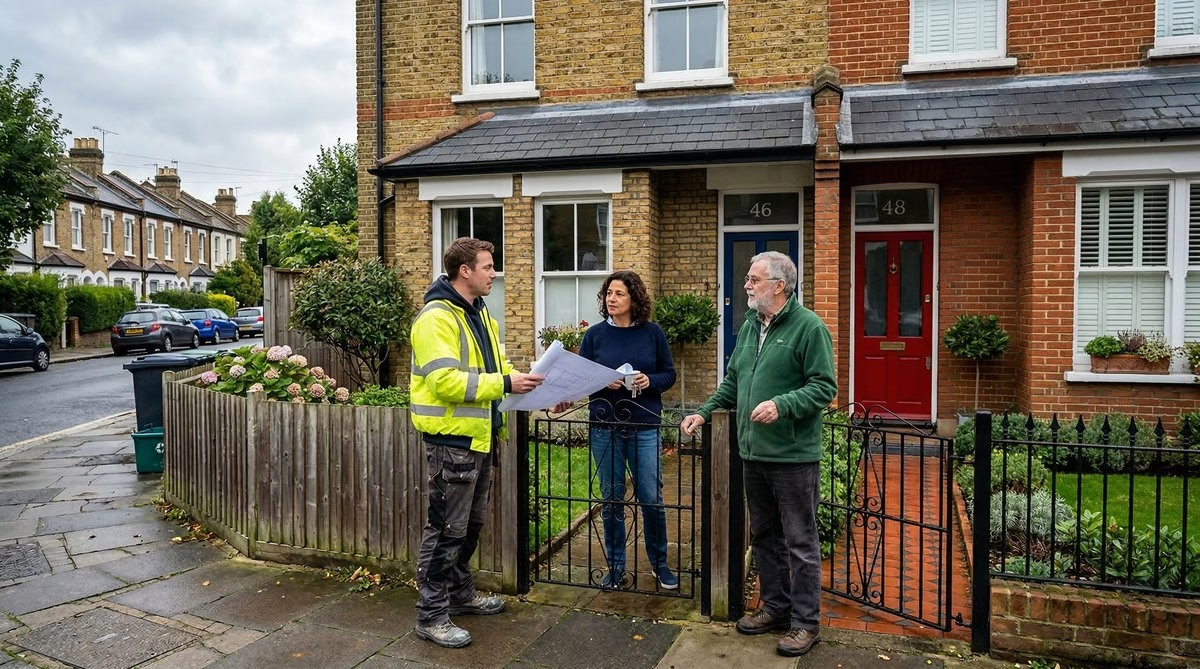
If you’re planning a rear extension and someone mentions the Party Wall Act, it can feel like your project has suddenly turned into a legal dispute. Most homeowners aren’t trying to “fight” a neighbour — they just want to build properly, protect both properties, and avoid delays. The problem is that the party wall process has its own timelines and rules, and if you ignore it (or handle it badly), it can derail your build.
We’re Fixiz Ltd in London. We build extensions and manage the real-world headaches around them — especially in terraced and semi-detached streets where boundaries are tight and trust is fragile. Our approach is simple: be clear, be documented, and do things in the right order so nobody feels cornered.
What the party wall process actually is — and why it matters
The Party Wall etc. Act 1996 exists to balance two realities: you have a right to improve your home, and your neighbour has a right to protect their property. When your extension involves work to a shared wall, excavation near their foundations, or building on/at the boundary, the Act sets out a formal notice and agreement process.
Where homeowners get into trouble is assuming it’s “just a formality”. In practice, the party wall process is a structured risk-management system: notices, written responses, surveys (if needed), and a Party Wall Award that sets out how the work will be done and how damage is handled.
- Legal protection: A proper process reduces the chance of injunctions and stop-work scenarios.
- Clarity: It documents what you’re doing, when, and how the neighbour’s property will be protected.
- Damage handling: It sets out inspection and repair routes if cracking or movement occurs.
- Neighbour relations: It gives your neighbour a structured way to engage without personal conflict.
Tip: Treat the party wall process like building control — a compliance step, not a “nice-to-have”.
The biggest homeowner fear: “My neighbour won’t sign — what happens now?”
This is extremely common in London. Sometimes neighbours are busy. Sometimes they’re suspicious. Sometimes they’re planning their own works and don’t want to commit. And sometimes they disagree with the design or worry about noise, dust, or structural risk.
If a neighbour doesn’t respond to a party wall notice within the relevant timeframe, the process doesn’t stop forever — it moves to the surveyor route. This is where many homeowners panic, because they imagine court. In reality, surveyors are often the mechanism that gets things unstuck: they document existing condition, agree protective measures, and issue an Award that allows work to proceed with safeguards.
- No response: Usually triggers the need for surveyor involvement to keep the process moving.
- They dissent: Not the end of the world — it just means the formal route is used.
- They request changes: Some concerns can be handled by better drawings, method statements, and a calmer explanation.
- They become hostile: The more formal and documented your approach is, the safer you are.
We always tell clients the same thing: you can’t control your neighbour’s emotions, but you can control your documentation, your sequencing, and your site behaviour. That’s what keeps projects moving.
Common mistakes that cause party wall delays (and how we avoid them)
Most party wall delays aren’t caused by the Act itself — they’re caused by poor communication and poor preparation. A neighbour is far more likely to ignore you if they feel surprised or rushed, or if the information is vague.
- Serving notice too late: Homeowners leave it until the builder is ready to start, then get stuck waiting.
- Unclear drawings: A neighbour can’t assess risk if the plans don’t show excavation depth, boundary lines, and structure.
- Over-promising: Saying “there will be no cracking” destroys trust — it’s better to explain how you’ll manage risk and fix damage if it occurs.
- Site behaviour: Early noise, skipping protection, or messy work validates a neighbour’s worst fears.
Tip: The best party wall strategy is an early friendly conversation, followed by formal notice at the right time — not the other way round.
How the party wall process fits into an extension timeline
Homeowners often ask us, “Do we do party wall before planning?” In reality, the right sequencing depends on your project, but the key is to avoid stacking critical steps on top of each other. If you leave party wall until the last minute, it becomes the bottleneck.
In practice, we like a flow that looks like this:
- Design clarity: Plans that show structure, excavation, and boundaries.
- Early neighbour chat: A calm explanation of what’s happening and when.
- Formal notice: Served at an appropriate time so the legal clock starts before you need to build.
- Surveyor route if required: Condition schedule, protective measures, Award.
- Build with discipline: Protection, monitoring, tidy site, respectful working hours.
This isn’t about being “nice” — it’s about risk reduction. Extensions are already complex. The party wall process is one of the few tools you have to keep neighbour risk manageable.
How Fixiz helps — practical, London-first support
We don’t pretend we’re party wall surveyors. What we do is make sure your build side is prepared so the party wall process has fewer reasons to stall. That means clear information, realistic methods, and a contractor who behaves in a way that keeps the temperature down.
- Buildability review: We sanity-check the design from a construction perspective so details don’t create unnecessary neighbour risk.
- Method clarity: We explain how we’ll excavate, support, protect, and manage dust/noise.
- Neighbour confidence: A tidy site, predictable working hours, and fast response to concerns.
- Damage minimisation: We focus on prevention first — then fast making-good if issues arise.
When the neighbour sees that the contractor is organised and respectful, resistance often softens. Not always — but often enough that it saves weeks.
FAQ — party wall worries for rear extensions
Do I need a party wall agreement for a rear extension?
It depends on the work. If you’re excavating near a neighbour’s foundations, working on a shared wall, or building at the boundary, party wall procedures are commonly required. A professional assessment early on prevents last-minute surprises.
What if my neighbour refuses to respond?
Non-response typically pushes the process towards surveyor involvement so the matter can be formalised and documented. The goal is to protect both sides and allow compliant work to proceed.
Will party wall delay my start date?
It can if you leave it late. If you plan it alongside design and approvals, it’s usually manageable. The biggest delays come from vague information and rushed communication.
Can my neighbour stop my extension completely?
If you ignore the process or act unreasonably, you increase the risk of disputes and stop-work situations. If you follow the correct route with proper documentation, you reduce that risk significantly.
Ready to move from confusion to construction? Get in touch with Fixiz today for a no-pressure chat about your extension plans, boundary risks, and the smoothest route through party wall compliance.