
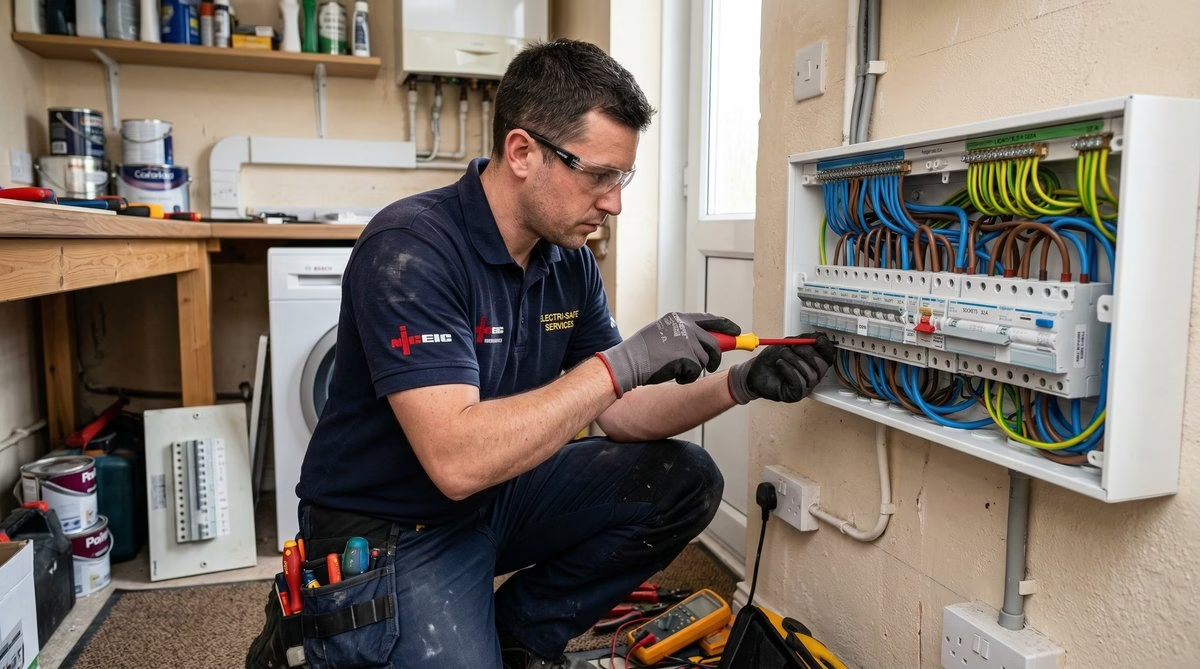
An Electrical Installation Condition Report (EICR) that comes back with a list of codes — C1s, C2s, F1s — is unsettling, particularly when the electrician who produced it is also the one quoting for the remedial work. Homeowners regularly come to us having been told they need a full rewire when they don’t, or having had a consumer unit replacement recommended without any discussion of whether it actually addresses the codes on the report. Understanding what your EICR is telling you, what a full rewire actually involves, and when a consumer unit upgrade is the appropriate response, puts you in a far better position to make a decision that protects your property without spending money you don’t need to.
What an EICR actually measures — and what the codes mean
An EICR is a detailed inspection and test of your electrical installation. The inspecting electrician checks the condition of the consumer unit (fuse board), the wiring circuits throughout the property, the earthing and bonding, and the condition of accessories (sockets, switches, light fittings). They test the integrity of circuits using instruments and compare the results against the current edition of BS 7671 — the IET Wiring Regulations.
The report produces classification codes for any observations that don’t comply with the current standard or present a risk:
- C1 — Danger present: A risk of injury exists and the fault requires immediate rectification. The EICR cannot be completed as satisfactory with a C1 outstanding. Examples include exposed live conductors, a missing earth, or a live terminal accessible without tools.
- C2 — Potentially dangerous: The installation has a deficiency that could become dangerous. Remedial work is required, but the level of urgency is lower than a C1. Examples include a consumer unit without RCD protection, circuits with inadequate earthing, or mechanical damage to cables in accessible locations.
- C3 — Improvement recommended: The installation does not comply with the current edition of BS 7671, but the deviation does not present an immediate safety risk. C3 codes do not make an EICR unsatisfactory. They are recorded as recommendations and do not require action to achieve an “Unsatisfactory” classification, but may indicate an ageing installation that will require attention over time.
- F1 — Further investigation required: The inspector has identified a potential issue that cannot be confirmed without more detailed investigation. Examples include suspected damage to concealed cables.
An EICR is “Satisfactory” only when there are no C1 or C2 codes. A report with C1 or C2 codes is “Unsatisfactory” and requires those deficiencies to be addressed before the installation can be certificated. A report with only C3 codes is Satisfactory — the recommendations are advisory, not mandatory.
Tip: Before agreeing to any remedial work based on an EICR, read the report in full. Note which codes are C1, which are C2, and which are C3. The difference matters enormously — C1 and C2 require action, C3 does not.
When a consumer unit upgrade is the right answer
The consumer unit is the distribution board that houses the main switch, fuses or circuit breakers, and residual current devices (RCDs). In properties with older consumer units — particularly those with rewirable fuses (often in a wooden box) or early MCB boards without RCDs — a consumer unit upgrade is frequently the single change that addresses most or all of the C2 codes on an EICR.
Current regulations require that new consumer units in domestic premises use non-combustible enclosures (steel rather than plastic), and that circuits providing general socket outlets and circuits for kitchens and bathrooms have RCD protection. An older installation without these features will attract C2 codes that can typically be resolved by replacing the consumer unit with a modern dual-RCD or RCBO board, without touching the wiring circuits.
- What a CU upgrade includes: A new consumer unit (typically a dual-RCD board or an RCBO board), replacement of all circuit breakers, correct labelling, and verification testing of all circuits after installation. The work is notifiable under Part P of the Building Regulations and must be carried out by a registered electrician (NICEIC, NAPIT, or equivalent).
- What it costs: A consumer unit upgrade on a standard London property typically costs £400–£900, depending on the number of circuits and the type of board specified. This is a contained, low-disruption job that normally takes a day.
- What it doesn’t fix: A CU upgrade does not address defects in the wiring itself — deteriorated cable insulation, undersize cables, missing earths on circuits, or damage to the wiring run. If the C2 codes on your EICR relate to circuit wiring rather than the board, a CU upgrade alone will not resolve them.
Tip: Ask your electrician to identify which specific codes each remedial action addresses. If a CU upgrade is proposed, ask which codes it resolves and whether any codes remain outstanding after the upgrade. This gives you visibility over whether you’re being quoted for the right work.
When a full rewire is actually necessary
A full rewire — replacing all the wiring throughout the property, from the consumer unit to every socket, switch, and lighting point — is a major undertaking. It involves significant disruption: in most properties, it requires lifting floors, chasing walls, temporary loss of power, and redecoration of every room where cables have been run. In a typical London terraced house, a full rewire typically costs £4,000–£8,000 and takes 5–10 days on site. Understanding when it is genuinely necessary — rather than a maximally profitable recommendation — is important.
A full rewire is genuinely necessary in the following circumstances:
- Pre-1966 rubber-insulated wiring: Properties with wiring installed before the mid-1960s often have rubber or lead-and-sheathed insulation that has degraded over time. Rubber insulation becomes brittle and friable with age and can crumble away from conductors, creating genuine shock and fire risks. This wiring cannot be made safe by partial remedial works — replacement is required.
- Aluminium wiring: Some properties from the 1960s and 1970s have aluminium wiring rather than copper. Aluminium wiring requires specific termination fittings and has characteristics that make connections unreliable over time. Where aluminium wiring is present, replacement with copper is the appropriate resolution.
- Wiring with widespread circuit defects: Where the EICR identifies C2 codes on multiple circuits — inadequate earthing, damaged cables, missing cross-bonding — across the whole installation, the cost and disruption of remedying each circuit individually may approach or exceed the cost of a full rewire, and a rewire may be more cost-effective.
- Property renovation: Where a property is being stripped back to the structure for a major renovation, a full rewire is logical because the access needed to replace the wiring is already available. Rewiring a property when the walls are open costs far less in disruption than rewiring a decorated property.
Situations where a full rewire is not necessary
Many EICR reports that come back with a list of codes do not require a full rewire. The codes can be addressed with targeted remedial works — replacing the consumer unit, improving earthing and bonding, replacing damaged accessories, or extending the earth conductor to circuits where it is missing.
- Modern PVC-insulated cable in good condition: If the wiring is PVC-insulated (post-1960s) and the cable condition is good — no heat damage, no mechanical damage, insulation intact — the wiring circuits themselves are likely to be serviceable for many more years. Codes relating to the absence of RCDs or a non-compliant consumer unit can be addressed by a board upgrade alone.
- C3 codes only: As noted above, C3 codes do not make an installation unsatisfactory and do not require immediate action. An installation with only C3 observations needs monitoring and gradual improvement, not a full rewire.
- Isolated circuit defects: Where one or two circuits have specific defects — a missing earth on a ring final, a damaged cable run in one location — the appropriate response is to address those specific defects, not to replace the entire installation.
Tip: If you’ve been told you need a full rewire based on an EICR, ask the electrician to show you which specific observations require complete circuit replacement, as opposed to which could be addressed by targeted remedial works. If they can’t or won’t answer this question, seek a second opinion.
How disruption is managed — and minimised
One of the most common concerns we hear is about disruption. Both CU upgrades and partial remedial works can typically be carried out with the household in residence and with minimal damage to decoration. A full rewire is more disruptive, but there are techniques that reduce the impact.
- Channel and chase approach: For a full rewire in a decorated property, electricians chase new cable routes into the wall plaster, run cables through the floor void where possible, and use surface conduit where concealment isn’t critical. Redecoration is required, but it’s limited to specific chase lines rather than entire rooms.
- Phased approach: For a property being gradually renovated, a rewire can be phased room by room to align with redecoration — doing the electrical work in each room as it’s stripped, rather than all at once.
- Living in during the work: A full rewire can usually be carried out with the household in residence if the work is sequenced carefully. Temporary connections can maintain power to essential circuits (kitchen, bathroom) while other areas are worked on.
How Fixiz interprets EICR results and plans remedial works
When we review an EICR — whether we produced it or you’ve brought it to us for a second opinion — we start with the codes. We identify which observations are C1 (immediate action), which are C2 (require remediation for a satisfactory certificate), and which are C3 (advisory). We then assess whether the proposed remedial scope is proportionate to the actual findings.
We frequently find that a CU upgrade, combined with targeted remedial works on specific circuits, resolves all C1 and C2 codes without any need for a full rewire. Where a full rewire is genuinely the right answer — typically in a pre-1966 installation with degraded rubber wiring — we say so and explain why. We provide an itemised quote that links each line of work to specific observations on the EICR, so you can see exactly what you’re paying for and why.
We’re registered with a Competent Person Scheme, which means we can self-certify the work and issue the required electrical certificates. You’ll get an Electrical Installation Certificate for the remedial works, and a new EICR after completion showing a satisfactory result.
Frequently asked questions
Does an unsatisfactory EICR mean I need a full rewire?
Not necessarily. An unsatisfactory EICR means there are C1 or C2 codes that require remediation — but in many cases those codes can be addressed by a consumer unit upgrade, targeted circuit repairs, or bonding improvements, without replacing the entire installation. The remediation should be proportionate to the specific observations on the report.
How often does an EICR need to be done?
For owner-occupied residential properties, every 10 years is typically recommended. For rental properties in England and Wales, the Electrical Safety Standards in the Private Rented Sector Regulations 2020 require an EICR at least every 5 years, with a copy provided to tenants. On change of tenancy, a new EICR is recommended.
What is the difference between a consumer unit and a fuse box?
They are essentially the same thing — the distribution board that contains the main switch and the protective devices for each circuit. Older “fuse boxes” contain rewirable fuses or early MCBs without RCDs. A modern “consumer unit” contains MCBs or RCBOs with RCD protection on all circuits, in a non-combustible enclosure. Upgrading from a fuse box to a modern consumer unit addresses several common EICR observations.
Can a full rewire be done in a day?
No. A standard two or three-bedroom London property typically takes 5–10 days for a full rewire. A consumer unit upgrade alone can be done in one day.
Will I need to redecorate after a rewire?
Yes, to some extent. Wiring runs are chased into walls and floors, and those chases must be filled and redecorated. The extent of decoration required depends on how the cables are routed — a property being renovated requires far less additional redecoration than a fully decorated one. Your electrician should confirm the extent of making-good that is included in their quote.
Ready to move from confusion to construction? Get in touch with Fixiz today for a no-pressure chat about your project and the fastest route to full compliance.