
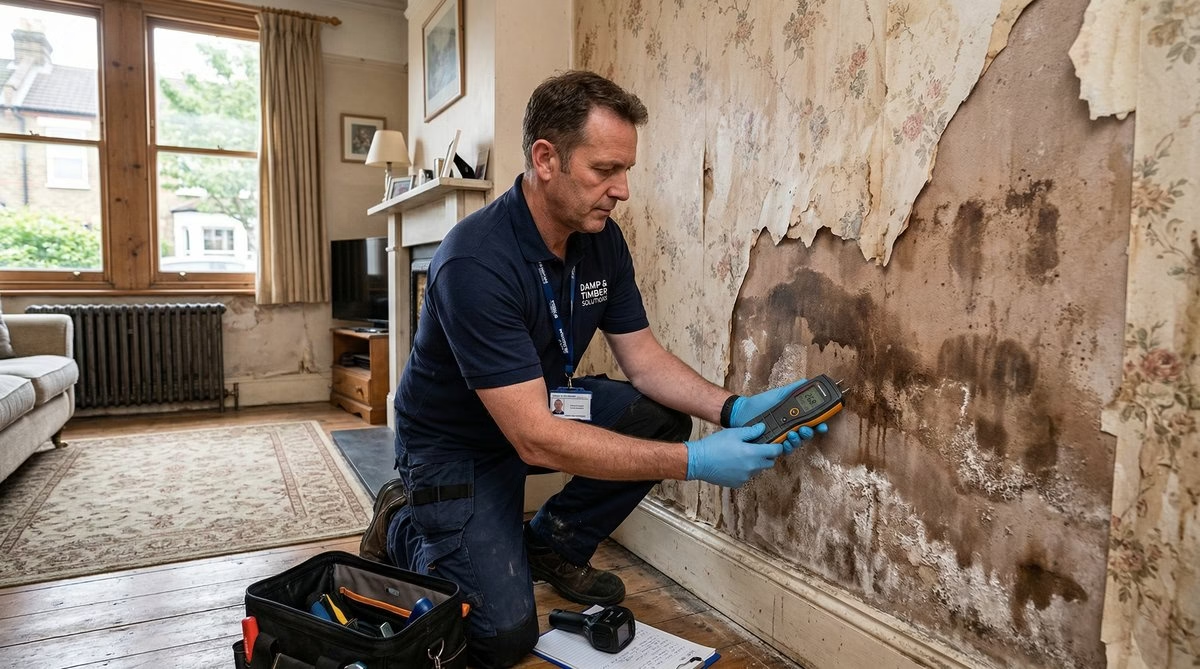
Damp is one of the most misdiagnosed problems in UK housing — and one of the most aggressively sold. If you’ve recently had a survey or a free damp inspection and been told you need chemical injection, a tanking membrane, or a full replastering scheme without the surveyor first explaining exactly what type of damp you have and what’s causing it, you may be about to spend thousands of pounds on the wrong treatment. Understanding the difference between a damp survey and a damp proofing quote, and knowing when to seek a second opinion on rising damp, is the most important thing you can do before committing to any remediation work.
Why damp misdiagnosis is so common — and so costly
Damp in buildings has three primary causes: rising damp (water drawn up through masonry by capillary action), penetrating damp (water entering through a defect in the external envelope), and condensation (moisture from internal air depositing on cold surfaces). The treatment for each is entirely different. Rising damp is addressed by inserting a new damp proof course and replastering with a salt-resistant render. Penetrating damp is addressed by finding and fixing the external defect — a cracked render, a faulty gutter, a failing pointing. Condensation is addressed by improving ventilation and sometimes insulation.
The problem is that damp proofing companies — which are sales organisations as much as technical ones — are financially incentivised to diagnose rising damp, because chemical injection and replastering is a significant and repeatable revenue source. A condensation problem or a penetrating damp problem costs next to nothing to fix if correctly diagnosed. A “rising damp” diagnosis generates a five-figure contract. This doesn’t mean every company is acting dishonestly, but it does mean there is a structural conflict of interest whenever the person diagnosing the problem is also selling the solution.
Tip: If a damp inspection is free, consider who is paying for it. Free inspections from damp proofing contractors are marketing activities, not independent surveys. Always commission a paid, independent damp survey from a surveyor who has no commercial interest in any particular treatment.
The structural surveyor vs. the damp proofing contractor
A chartered surveyor (RICS) or a specialist independent damp surveyor will assess the property, identify moisture readings in the walls, analyse the pattern of damage, and give you a diagnosis and recommendation that is not tied to any particular product or treatment. Their fee — typically £300–£600 for a residential property — is money that protects you from potentially thousands in unnecessary work.
A damp proofing contractor carrying out a “free survey” is there to quote for work. Their survey form is a diagnostic tool that leads to a sales proposal. It is not the same as an independent professional opinion, and in our experience it frequently results in a treatment recommendation that is more extensive than the problem warrants.
How to recognise the three types of damp
Understanding the basic characteristics of each damp type helps you evaluate any diagnosis you’re given and ask the right questions.
Rising damp
True rising damp is actually less common than the damp proofing industry would have you believe. It occurs when there is no damp proof course (DPC), or the DPC has failed, and groundwater is drawn up through porous masonry. Key indicators are a ‘tide mark’ of staining that stops at around 1 metre height (capillary rise has a physical limit), salt crystallisation on the wall surface (white fluffy deposits called efflorescence), and consistently elevated moisture readings at low level that reduce as you move up the wall.
Important context: many Victorian and Edwardian properties have either no DPC or an original slate or bitumen DPC that remains effective. The presence of low-level moisture doesn’t automatically mean the DPC has failed — it may mean a bridged DPC (where render or soil has been built up above the DPC level), a failed airbrick, or a leaking underground pipe.
Penetrating damp
Penetrating damp enters through a specific defect — a crack in the render, failed pointing, a faulty window seal, a blocked or leaking gutter, a roof defect, or water bridging through a poorly detailed extension. The pattern of damp usually maps to the defect: it appears at a specific height on a specific wall, often as a discrete patch rather than a band. It is worse after rain. Fixing it means finding and rectifying the defect, which is often straightforward and inexpensive.
Penetrating damp is frequently misdiagnosed as rising damp, particularly where it affects lower sections of an external wall. A moisture meter reading at low level does not distinguish between the two — the same elevated reading can result from either cause. Only a full investigation — including inspection of gutters, render, pointing, and external ground levels — can confirm the diagnosis.
Condensation
Condensation is by far the most common cause of damp in modern UK homes, particularly in properties that have been draught-proofed without improving ventilation. Warm, moist air — generated by breathing, cooking, and bathing — moves to the coldest surfaces in a room and deposits moisture. Black mould growth on cold wall surfaces, window reveals, and the backs of external walls is almost always condensation. It is not a structural defect, and it cannot be solved by injecting a DPC.
The solution to condensation is ventilation: mechanical extractor fans in kitchens and bathrooms, trickle vents in windows, and sometimes a whole-house mechanical ventilation with heat recovery (MVHR) system in very airtight properties. Insulating cold external walls improves surface temperatures and reduces condensation risk. Neither of these solutions generates the revenue of a chemical injection programme, which is one reason condensation is systematically under-diagnosed by damp proofing salespeople.
What a proper damp survey should include
If you commission an independent damp survey, here is what it should cover — and what you should expect in the report.
- Visual inspection: A thorough walkthrough of the affected areas, noting the position, height, and pattern of any staining, mould, or salt deposits.
- Moisture readings: Wall moisture readings taken at multiple heights and locations, with the data recorded — not just a pass/fail judgement. Readings should be compared across surfaces and elevations.
- External inspection: A check of gutters, downpipes, render, pointing, DPC level, external ground levels, and airbricks — because most damp problems have an external cause.
- Differential diagnosis: An explicit conclusion about which type of damp is present and why — not just “damp present” or “rising damp confirmed”.
- Proportionate recommendations: A treatment recommendation that is appropriate to the diagnosed problem. If the problem is a blocked gutter, the recommendation should be to clear the gutter — not to replaster the internal wall.
- Independence disclosure: Confirmation that the surveyor has no commercial interest in any particular treatment or product.
Tip: Ask the surveyor before commissioning the survey: “Do you or your company also carry out damp proofing works?” If the answer is yes, they are not fully independent, even if the survey itself is professionally conducted. For true independence, use a surveyor whose only service is surveying.
When to get a second opinion on a damp diagnosis
There are specific situations in which we strongly recommend seeking a second opinion before proceeding with any damp treatment.
- Large quoted value: If the remediation quote exceeds £2,000–£3,000, the cost of a second independent survey (£300–£600) is clearly justified.
- No external investigation: If the surveyor or contractor hasn’t inspected gutters, render, ground levels, and airbricks, the diagnosis is incomplete. A second opinion that includes external investigation is warranted.
- Black mould without structural wet: If the main presentation is black mould on walls without any obvious water ingress or penetrating staining, condensation is the most likely cause and a chemical injection programme is almost certainly the wrong treatment.
- Pre-purchase survey: If a structural survey flags damp and a damp proofing company’s free survey then confirms a major rising damp problem, commission an independent survey before exchanging contracts. The structural surveyor’s flag and the contractor’s diagnosis may not be based on the same evidence.
- Guaranteed treatments that have failed: If a property has had a guaranteed damp proofing treatment that is still within its guarantee period but the damp has returned, the diagnosis was likely wrong. A second opinion can identify what was actually happening.
The ‘cover it up’ fix — and why it fails
One of the most frustrating patterns we see is properties where damp has been addressed by covering the symptoms rather than removing the cause. The classic version is applying a tanking membrane or waterproof render to an internal wall that has penetrating damp — the external defect is never addressed, the moisture continues to enter the wall, and within a few years the membrane lifts, the render blows, and the problem is back — often worse than before because the moisture has been trapped rather than allowed to dry out.
Another version is applying a chemical injection DPC to a wall where the damp is caused by bridging of the original DPC by high external ground levels or render. Injecting a new DPC six inches above the bridge achieves nothing if the water can still enter above the injection line. The right solution is to reduce the external ground level or cut back the render below DPC level — a physical fix rather than a chemical one.
We have also seen extensive internal replastering schemes specified for condensation problems. The new plaster looks good initially, but the condensation returns because the cause — inadequate ventilation — has not been addressed. The treatment had no meaningful effect on the problem.
How Fixiz approaches damp investigation
Our damp surveys are independent and diagnostic. We start externally — gutters, rainwater goods, render, pointing, DPC level, ground levels, airbricks — because the majority of damp problems in London properties have an external cause. We take moisture readings at multiple heights and locations and record them in our report. We provide a differential diagnosis that explicitly distinguishes between rising damp, penetrating damp, and condensation, and we recommend only what is necessary to resolve the identified cause.
Where the diagnosis is a maintenance defect — a blocked gutter, failed pointing, cracked render — we say so, and we can carry out the repair work directly. Where chemical injection and replastering is genuinely the right answer, we will say that too. What we don’t do is recommend the same treatment for every presentation of damp, or sell guaranteed systems that address the symptom rather than the cause.
Frequently asked questions
How do I tell if I have rising damp or condensation?
Rising damp presents as a tide mark at low level (below 1 metre), often with white salt deposits. Condensation presents as black mould, particularly in corners, on window reveals, and on cold external walls — and is worse in rooms with poor ventilation. A moisture meter alone cannot distinguish between them; a full inspection including external investigation is needed.
Is a free damp survey from a damp proofing company worth having?
It will give you one company’s quote, but it should not be treated as an independent diagnosis. For any significant damp problem, commission a paid independent survey from a surveyor with no commercial interest in the treatment.
How much does an independent damp survey cost?
Typically £300–£600 for a residential property in London, depending on the size of the property and the complexity of the problem. This is almost always money well spent compared to the cost of an unnecessary treatment.
What should I do if a guaranteed damp proofing treatment has failed?
Contact the company that carried out the work and invoke the guarantee. If the guarantee is with a third-party warranty provider and the company has ceased trading, contact the warranty provider directly. Before accepting any further treatment, commission an independent survey to establish whether the original diagnosis was correct.
Can I claim on my buildings insurance for damp damage?
Standard buildings insurance does not cover gradual damp damage — it covers sudden and accidental events. Damp caused by a maintenance failure (blocked gutter, failed pointing) is typically not covered. Damp caused by a sudden event (a burst pipe, storm damage to the roof) may be covered depending on your policy terms.
Ready to move from confusion to construction? Get in touch with Fixiz today for a no-pressure chat about your project and the fastest route to full compliance.