
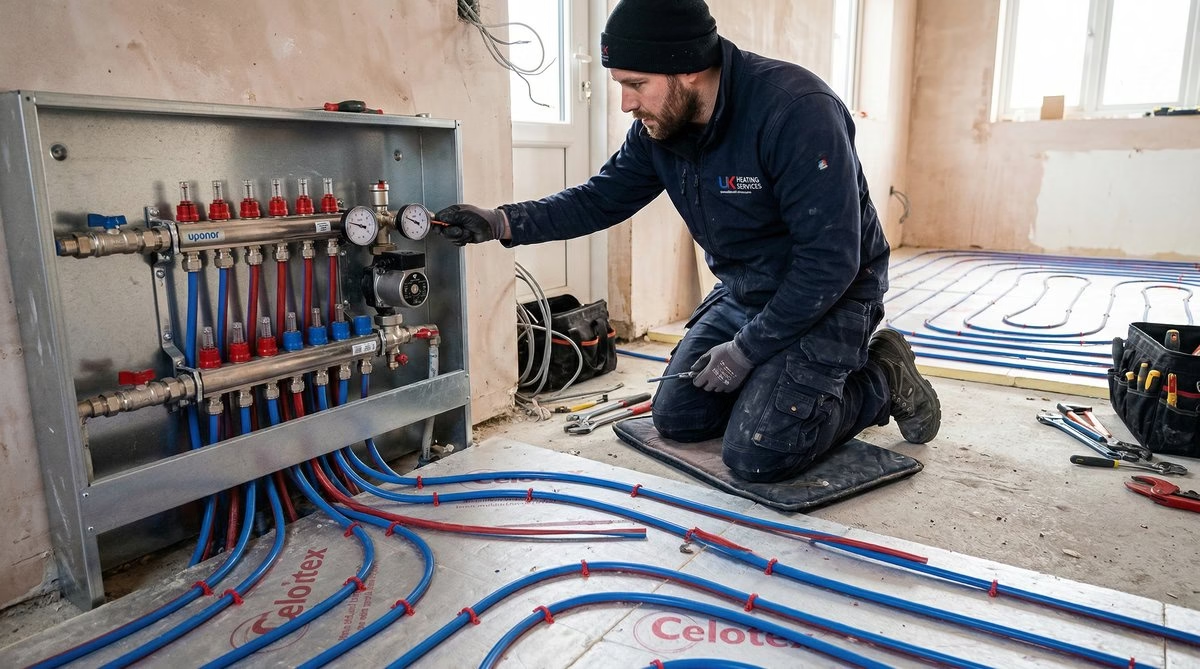
If you’re the day before a screed pour and you’ve just noticed that your underfloor heating pressure is lower than it was yesterday, the panic is completely understandable. You’ve invested in a UFH system, the screed contractor is arriving in the morning, and the last thing you need is to find out there’s a leak — or worse, to pour the screed over one without realising. Understanding what’s happening with your system, what’s normal, and what genuinely demands attention before the pour is critical. This guide covers everything we see on UFH pressure drop before screed, how to protect yourself, and what to do if the numbers don’t add up.
Why UFH systems are pressure tested before screed
The purpose of pressure testing an underfloor heating system before screeding is straightforward: once the screed is down, you cannot access the pipework. Any leak in a screeded UFH system is a serious problem — it may mean cutting up the floor, relaying the screed, and potentially dealing with water damage to the structure beneath. The test is your last opportunity to confirm the system is sound before it becomes permanently inaccessible.
The standard approach in the UK, as set out by the UFH industry and typically specified by manufacturers, is to pressurise the system to 6 bar (or 1.5 times the working pressure, whichever is greater) and hold that pressure for a defined period — commonly 30 minutes for the initial stability check, followed by a longer observation period. Some manufacturers and main contractors specify holding 3 bar during the actual screed pour and throughout the curing period so that any damage caused by screeding activity is immediately visible as a pressure drop.
Tip: Always check the specific requirements of your UFH manufacturer or installer. The test pressure and hold time vary between systems, and following the wrong protocol can either miss a fault or give you a false alarm about normal behaviour.
What causes pressure to drop — and what’s normal
This is where confusion almost always starts. A pressure drop in a UFH system overnight or over a few hours is not automatically evidence of a leak. There are several reasons why pressure drops occur in a correctly installed system with no defects.
Temperature-driven pressure changes
Water expands when it warms and contracts when it cools. If you pressurised the system when the pipework was warm — for example, after a flush with warm water — and the ambient temperature then dropped overnight, the water in the system will contract, and the pressure gauge will show a lower reading. This is physics, not a fault. A drop of 0.3–0.5 bar overnight due to temperature change is common and does not indicate a leak.
Conversely, if you pressurised on a cold morning and the system warms up during the day due to solar gain or a heated building, pressure can rise. If you’re checking against a reference reading taken at a different temperature, the comparison is not meaningful.
Air in the system
Air is compressible; water is not. If there is air trapped in the system, the pressure reading is partly supported by compressed air, which will gradually dissolve into the water or migrate to a high point. As it does, the pressure drops — even with no leak present. A system that hasn’t been properly purged of air will show unstable pressure readings that can look alarming but are actually just the system settling as air is absorbed or expelled.
Proper purging — flushing each circuit individually at flow velocity to carry air out — is essential before a meaningful pressure test can be conducted. A system that hasn’t been purged cannot give you a reliable test result.
Gauge inaccuracy and temperature compensation
Analogue pressure gauges on manifolds are not laboratory instruments. A cheap gauge can show half a bar of variation simply due to the quality of the gauge itself. If you see a small drop (less than 0.3 bar) over 24 hours and the temperature has been stable, consider whether the gauge is reliable before concluding there’s a leak.
- Reference measurement: Note the pressure and the ambient temperature at the time of test. Return to check at the same temperature if possible.
- Multiple circuits: If one circuit shows a drop and others don’t, you’ve localised the issue. If all circuits drop equally, temperature change or air is more likely.
- Digital gauges: For any project where accuracy matters, a calibrated digital test gauge is worth hiring or borrowing. It eliminates gauge quality as a variable.
What pressure drop is not normal — and should stop the pour
While small drops due to temperature and air are common and manageable, some pressure behaviour genuinely indicates a problem that should be resolved before screed is poured.
A drop of more than 0.5 bar over a stable 24-hour period, with no significant temperature change and after the system has been properly purged, warrants investigation. A continuous drop — where the pressure is falling steadily rather than reaching a new stable level — is a stronger signal of an actual leak. If you can hear water movement when the system should be static, that is also a warning sign.
Tip: If you’re unsure whether a drop is temperature-related, record the pressure and temperature at the same time each morning and evening for 48 hours. Plot both sets of readings. If pressure drops correlate with temperature drops, the behaviour is almost certainly thermal. If pressure drops independently of temperature, investigate further before pouring.
Locating a suspected leak before screed
If the pressure evidence suggests a genuine leak, the system needs to be inspected visually before anything is poured. Look at every fitting, manifold connection, and pipe end. Check that all pipes are fully seated in the manifold ports. Look for wet spots on the subfloor. If the pipework is already partially covered (for example, by insulation board with pipes clipped in), any wet patches on the insulation surface will indicate approximately where the problem is.
Do not pour screed over a system that you haven’t been able to clear of suspicion. The cost of cutting up a screed to find and repair a leak is far greater than a delay to the programme.
The right pressure to hold during and after the screed pour
Industry practice — and the recommendation of most major UFH manufacturers — is to maintain the system at a positive pressure during the screed pour. The typical recommendation is 3 bar, or the test pressure, throughout the pour and for a minimum of 24 hours afterwards. The reason is simple: if the screed contractor damages a pipe with a screed rake or by walking on insufficiently protected areas, the pressure drop will be immediate and visible before the screed sets. A system left unpressurised during the pour will show no indication of damage until the system is commissioned — at which point the screed is hard and the repair is expensive.
- During the pour: Maintain pressure at 3 bar (or as specified). Check the gauge at regular intervals during the pour — every 30–60 minutes.
- After the pour: Maintain positive pressure for at least 24 hours, preferably until the screed has reached initial set (typically 24–48 hours for traditional sand and cement screed, shorter for liquid/anhydrite screed).
- Curing period: Keep the system at positive pressure throughout the curing period — typically 28 days for traditional screed. Do not commission (i.e., heat) the system until the screed is fully cured, or you risk cracking the screed and potentially damaging the pipes.
Tip: Assign someone — the main contractor, the UFH installer, or yourself — to be responsible for monitoring and recording the pressure during the pour. A written log with time, pressure reading, and signature is good practice and protects everyone if there’s a dispute later.
Common mistakes that create genuine problems
Many of the pressure test failures and post-screed leaks we investigate are the result of avoidable errors made during installation or the screed process itself.
- Pipe damage during screed: Screed rakes dragged across unprotected pipe can create point loads that crack PEX or push fittings loose. Ensure the screed contractor understands the pipe layout and that all pipe is protected to the specified cover depth before heavy traffic begins.
- Fittings not fully engaged: Manifold connections that haven’t been tightened fully, or push-fit fittings that aren’t seated correctly, can hold pressure initially and then release as the system cycles. Check every fitting before the test.
- Testing too soon after filling: Filling and immediately testing gives the air no time to be expelled. Fill, purge all circuits, then allow the system to stabilise for several hours before conducting the formal pressure test.
- Screed poured too early: Some contractors want to get the screed down quickly and push to pour before a proper pressure test has been completed. Resist this. The programme delay for a proper test is measured in hours; the programme delay for a post-screed leak is measured in weeks.
- Thermal commissioning too early: Beginning the heating-up sequence before the screed is fully cured is a very common cause of screed cracking and pipe stress. Follow the manufacturer’s commissioning protocol — typically a step-up temperature programme starting no earlier than 28 days after pour for traditional screed.
How Fixiz helps when pressure test results are ambiguous
We work regularly on projects where a UFH pressure test result has created uncertainty and the screed pour is imminent or already done. Our approach is methodical: we start with the pressure and temperature data, assess whether the behaviour is consistent with thermal change or air movement, and — where the evidence is inconclusive — use thermal imaging to identify cold spots or wet areas in the subfloor that indicate active water movement. Where a leak is confirmed, we can locate it precisely before any remedial work is planned, which minimises the area of screed that needs to be cut.
We also advise during project planning on test protocols, commissioning schedules, and the protection measures that should be in place before and during the screed pour. Getting these right at the outset costs very little; sorting out problems after screed is poured costs significantly more.
Frequently asked questions
How much pressure drop overnight is acceptable in a UFH system?
A drop of up to 0.3–0.5 bar overnight can be normal if there has been a temperature change or residual air in the system. A drop of more than 0.5 bar with stable temperature and a fully purged system warrants investigation before screed is poured.
Can I pour screed if the pressure has dropped slightly?
Only if you are confident the drop is thermal or air-related, not a leak. If you cannot explain the drop, do not pour. Delay the screed until you have clarity — the cost of a delay is insignificant compared to the cost of a screeded-in leak.
What pressure should UFH be held at during the screed pour?
Typically 3 bar, or the test pressure specified by the manufacturer. Maintaining positive pressure during the pour means any pipe damage is immediately detectable as a pressure drop, before the screed sets.
When can I commission (heat up) the UFH after screeding?
Not before 28 days for traditional sand and cement screed. Liquid (anhydrite) screeds may allow earlier commissioning — typically 7 days — but follow the screed manufacturer’s guidance. Start with low temperatures (25°C flow temperature) and increase gradually over 7–14 days to avoid thermal shock to the screed.
Do I need a professional to carry out the pressure test?
The test can be performed by a competent installer, but using a calibrated test gauge and following a documented protocol is important. For any project where there is doubt, an independent check — especially using thermal imaging — provides evidence that protects all parties if there is a dispute.
Ready to move from confusion to construction? Get in touch with Fixiz today for a no-pressure chat about your project and the fastest route to full compliance.